
The Golden Invitation
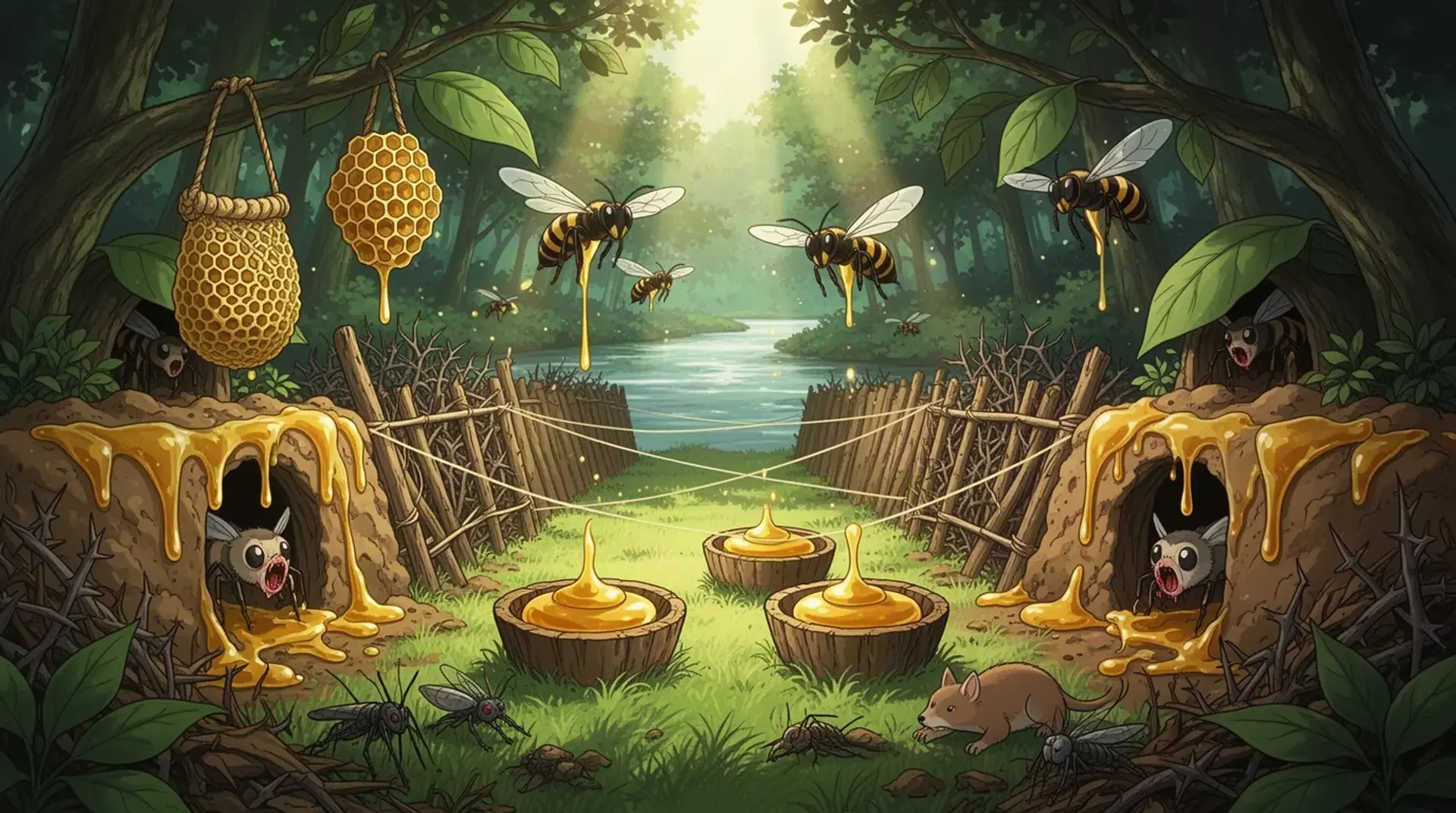
At the riverwood forest edge, the infected giant bees have turned ordinary foraging into a territorial ambush. They leave fresh, accessible honey where travelers can easily see it, then shape the surrounding ground into defensible lanes and concealed firing positions. The trap is designed to punish commitment rather than simple proximity. A cautious observer can recognize the pattern, wait for night, or approach from an unexpected direction.
The Golden Invitation
Defenses
Detection
“Several thumb-sized combs hang from low branches beside a clear patch of trampled grass. Golden honey pools in shallow bark bowls, glistening in direct sunlight. The surrounding brush contains waist-high walls of mud, resin, sticks, and leaf litter, all shaped into narrow lanes that lead toward the offerings.”
Standard Engagement
The hazard triggers when a creature eats, harvests, touches, or attempts to carry away the honey, or when a creature moves into the final 5-foot approach to the offering through a prepared lane. The first creature to trigger it is the primary target, but all creatures within 20 feet are exposed to the opening sting attack.
On initiative count 20 during daylight, the hazard performs one routine, in order. Round 1: the bees rise from cover, and each creature within 20 feet of the bait makes the Coordinated Stinging Swarm saving throw. Round 2: resin lanes collapse beneath up to two creatures that are moving toward the honey, triggering the Resin Lane effect. Round 3: the bees focus on the creature closest to the offering, forcing it to make the Coordinated Stinging Swarm saving throw again. If the party retreats 30 feet from the prepared ground, the bees pursue for only 1 round before returning to the colony. At night, the routine stops.
The bait is replaced and the physical defenses are repaired during the next daylight period. The hazard resets after 24 hours if the colony remains undisturbed. If the honey is removed at night and the prepared ground is dismantled, it does not reset until the bees have at least one uninterrupted daylight period to rebuild.
When the hazard is triggered, up to six controlled giant bees rise from concealed positions. Each creature within 20 feet of the honey offering must make a DC 12 Dexterity saving throw. On a failure, a creature takes 3 (1d6) piercing damage and 3 (1d6) poison damage, or half as much damage on a success. A creature that fails by 5 or more is also poisoned until the end of its next turn.
A creature that moves through one of the prepared lanes without first identifying it must succeed on a DC 12 Dexterity saving throw or become tangled in sticky resin and thorny brush. Its speed becomes 0 until the end of its next turn, and it takes 2 (1d4) bludgeoning damage. A creature can use its action to make a DC 11 Strength (Athletics) check, freeing itself on a success.
A low branch snaps and drops a woven pouch of irritant pollen when a creature touches, cuts, or climbs over it. The triggering creature and each creature within 5 feet must succeed on a DC 12 Constitution saving throw or be blinded until the end of its next turn. On a success, a creature is not blinded but has disadvantage on its next attack roll before the end of its next turn.
A hardened honey wall collapses when struck or climbed. The creature interacting with it must succeed on a DC 12 Dexterity saving throw or fall prone and be covered in sticky honey. Until the honey is removed with an action and a small amount of water or alcohol, the creature has disadvantage on Dexterity (Stealth) checks and the bees have advantage on attack rolls against it.
The parasite controlling the bees is most active in daylight. From sunrise until sunset, the hazard functions normally. During night, the hazard does not trigger its coordinated routine, and all checks to observe, bypass, or dismantle its prepared defenses are made with advantage unless characters enter the colony itself.
The honey offering is a commitment trigger. Merely seeing or standing within 20 feet of the honey does not activate the hazard. It activates when a creature eats, harvests, touches, attempts to remove, or moves within 5 feet of the offering while ignoring the prepared approach lanes.
A creature that approaches from a direction not connected to a prepared lane, remains at least 10 feet above the ground, or reaches the offering without touching a defense does not trigger the physical defenses. The bees still attack if the creature disturbs the offering or colony.
The parasite has not made the honey itself infectious. Eating the honey has no special disease effect under this hazard. The DM should apply infection only through a separate established rule or adventure consequence.
The bees are controlled hosts, not a supernatural swarm. A character who blocks a bee's flight, uses smoke or cloth, separates it from the colony, or otherwise interacts with an individual bee can affect it through ordinary creature rules. The hazard represents their coordination, positioning, and prepared defenses rather than an indestructible magical effect.
The Coordinated Stinging Swarm effect represents the attacks of the bees participating in the hazard routine. Those same bees do not also make separate attack rolls on their own turns during the three-round hazard routine unless the scene transitions into a separate creature encounter.
Turn The Golden Invitation into a sheet
A high-res, share-ready sheet you can post or print.