Skip to content
CreatePricing
Obsidian Tribunal Acolyte (Acolyte) - AI-generated fantasy Monster

Obsidian Tribunal Acolyte (Acolyte)

The name Obsidian Tribunal Acolyte began as a mistaken assumption by keep guards that each masked clerk was an ordained judge of the Tribunal. The title stuck, even though these figures are junior custodians, not magistrates. Acolytes use the error to command attention, but never claim authority when formally challenged.

Medium humanoid · CR 1/4 (50 XP) · Common

Obsidian Tribunal Acolyte (Acolyte)

A junior keeper of the Obsidian Tribunal's sabotage records, trained to support guards with modest divine magic while protecting testimony and physical evidence.
AC10
HP9/9
CR1/4 (50 XP)
Init
STR
DEX
CON
INT
WIS
CHA
ConditionsNone

Combat

AC 10 · HP 9 · CR 1/4 (50 XP)

Obsidian Tribunal Acolyte (Acolyte)

Medium humanoid (acolyte), lawful neutral
Armor Class10
Hit Points9 (2d8)
Speed
Walk 30 ft.
STR
DEX
CON
INT
WIS
CHA
SkillsReligion
Weaknesses
The acolyte is physically frail and poorly armored.
Its concentration on Bless can be broken by damage.
Senses
Passive Perception 10
Languages
Common,
Celestial
Challenge1/4 (50 XP)
Proficiency Bonus+2
Spell Save DC11
Spell Attack Bonus+3
Spellcasting. The acolyte is a 1st-level spellcaster. Its spellcasting ability is Wisdom (spell save , to hit with spell attacks). It has two 1st-level spell slots and knows Bless and Cure Wounds. It can cast Sacred Flame at will.

Spells

Bless (level 1, enchantment). Up to three creatures of the acolyte's choice within 30 feet who can hear it add to attack rolls and saving throws for up to 1 minute. Concentration, up to 1 minute.
Cure Wounds (level 1, evocation). A creature the acolyte touches regains hit points.

Actions

Club. Melee Weapon Attack: to hit, reach 5 ft., one target. Hit: 4 () bludgeoning damage.
Sacred Flame. The acolyte points at one creature it can see within 60 feet. The target must succeed on a Dexterity saving throw or take 4 () radiant damage. The target gains no benefit from half cover or three-quarters cover for this save.
Role
Controller
Built for
Any level; intended as a low-threat support creature alongside other foes.

Gear

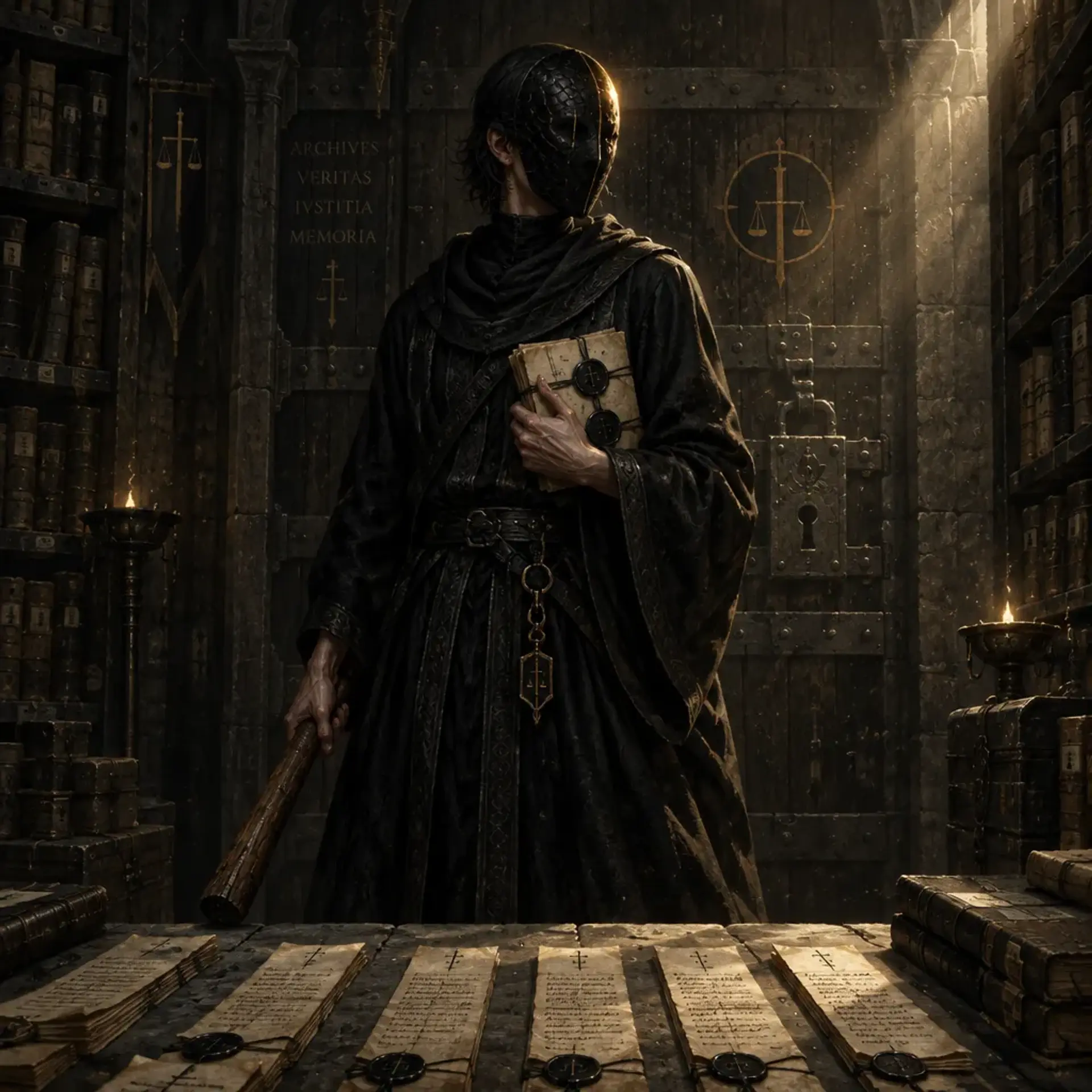
  • Club (Weapon, 1 sp)A plain wooden cudgel used as a simple melee weapon.
  • Evidence packet (Quest item, Priceless to the Tribunal)A sealed packet containing copied testimony and notes about the sabotage.
  • Obsidian half-mask (Insignia, 5 gp)A smooth black half-mask marked with the Tribunal's scales.

Notes for the game master

Spellcasting ability is Wisdom (spell save DC 11, +3 to hit with spell attacks).
The acolyte has two 1st-level spell slots and regains expended slots after a long rest.
Bless requires concentration. The acolyte cannot concentrate on another spell while Bless is active.
Sacred Flame is presented as an at-will action, matching the classic acolyte's simple cantrip use.

Tactics

  1. Opening

    Use Bless on up to three allies before the fight when it has warning. Otherwise, begin with Sacred Flame while allies move to protect the evidence.

  2. Mid-fight

    Keep allies between itself and attackers. Use Cure Wounds on a badly injured ally, or Sacred Flame against a target who is difficult to reach.

  3. End of the fight

    If the evidence is threatened, use the club to buy space, then flee with the packet or hide it in a prepared recess.

  4. Retreat

    The acolyte retreats when reduced to 3 hit points or fewer, unless leaving would expose the evidence. It surrenders if cornered and offered a credible way to preserve the record.

How it fights

Use Bless before combat if there is time to prepare.
Remain behind guards and use Sacred Flame to pressure exposed attackers.
Spend Cure Wounds on an ally who can continue blocking access to the evidence.
Do not spend both spell slots early if the encounter may involve pursuit or a second confrontation.

Who it attacks first

A creature reaching for or carrying the evidence packet.
An exposed attacker threatening a wounded ally.
A distant or protected target that can be pressured with Sacred Flame.

Works well with

Bless makes nearby guards more reliable and can help them hold a narrow approach.
A sturdy ally can screen the acolyte while it heals an injured defender or moves the packet.

How to beat it

Its AC and hit points are low, making focused attacks effective.
Spread out to reduce the value of Bless on several allies.
Break line of sight to prevent Sacred Flame from targeting a creature.
Control or disarm the acolyte before it can carry the evidence away.

Ways to avoid a fight

Offer to exchange a truthful account of the sabotage for safe conduct.
Point out inconsistencies in forged evidence with a successful DC 12 Intelligence (Investigation) check.
Hide the evidence packet in a prepared wall recess, requiring a DC 12 Wisdom (Perception) check to find it.

Ecology

A slight figure in a soot-black robe and a smooth obsidian half-mask, its surface etched with tiny scales and verdict marks. It carries a plain wooden club and a wax-sealed packet that it guards more carefully than its own life.

Behavior

Controlled and dutiful rather than fanatical. The acolyte tries to direct the conflict away from the evidence and lets better-armed allies engage intruders.

How it lives

Acolytes are recruited from clerks, apprentices, and witnesses who show patience with testimony and a willingness to preserve records under pressure.

Lair

The acolyte has no lair of its own. When assigned to guard evidence, it uses a locked records room or a screened alcove near the keep's inner court.

Habitat
Courthouses, archive vaults, fortified keeps, and rooms converted into temporary evidence stores.

Signs that it is near

Black wax seals stamped with a set of scales.
Small slips of testimony arranged in strict chronological order.
A faint scent of lamp oil and hot sealing wax.

Tags

humanoid,
support,
divine magic,
evidence custodian

Lore

The name Obsidian Tribunal Acolyte began as a mistaken assumption by keep guards that each masked clerk was an ordained judge of the Tribunal. The title stuck, even though these figures are junior custodians, not magistrates. Acolytes use the error to command attention, but never claim authority when formally challenged.

What drives it

Preserve the record of the sabotage and ensure its contents reach a Tribunal magistrate, even if the acolyte must abandon the keep.

After the fight

If captured, the acolyte may trade the Tribunal's coded testimony for protection. If defeated, their annotated evidence packet remains intact unless the party damages it.

“The title stuck, even though these figures are junior custodians, not magistrates.”
From its lore

Variants

A docket acolyte carries a hidden duplicate of the evidence packet.
A lantern acolyte uses a hooded lantern to signal allies and has the same statistics.

Hooks

Plot hooks

The packet proves that a trusted quartermaster altered the keep's supply ledgers.
The acolyte believes the evidence implicates a Tribunal magistrate and is unsure whether to report it.
A duplicate packet has been planted, and the acolyte can identify one subtle difference between the real and false records.

How to use it

Use as the controller and evidence custodian in Keep the Sabotage Evidence.
Give the acolyte cover, a clear route to the evidence, and one or two allies who can screen it.
Treat the evidence as an objective. The acolyte may prioritize hiding or carrying it over dealing damage.
At CR 1/4, it is best used alongside other low-CR creatures rather than as a solo threat.

Treasure

The evidence packet, valuable as a story object but not necessarily as coin.
1d6 sp and a Tribunal writ identifying the acolyte's assignment.

Media

0 images

No images yet.

Visual sheet

Turn Obsidian Tribunal Acolyte (Acolyte) into a sheet

A high-res, share-ready sheet you can post or print.