Skip to content
CreatePricing
Late Antique Germanic Warrior - AI-generated fantasy Monster

Late Antique Germanic Warrior

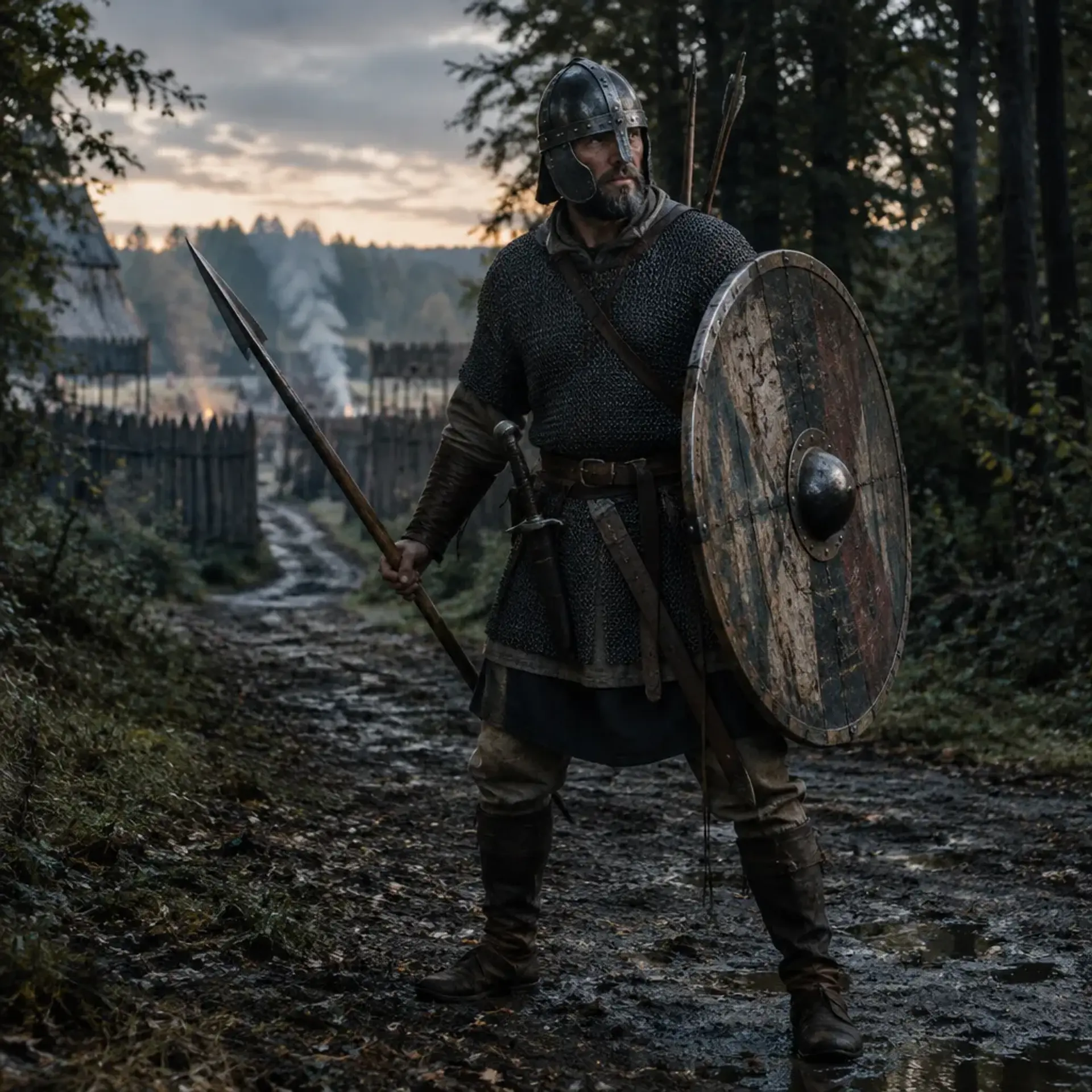
The 4th century was a period of movement, diplomacy, warfare, and exchange across the Roman frontier. Germanic peoples were diverse, and there was no single uniform warrior kit. This warrior's mail, spear, shield, and iron helmet represent one plausible well-equipped individual. The helmet is described conservatively: a band-built construction with riveted plates, an early form associated with the development of spangenhelm construction. More elaborate, recognizable spangenhelms are especially associated with later late antique contexts, so this design should not be treated as a universal 4th-century standard.

Medium humanoid · CR 5 (1,800 XP) · Uncommon

Late Antique Germanic Warrior

A historically grounded late antique Germanic warrior of the 4th century, represented in D&D 5e as a formidable veteran rather than a supernatural creature. His equipment reflects contact with the Roman world and regional variation.
AC17
HP90/90
CR5 (1,800 XP)
Init
STR
DEX
CON
INT
WIS
CHA
ConditionsNone

Combat

AC 17 · HP 90 · CR 5 (1,800 XP)

Late Antique Germanic Warrior

Medium humanoid (human), any non-evil alignment
Armor Class17 (mail shirt, iron helmet, shield)
Hit Points90 (12d8 + 36)
Speed
Walk 30 ft.
STR
DEX
CON
INT
WIS
CHA
Saving ThrowsStrengthConstitution
SkillsAthleticsIntimidationPerceptionSurvival
Senses
Passive Perception 12
Languages
Germanic language appropriate to the campaign region,
Trade speech or Latin, if his history includes contact with Roman forces
Challenge5 (1,800 XP)
Hit Dice12d8
Proficiency Bonus+3
Initiative+2
Shield-Line Training. The warrior has advantage on a Strength (Athletics) check made to shove a creature while wielding a shield.
Steady Among Companions. While the warrior is within 5 feet of at least one conscious allied creature wielding a shield, he has advantage on saving throws against being frightened.

Actions

Multiattack. The warrior makes two attacks with his spear or sword.
Spear. Melee or Ranged Weapon Attack: to hit, reach 5 ft. or range 20/60 ft., one target. Hit: 8 () piercing damage, or 9 () piercing damage if used with two hands in melee.
Sword. Melee Weapon Attack: to hit, reach 5 ft., one target. Hit: 8 () slashing damage, or 9 () slashing damage if used with two hands. The warrior can use his sword with a shield or in two hands.
Shield Bash. Melee Weapon Attack: to hit, reach 5 ft., one target. Hit: 7 () bludgeoning damage, and the target must succeed on a Strength saving throw or be pushed 5 feet. The warrior can use this attack only while holding a shield.
Javelin Volley. The warrior hurls a javelin at a point he can see within 30 feet. Each creature within 10 feet of that point must make a Dexterity saving throw, taking 10 () piercing damage on a failure, or half as much damage on a success. The warrior carries two javelins and can use this action once.

Reactions

Shield Parry. When a creature the warrior can see hits him with a melee attack, he adds 2 to his AC against that attack, potentially causing it to miss. He must be wielding a shield.
Role
Veteran infantry leader and shield-line fighter
Built for
A suitable single major foe for a party of four 5th-level characters; add allies for a larger or more dangerous encounter.

Gear

  • Band-built iron helmet (Armor, Included in AC)A plausible 4th-century iron helmet constructed with a crown band and riveted crossing strips securing iron plates. Its cheek pieces are simple and functional. This is a cautious period-appropriate reconstruction, not a claim that one exact pattern was universal.
  • Mail shirt (Armor, Included in AC)A mail shirt, potentially obtained through trade, service, inheritance, or capture. Mail was expensive and not standard equipment for every warrior.
  • Shield (Shield, Included in AC)A wooden shield faced with hide, marked with a simple painted pattern or left plain.
  • Spear (Weapon, Included in attacks)A thrusting spear used in close combat or thrown at range.
  • Sword (Weapon, Included in attacks)A practical single-edged or double-edged iron sword, dependent on region, wealth, and individual access to arms.
  • Javelins (Weapon, Included in attacks)Two light throwing spears for use before or during an approach.

Notes for the game master

Custom 5e NPC statblock. The warrior is a human combatant, not a canonical monster.
The helmet's construction is an intentionally cautious historical reconstruction. A band-built iron helmet with riveted plates is plausible for a well-equipped late 4th-century individual, but equipment varied substantially.
Armor Class assumes the warrior is wearing a mail shirt and helmet and carrying a shield. Without his shield, reduce his AC to 15.
Javelin Volley is a custom action for encounter play, not a claim about a canonical D&D feature.

Tactics

  1. Opening

    He begins behind cover or among companions, spear ready and shield forward. If negotiations fail, he warns opponents once, then advances with allies rather than charging alone.

  2. Mid-fight

    He uses the shield to disrupt one opponent while thrusting at another, and coordinates with allies to keep a shield line intact. He throws his javelins only when a ranged threat or exposed leader presents a worthwhile target.

  3. End of the fight

    If outnumbered, he backs toward cover or a defensible doorway, using his shield to protect himself while allies withdraw. He surrenders if the fight is clearly lost and his cause does not require death.

  4. Retreat

    He is a disciplined, mortal fighter, not a fanatic. He retreats when ordered, when his allies break, or when badly wounded; he may lay down arms if offered safe terms.

How it fights

Keep his shield between himself and the most dangerous opponent.
Use spear reach only where the battlefield permits, and switch to the sword if pressed.
Fight near allies rather than chasing a mobile enemy alone.

Who it attacks first

An enemy threatening his companions or position
A lightly armored combatant he can push out of formation
A visible ranged attacker, especially before it can freely target his allies

Works well with

Allies with shields can hold a narrow passage while he protects a flank.
Archers or javelin-throwers can exploit the space created when he presses opponents with his shield.

How to beat it

Use ranged attacks or spells that force him away from his shield-bearing position.
His AC depends on his shield. Disarming him or forcing him to drop it makes him easier to hit.
Shoves, grapples, and difficult terrain can disrupt his formation and deny him advantageous positioning.
He has no special resistance to magic, poison, or fear.

Ways to avoid a fight

He can negotiate a passage or exchange information in return for food, safe conduct, or a promise of noninterference.
He can identify local loyalties, recent movements, and the practical dangers of a route, though his account may be biased.
He may accept a challenge, ransom, or formal settlement in place of a fight if it protects his companions.

Ecology

A broad-shouldered, weather-beaten man with a wool tunic beneath a mail shirt, a wooden shield faced with hide, and a spear in hand. His iron helmet is built around a narrow crown band with raised crossing iron strips riveted over a cap of iron plates. It has simple cheek pieces and no exaggerated horns or face-covering mask. The dark iron is scratched, patched, and dulled by use.

Behavior

Alert, practical, and protective of his companions. He favors formation fighting and does not pursue enemies recklessly. He may be a mercenary, retainer, raider, guard, or veteran returning from service.

How it lives

A member of a human community whose arms and fighting methods vary by region, wealth, and contact with Roman forces. Mail and a well-made helmet indicate resources or access to trade, service, or captured equipment, not a universal standard for Germanic fighters.

Lair

He has no supernatural lair. When encountered at home, he is likely near a timber hall, farmstead, palisaded settlement, or a temporary camp shared with kin and companions.

Habitat
Frontier settlements, river crossings, wooded roads, farms, hilltop enclosures, and Roman or post-Roman borderlands.

Signs that it is near

Bootprints and spear marks around a recently used camp
A shield boss or iron fitting bearing fresh hammer repairs
The smell of smoke, wet wool, and oiled leather

Tags

human,
historical-inspired,
late-antique,
martial,
custom-NPC

Lore

The 4th century was a period of movement, diplomacy, warfare, and exchange across the Roman frontier. Germanic peoples were diverse, and there was no single uniform warrior kit. This warrior's mail, spear, shield, and iron helmet represent one plausible well-equipped individual. The helmet is described conservatively: a band-built construction with riveted plates, an early form associated with the development of spangenhelm construction. More elaborate, recognizable spangenhelms are especially associated with later late antique contexts, so this design should not be treated as a universal 4th-century standard.

What drives it

Protect his companions, secure a livelihood, defend his community, fulfill a contract, or gain status through successful service.

After the fight

The warrior's gear is practical, repaired, and carried rather than ceremonial. If he falls, his companions may retrieve his arms and bury him with them, or barter the equipment to a local leader.

“Germanic peoples were diverse, and there was no single uniform warrior kit.”
From its lore

Variants

A less wealthy fighter wears a padded or leather garment instead of mail and has AC 15 with a shield.
A Roman-trained frontier veteran carries a heavier shield and speaks some Latin, but need not have different statistics.
A mounted retainer can be represented with a riding horse and the same statistics while mounted.

Hooks

Plot hooks

A veteran insists that a disputed stretch of road belongs to his community, while a Roman official claims it as imperial territory.
The warrior seeks the return of a helmet and sword taken from a dead kinsman before they are sold at a frontier market.
A local leader has hired him as an escort, but the party discovers that his employer intends to use the journey to provoke a border conflict.

How to use it

Use him as a named captain among a small band of human warriors, with the captain's CR 5 making him the centerpiece rather than the entire encounter.
Place him as a gate guard, hired escort, border fighter, or veteran negotiator whose armed presence creates tension without requiring combat.
For a more historically grounded fight, give allies simpler equipment and make terrain, cohesion, and morale matter more than exotic abilities.

Treasure

His practical weapons, shield, mail shirt, and iron helmet may be valuable, but their worth depends on condition, local demand, and the campaign's economy.
A personal token, belt fitting, or small brooch may identify his family or community.

Media

0 images

No images yet.

Visual sheet

Turn Late Antique Germanic Warrior into a sheet

A high-res, share-ready sheet you can post or print.