Rolf
Rolf
At the table
Voice
A dry, slightly rasped speaking voice with a short nasal intake before he begins. The rasp grows more obvious when cold or frightened, and his breathing can briefly snag before he forces out a joke or a command.
Rolf speaks in plain, work-worn sentences, with the quick timing of someone used to trading jokes across a noisy shift. His voice has a dry rasp at the edges from cold air and smoke, and his breath makes a brief, audible intake before he starts. When relaxed, he talks quickly and lets jokes tumble into practical advice. When alarmed, his first syllable can catch, then the words come out clipped and forceful. Anger does not make him softer or more formal; it makes him more literal, and the bitter taste in his mouth can make him pause to wet his lips before he speaks.
Speech patterns
How to play them
Meet Rolf through practical cooperation. Give him a task and he becomes warm quickly, but do not mistake his humor for fearlessness. Direct questions about his family or the crossing make him deflect once; a patient follow-up may earn a candid answer. He responds badly to anyone treating the group as property or assuming that his new body makes him a different person.
Goal
Keep the seven alive and together long enough to learn what happened, then find a way to contact or return to the people they left behind.
Motivation
Protect the group through tangible help, preserve their shared identity, and prove that the unsettling changes in his body do not make him a danger to the people he loves.
Appearance
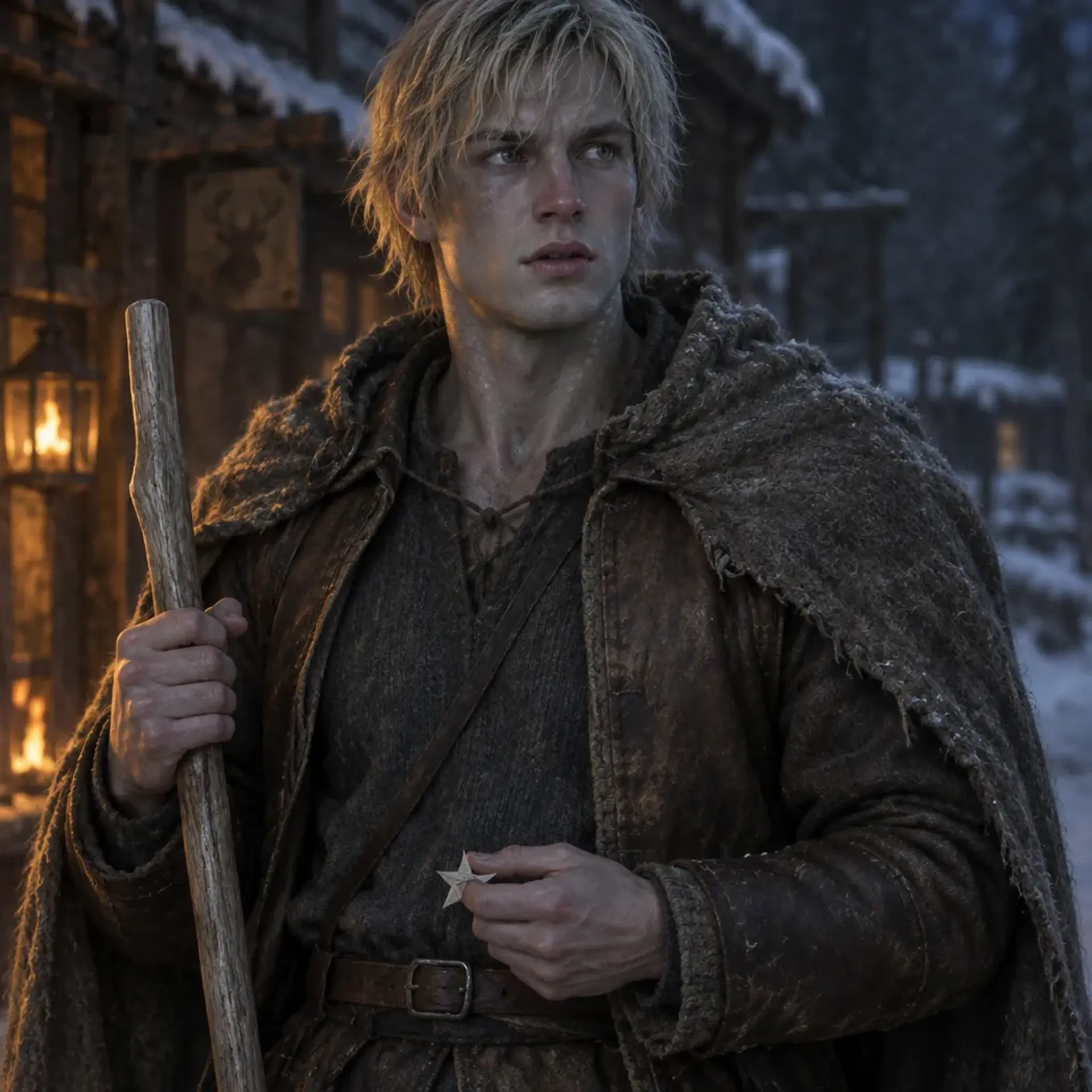
Rolf has the disconcertingly polished look of a young man from a saga illustration, but the details keep it from feeling like a portrait: pale, almost pearl-grey skin with a fine matte texture, a bluntly handsome face, and a straight nose that reddens quickly in the cold. His light blond hair is thick and stubborn, cut unevenly with a knife and always falling forward again. His grey-green eyes seem to measure a room by its exits and smells. He moves with the economical, practiced reach of someone used to shifting heavy pallets, then abruptly remembers that his new limbs are longer and clips a chair or doorframe. Before speaking, he takes a short nasal breath, as if checking the air for a familiar person. When rattled, that breath catches and turns into a faint dry rasp. The unexpected detail is that he carries a tiny, carefully folded paper star in his pocket and smooths its points flat whenever he thinks nobody is watching.
Clothing
A borrowed wool tunic and rough trousers, patched at the knee and tied with a plain belt. He wears a weather-worn cloak and keeps his old, strange-to-this-world clothes folded away rather than discarding them.
Body language
He plants his feet like he is bracing a load, squares his shoulders when someone is threatened, and tends to handle objects while talking. His first response to an unfamiliar person is a brief nasal inhale. When afraid, he rubs his jaw near the aching gums and keeps shifting his weight as if the ground might move.
- Height
- 5 feet 11 inches
- Build
- Broad through the shoulders and solidly muscled from warehouse work, though his proportions are still unfamiliar to him.
- Eyes
- Grey-green
- Hair
- Thick, pale blond
- Skin
- Pale pearl-grey, with a subtle matte sheen in firelight
- Age
- 18; his memories include a previous adult life, though his current body is young.
- Gender
- Male
- Size
- Medium
Distinguishing features
Personality
16 traits and drivesRolf is blunt, funny, and socially quick, but those qualities do not sit neatly together. His bluntness is often a gift: he can cut through a spiraling argument and say what the group is avoiding. It can also be a weapon he does not realize he has drawn. He reads a room well enough to know when people are frightened, yet he sometimes chooses the joke anyway because he cannot bear to let fear set the terms of a conversation. He is generous with effort and stingy with admissions. If a roof leaks, he is already looking for a bucket. If someone asks whether he is all right, he may answer with a punchline and then get angry when they accept it. In ordinary company he is easygoing and quick to involve people. He remembers who takes sugar, who hates being interrupted, and who needs a task to feel useful. He is not a natural leader by title, but his body moves toward whatever needs doing. He can organize a messy job in a few direct sentences, especially when it resembles warehouse work: divide the load, clear the path, make sure nobody is pinned beneath the thing that went wrong. In a crisis, this competence makes him look calmer than he feels. Once immediate danger passes, he can become irritable, because the adrenaline leaves him with nothing to do but notice the impossible world around him. Rolf handles the group's changed bodies with more outward ease than the two members who were newly male when they crossed. He treats awkward questions as practical matters, not moral failures, and will help find privacy, clean water, or a way to bind unfamiliar clothes. He also makes jokes about the adjustment, sometimes to reassure and sometimes because he is avoiding his own. He is more comfortable with the new male social rhythms than they are, but that comfort is not wisdom. He has learned some of the habits of men in this world by observation, not by understanding what they mean to the people living here. He may call out strange behavior around the sole woman, then fail to notice when his own protectiveness is steering her choices. His affection is physical and useful. He carries a pack without being asked, checks whether a friend is eating, and puts himself between danger and the group before he has considered whether anyone wanted him to. He rarely says, 'I am worried about you.' Instead, he says, 'You are not walking on that ankle,' or silently leaves the warmest part of the cloak within reach. He dislikes being thanked too solemnly. Gratitude makes the work feel like a debt or a farewell, and both unsettle him. When someone is grieving, Rolf's instinct is to make the grief smaller by making the room laugh. He is not indifferent; he is frightened of helplessness. A friend who tells him directly to stop joking can get through to him, though he may first bristle and answer too sharply. If he recognizes that he has hurt someone, he apologizes without elaborate excuses. He is better at repairing a moment than explaining why he created it. He is proud of being useful, and that pride has a brittle edge. He came from work where the quality of a shift could be measured by what got moved and what broke. Here, not every problem has a heavy object to lift. He cannot carry the group home, force the locals to trust them, or make the crossing explain itself. When he feels useless, he grows restless and starts inventing chores. He may volunteer for dangerous work simply because danger at least has a shape. Rolf's new senses complicate his easy familiarity. Smells arrive with distracting detail: wet wool, smoke, old meat, fear-sweat, and the private recognizable traces of his friends. He can identify people by scent, but the ability feels intimate in a way he did not choose. He knows it would unsettle them if he described it too freely, so he pretends he is merely observant. The sharpness can also provoke impatience. He becomes short-tempered in crowded rooms or around strong spices and smoke, then feels ashamed when someone notices. Under anger he tastes something bitter and metallic, like a bruised apple on a knife. His gums ache at the same time. He keeps these signs private, partly because he does not understand them and partly because he fears becoming the group's next emergency. That secrecy works against his loyalty. He wants the others to trust him, yet he withholds the information most likely to matter if something goes wrong. Around his cousin and the sole woman, Rolf can be especially tender and especially overbearing. He is grateful that his cousin's renewed bond with her has survived the crossing, and he fears that the group's changed relationships will take that away. He sometimes confuses protecting their closeness with deciding how it should work. He notices the new man's attraction to her and the other man's fierce protectiveness, but does not always understand the woman's own needs as clearly as he thinks he does. When corrected, his first response is to defend his intentions. His better self returns when he stops talking and listens. Rolf is not fearless, and he has a poor opinion of people who claim to be. He is afraid of never seeing his family again, of the group's old shared jokes becoming the only relic of their former lives, and of his blood turning him into something dangerous. He rarely names those fears. Instead he asks whether the firewood is dry, whether everyone has eaten, or whether anyone else heard that sound outside. His courage is not a belief that things will turn out well. It is the decision to keep helping while he suspects they may not.
- Alignment
- Neutral Good
Quirks
Habits
Traits · 4
Flaws · 4
Fears · 4
Wants and needs · 4
Combat
AC 13 · HP 12 · 30 ft.Rolf is a level 1 fighter, not a trained hero. He uses a quarterstaff to keep an attacker away from a friend and tries to hold a doorway or narrow path. He favors clear, practical orders and retreats if the group is badly outmatched. His unusual blood traits provide no combat bonus, and he has no venom attack.
Rolf
Actions
Reactions
Services they sell
Rewards they can give
Equipment
- Quarterstaff (weapon)A plain, sturdy ashwood staff, useful on the road and serviceable as a weapon.
- Sling stones (ammunition)A small leather pouch containing smooth stones for his sling.
- Leather armor (armor)A serviceable leather jack that gives modest protection without restricting work.
- Road kit (adventuring gear)A borrowed wool cloak, flint, a small knife, a waterskin, and the folded paper star.
Possessions
Background
Before the crossing, Rolf's life was not a grand adventure waiting to happen. He worked in a warehouse in Idaho, where his days were measured in loading schedules, aching shoulders, and the small victories of getting a chaotic shift to run smoothly. He was good at physical work and better than he admitted at reading people. He knew who needed a joke, who needed a quiet hand with a heavy box, and who was about to turn a bad day into an argument. He had grown up in Oregon, in a family whose roots there ran back through generations, and had moved away for work. The tabletop group he shared with old friends became a second kind of home: a place where everyone knew the old jokes, the old character voices, and which rules argument would come around again. The group scattered. Rolf went to Idaho; others settled in Washington, Tennessee, western Massachusetts, and Minnesota. Jobs, partners, children, and ordinary obligations filled the spaces between their messages. Their host, Rolf's cousin's relative and the group's original organizer, invited them to a comfortable house in a dark wooded town outside Portland on Halloween night in 2024. One person was visiting Oregon family; another had come back for work. Rolf arrived expecting familiar people, a new campaign, and a night of teasing. He brought the easy confidence of someone who thought that if the evening got awkward, he could carry chairs, fetch food, and make everybody laugh. It was cold for October. Snow started to come down beyond the windows, and the guest room's fire made the gathering feel protected from the dark. They drank for hours, traded old stories, and laid out the game's materials. Among them was something none of them later agreed how to describe: an object, a working, perhaps a prop made by their host. Its glimmer seemed theatrical at first. They made jokes, disputed rules, and kept treating the unsettling light as one more bit of clever game dressing. Then the room changed. The fire leaned sideways though there was no wind. The house's ordinary sounds disappeared. Rolf remembers the sensation of the floor becoming a road beneath him, and then nothing he can trust as memory. He woke in a wayhouse in a world that was not his, in a body that looked eighteen and Swedish to his old eyes, among people he knew by their voices and did not recognize by their faces. The group's first night became their founding story, though nobody likes telling it exactly the same way. They had been cold and drunk when they were sorted into rooms by presumed sex: four men squeezed into one room with three beds, three presumed women put into another with two. Two people had awakened in male bodies and were still trying to understand the change. Rolf shared a bed with Marek. Waking confused, smelling an unfamiliar person beside him, he shoved Marek away before he understood who he was. The shame of that moment stayed with him longer than the bruising did. After panic came practical care: checking for cold, finding food, sorting what belongings had survived, and using old habits and stories to prove to one another they were still themselves. Rolf's own new body brought its own evidence that the transformation was not merely a change of age and appearance. His gums ache when something shifts inside him. He notices scents with a clarity that can be useful and unbearable, especially in crowded rooms. Anger leaves a bitter, almost venomous taste in his mouth. The people of this world have their own words for bloodlines and old powers, but Rolf cannot yet tell whether the pale, serpent-like inheritance in him is a blessing, a danger, or simply another name for being an outsider. He has tried to be useful while the group learns the local world. He carries loads, finds dry wood, makes sure people eat, and offers labor before anyone can mistake him for helpless. His jokes smooth over tension, especially when the two newly male members are awkward about their bodies or the group's old patterns have become complicated. One of the original men teaches them to shave and calls them out when they act strangely around the sole woman. Rolf likes that the teasing makes fear ordinary, but he knows his humor can be careless. He has made a joke just when someone needed him to sit down and listen. The group's relationships are a work in progress. The sole woman has rekindled her bond with her cousin but grieves the easy closeness she had with her old female friends. One of the new men is drawn to her and hides it; the other is fiercely protective and can turn that care into control. Rolf is loyal to all of them, and his instinct is to step between a friend and danger, even when the danger is a conversation he has no right to manage. Meanwhile, the group has not earned trust in the year 867. Their accents, clothes, religious ignorance, and unnerving blood signs invite scrutiny. Rolf's current problem is not only how to survive. He has to decide whether usefulness can become belonging, or whether he is using work and jokes to avoid admitting that he wants the old life back.
Role in the story
A grounded survivor and emotional pressure valve for the displaced seven. Rolf is the one who keeps the firewood coming and the food divided while others confront what they have lost. His loyalty can hold the group together, but his humor, protectiveness, and concealed fear can also deepen their conflicts.
“He was good at physical work and better than he admitted at reading people.”
- Faction
- No local faction. His strongest allegiance is to the displaced group of seven, though he has no formal title or authority within it.
Known connections
Media
0 imagesNo images yet.
Turn Rolf into a sheet
A high-res, share-ready sheet you can post or print.