Oswin Hirst
Oswin Hirst
At the table
Voice
A clear, carrying voice trained by calling sheep over wind and distance. Its Yorkshire inflection is grounded and unshowy, with a dry rasp after long days outside. When his thoughts snag on a lost memory, he pauses as though listening for an answer from the hills; when threatened, the voice turns short, firm, and startlingly animal in its urgency.
His voice is shaped by years of calling sheep across open slopes: clear, carrying, and economical, with a dry Yorkshire cadence that clips the ends of practical instructions. He does not sound theatrical or grand. When tired, a rough breath catches before certain words, as if he has run uphill to deliver them. His speech becomes blunt and physically direct when danger threatens, but questions about his past make him hedge, repeat himself, or abruptly turn to business.
Speech patterns
How to play them
Begin with practical hospitality and offer useful help before discussing personal matters. He is gentle with children and animals, guarded around Mary's father, and evasive if questioned about his age, iron, or the wedding night. A patient visitor who does not corner him may earn a rare confession about his homesickness and fractured memories. Direct threats to his family bring out the Barguest without warning.
Goal
Keep Mary and William safe, make their home feel ordinary, and find out whether his failures of memory are a warning or a lie his own mind has made.
Motivation
He wants to be loved as a husband and father without having to reveal the frightening truth of what he is. He also longs for the open road and the uncanny freedom of his former life.
Appearance
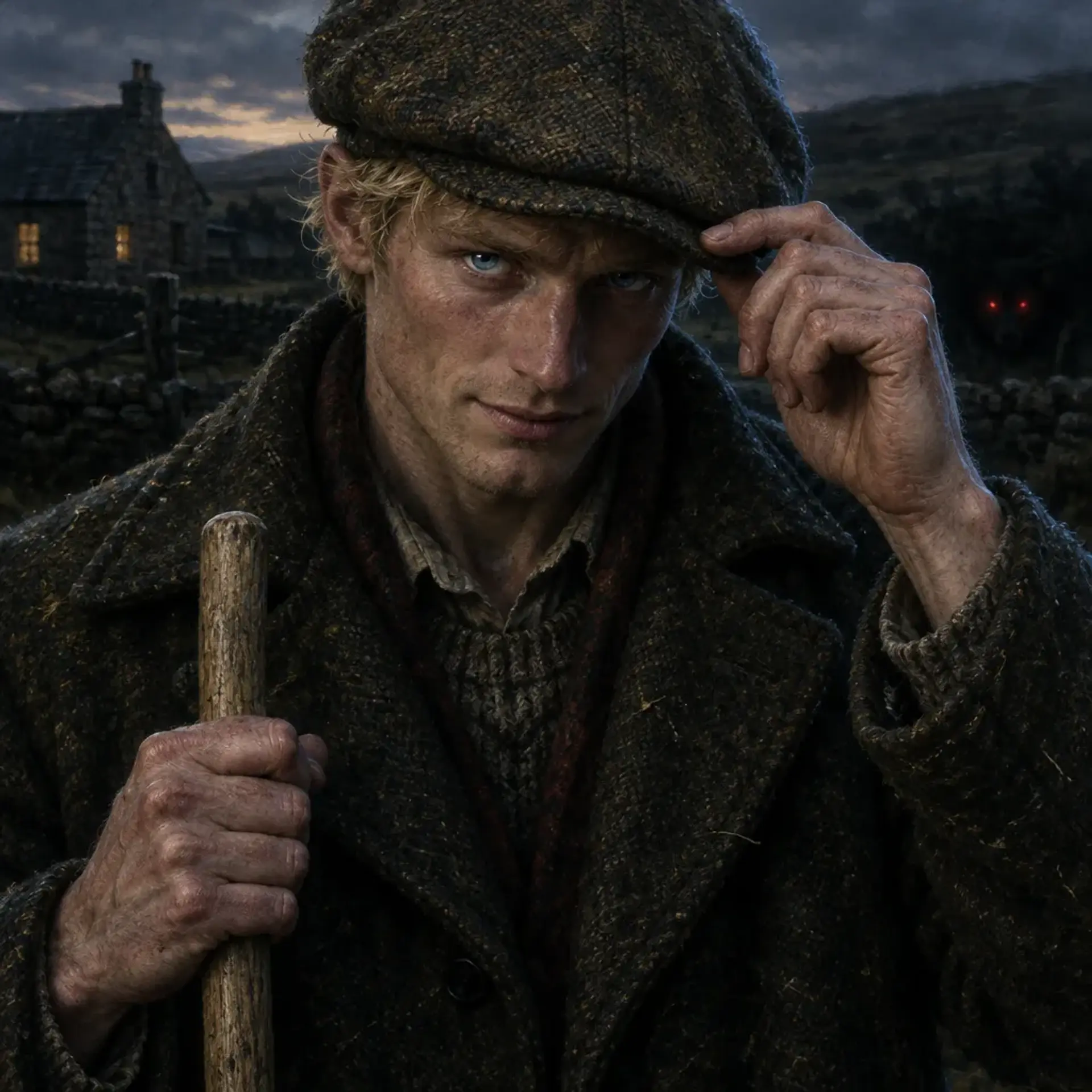
Oswin stands six feet tall, handsome in the way of a carefully carved church figure: pale, smooth-skinned, straight-nosed, with a youthful face that seems strangely untouched by passing years. His blond hair lies in straight, fine strands beneath a common flat cap, and his clear blue eyes hold a bright, furnace-like gleam when the light is low. He moves with a farmer's economical stride, but rarely plants both feet squarely; while waiting, he rests his weight on the balls of his feet, as if ready to cross a field at a run. His shadow sometimes has the long, lowered head and heavy shoulders of a hound even when he stands upright. Unexpectedly for a wary livestock owner feared as a beast, he keeps a tiny painted wooden lamb in his waistcoat pocket and rubs its worn ears with his thumb when anxious.
Clothing
A weathered flat cap, a good but plain wool coat, waistcoat, sturdy trousers, and boots cleaned more often than a farmer's boots ought to be. He wears no iron buckle or metal jewelry and favors horn, leather, and wood fastenings.
Body language
He keeps his shoulders loose and his hands visible around people he trusts, but angles himself between Mary or William and any stranger. His weight rests forward, his head turns quickly toward distant sounds, and under strain his stillness takes on the watchful quality of a dog scenting danger.
- Height
- 6 feet
- Build
- Tall, broad through the shoulders, and strong from walking hills and handling sheep, without looking like a trained soldier.
- Eyes
- Clear, vivid blue with an ember-bright intensity in darkness.
- Hair
- Pale blond, straight, and fine.
- Skin
- Pale, with a weathered flush across the cheeks after a day on the hills.
- Age
- Young adult in appearance, though he has lived far longer than he admits. His face has scarcely changed in the years since his wedding.
- Gender
- Male
- Size
- Medium in human form; Large in Barguest hound form.
Distinguishing features
Personality
16 traits and drivesOswin is kind in action but evasive in speech: he will mend a neighbor's wall before dawn, yet answer a personal question with a weather report. He is practical and shrewd about land, animals, and money, but unexpectedly tender with William. In safe company he can be wry and sociable; during haunted seasons he grows watchful and restless. He longs for the road while fiercely maintaining the domestic life he chose, and that contradiction leaves him both grateful and quietly resentful.
- Alignment
- Neutral, with a deep instinct to protect the household he has chosen, though his ideas of honesty and consent are badly compromised.
Quirks
Habits
Traits · 4
Flaws · 4
Fears · 4
Wants and needs · 4
Combat
AC 14 · HP 38 · 30 ft. walking; 50 ft. in Barguest hound form.Oswin avoids a fair fight. He uses fog, entangling growth, and darkness to break sight lines, then shifts into hound form to harry isolated foes or drag an injured ally clear. He prefers to frighten or scatter attackers rather than kill them. If Mary or William is threatened, restraint gives way to a vicious rush, and he will pursue a fleeing threat farther than is wise.
Oswin Hirst
Spells
Actions
Reactions
Services they sell
Rewards they can give
Equipment
- Ash staff (weapon)A stout ash walking staff, serviceable as a shepherd's tool and weapon.
- Farm clothes (clothing)A plain flat cap and good wool coat with horn buttons; he removes or alters any iron fastenings.
- Wooden lamb (personal keepsake)A little carved and painted lamb, worn smooth from handling.
- Shepherd's pouch (tools)A leather pouch of dried herbs, twine, and simple field remedies.
Possessions
Background
Oswin says he was born among the Yorkshire dales, learned sheep work from his father, and settled into a respectable life after years of wandering. The truth is older and less tidy. He is a Barguest, a shape-changing spirit of the roads and dark fields, and his memories of his roving days come in broken, contradictory fragments. He remembers a winter lane, a lost traveler, and the red eyes of something that may have been himself. When he first courted Mary, he tried to approach their wedding night in human form and failed in a way he cannot explain without admitting how little he understands human intimacy. Later that night, while Mary slept, he took the form of a headless man with red, saucer-bright eyes and consummated the marriage. Mary woke with no clear memory, only terror, and has long believed a Barguest violated her. Oswin has never told her it was him. She once cut him with iron scissors, and the shock of her fear affected him more than any wound. Their son William was born with black hair and Oswin's burning blue eyes, and is slower to speak and learn than other children his age. Mary calls him Black William, sometimes Blackby, and privately fears he is the devil's child. She does not know Oswin's nature or the truth of that night. Her father, a suspicious man, has heard enough of her account to watch Oswin closely. Mary has also suffered other failed pregnancies, which Oswin privately fears are connected to his unnatural nature. He owns a fine farmhouse and a good flock, tends both with shrewd care, and deliberately sets aside time each day for Mary and William, even when certain seasons bring sleepless nights and strange sounds across the dales. He dreams of his old wandering life, then wakes ashamed that he misses it.
Role in the story
A helpful but unsettling neighbor, potential guide through haunted countryside, and a family man whose buried truth could become a painful moral reckoning. His story puts the characters between Mary's fear, Oswin's devotion, and the child's need for safety and understanding.
“He is a Barguest, a shape-changing spirit of the roads and dark fields, and his memories of his roving days come in broken, contradictory fragments.”
- Faction
- No formal faction. His loyalties are to his household, his flock, and the scattered old spirits of the dales, though he does not know which of them still considers him kin.
Known connections
Media
0 imagesNo images yet.
Turn Oswin Hirst into a sheet
A high-res, share-ready sheet you can post or print.