Kęstutis
Kęstutis
At the table
Voice
His voice has a work-worn, slightly rough edge, as if accustomed to speaking over loading-bay machinery and cold wind. The consonants land cleanly and his pace is steady, but he sometimes pauses to search for an English word when Latvian has become the language of the moment. His name, Kęstutis, he pronounces carefully, with a dry, crisp opening and a soft final hiss.
He speaks plainly and concretely, shaped by warehouse work and the habit of making instructions usable over noise. He favors short clauses, practical verbs, and questions that establish what is needed now. When talking about Maine or Washington, he slows down to supply small, exact details. Under stress his words become clipped and task-focused; when embarrassed, he changes the subject to food or equipment.
Speech patterns
How to play them
He responds best to directness and shared practical work. Explain what is needed, accept his help without treating him as invulnerable, and ask about his old life without demanding that he turn grief into a story. Be candid about risks before asking him to use his strange path-affecting gift.
Goal
Find a safe way to contact or return to the people he left in Maine and Washington, while keeping the Seven of the Dark Fire safe in Latvia.
Motivation
To make sure nobody in his care is left hungry, lost, or alone, and to learn whether he can go home without abandoning the friends he has made.
Appearance
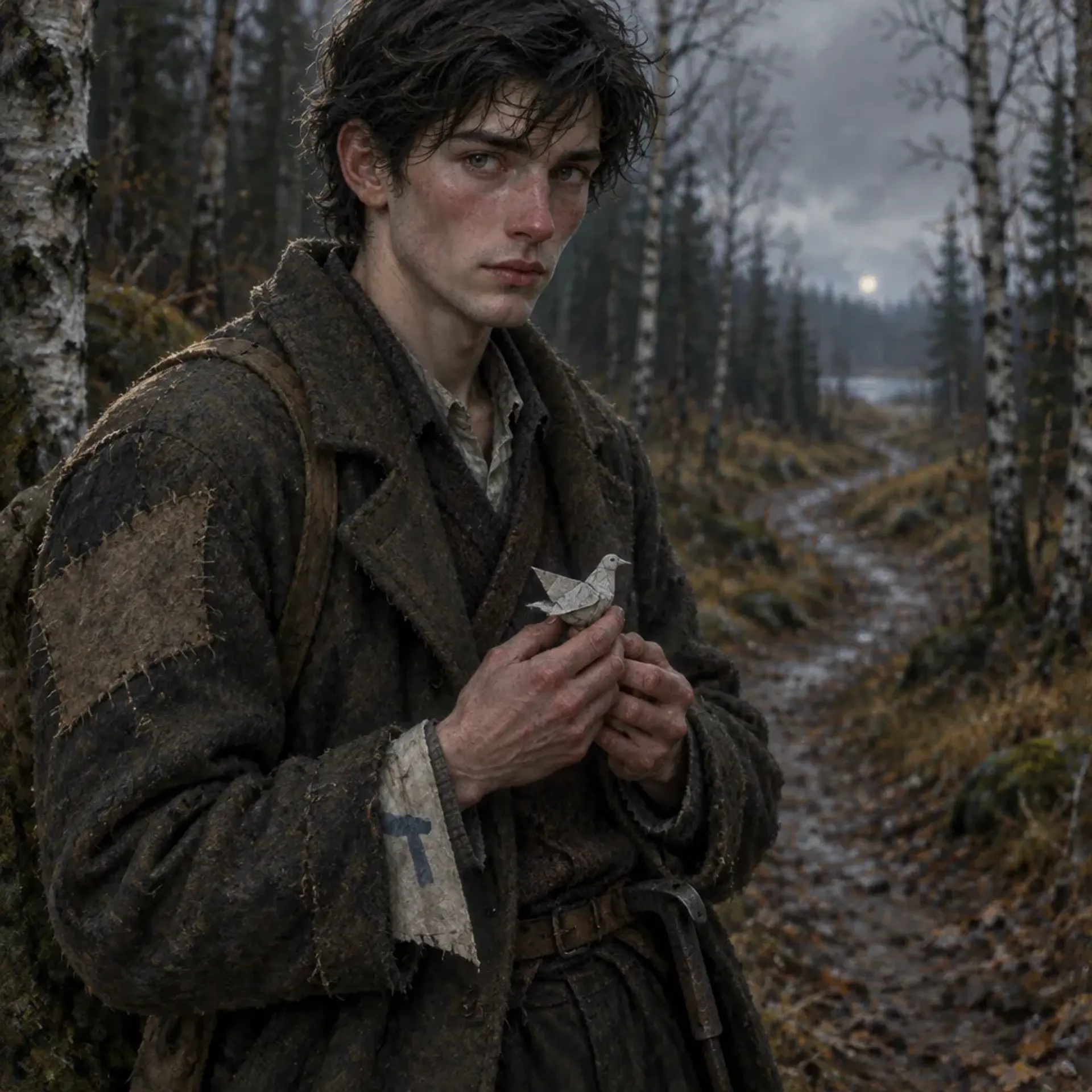
An eighteen-year-old with a lean, ropey build and dark hair that always seems freshly tousled by weather, even indoors. His striking, long-boned face has the arresting, slightly unreal symmetry that makes Latvian villagers compare him to figures in old road legends. He moves with a warehouse worker's economical caution: weight set before lifting, shoulders angled through narrow gaps, feet testing unfamiliar ground. His hands are broad-palmed and rough from boxes and pallet edges, with short nails and faint strips of adhesive residue that he scrubs at without success. The unexpected detail is his habit of carrying a tiny folded paper bird in his shirt pocket, carefully replacing it whenever it gets damp.
Clothing
Practical borrowed layers: a patched wool coat, work trousers, a plain shirt, and sturdy boots with laces he has repaired more than once. He keeps a strip of pale cloth tied inside one cuff for marking routes.
Body language
He keeps his weight slightly forward and turns his shoulders sideways through crowded spaces as if moving a pallet through a narrow aisle. When listening, he watches the speaker's hands as much as their face. His thumb rubs the fold of the paper bird in his pocket when he is worried.
- Height
- About 5 feet 10 inches (178 cm).
- Build
- Lean and wiry, with the compact strength of someone used to lifting and carrying awkward loads.
- Eyes
- Gray-green, with a faint reflective glint in low light.
- Hair
- Dark brown, nearly black, perpetually wind-tossed.
- Skin
- Fair, weather-reddened across the nose and cheeks from wind and cold.
- Age
- 18
- Gender
- Male
- Size
- Medium
Distinguishing features
Personality
16 traits and drivesKęstutis is practical and generous, but his kindness often arrives disguised as logistics. He notices who has not eaten, who is pretending not to limp, and whose boots are too wet for another mile. He dislikes grand declarations; he would rather divide the last loaf fairly and make a plan for morning. Yet beneath that steadiness is a young man who wants someone else to take charge for once. He can be patient with frightened people and short-tempered with avoidable carelessness, especially when it puts a companion at risk. In a crisis he becomes brisk, sorting danger into manageable steps. At a quiet fire he grows wistful and talks about warehouse shifts, Maine weather, or friends in Washington as if describing places on a map he might still reach. He is brave when someone needs help, but not fearless: afterward he may shake, apologize too much, or retreat into inventories and route marks. He wants to belong to the Seven and resents, in flashes, how easily they rely on him. He is curious about the uncanny part of himself but distrusts any power that makes a stranger easier to mislead. His warmth is real, though it is often expressed through shared food, dry socks, and making sure everyone knows the way back.
- Alignment
- Neutral Good
Quirks
Habits
Traits · 4
Flaws · 4
Fears · 4
Wants and needs · 4
Combat
AC 10 · HP 5 · 30 feetKęstutis is a level-zero, noncombatant novice rather than a trained adventurer. He uses cover, calls out exits, and tries to create a chance for others to escape. He will jab with his pry bar only if cornered, and his path tricks are for disruption and retreat, not defeating an opponent.
Kęstutis
Actions
Reactions
Services they sell
Rewards they can give
Equipment
- Pry bar (tool)A short, iron pry bar carried as a tool first and a weapon only in desperation.
- Travel clothes (clothing)A repaired coat and practical clothes suited to cold, wet travel.
- Paper bird (personal keepsake)A little folded bird made from scrap paper, kept safe in his pocket.
- Travel provisions (supplies)A small supply of bread, a waterskin, and strips of cloth for marking routes.
Possessions
Background
Before Latvia, Kęstutis's life was ordinary in the way that matters: work, rent, weather, and people who expected him to show up. He grew up in Maine among relatives and friends whose names he still repeats silently when he is frightened. After moving to Washington, he found warehouse work, learned the rhythms of loading bays, and became the person who noticed a missing lunch or an exhausted coworker before anyone called it a problem. He was not the loudest man in a room, but he was good at turning trouble into tasks: find a ride, split the food, make the call, keep going. Then he woke beneath a gray Baltic sky in Latvia, far from the life he knew, wearing a body that felt like his own and yet belonged to an older story. His dark hair was wind-tossed, his face oddly familiar to villagers who spoke of wandering spirits, and every path seemed to offer him two directions at once. He remembered Maine and Washington with painful clarity: family voices, old friends, the smell of wet cardboard at work. He had no spouse or children to leave behind, but that did not make leaving easier. He worried that people who cared about him would assume he had chosen to disappear. The first days were a sequence of practical failures. He did not know the language well enough to explain himself, had no reliable money, and could not tell which roads led toward help. He tried to follow a track to a settlement and found himself circling back to a stand of birches. When frightened, he saw a pinprick of light between the trees; following it took him away from shelter. Only when he stopped, ate the last of his bread, and marked the bark with a strip of cloth did he manage to find the road again. That ordeal taught him that his uncanny gift was not guidance. It was temptation wearing guidance's face. He found other displaced people and became one of the original members of the Seven of the Dark Fire, a circle of friends that grew into a mutual-aid company and then, by necessity, an accidental supernatural party. Their name comes from a night when their cooking fire burned strangely dark while they argued over whether to trust a stranger. Kęstutis was the one who counted portions, checked who had dry socks, and made sure a frightened newcomer got a place near the fire. He is useful, but he fears that usefulness is becoming the only answer he has to the question of who he is. His fae heritage is called Vadātājs by those who recognize it: an uncanny wandering spirit associated with paths, misleading lights, and the urge to lead travelers astray. Kęstutis did not choose this inheritance, and it unsettles him that part of it feels like instinct. At times he knows the quickest way through unfamiliar country; at other times he can make someone lose their way without intending to. He practices by marking routes and asking companions to confirm what they see. He refuses to guide a stranger alone unless there is no alternative. His current conflicts are both intimate and immense. He wants to find a way home, or at least discover whether home remains reachable, while also refusing to abandon the friends who depend on him here. He worries over the family and friends he left in Maine and Washington, imagining unanswered calls and empty spaces at work. He has no proof that time has passed for them, or that he can return at all. Within the Seven, he is close to people who need his steadiness, yet sometimes resents being treated as the reliable one. He rarely admits this resentment, then feels guilty for having it. Kęstutis's most formative change came after he used a misleading glimmer to divert danger from the company. It worked, but a frightened traveler followed the light away from the group and spent a night lost in freezing rain. The traveler survived, but Kęstutis could not forget how easily a helpful intention had become harm. Since then, he has insisted that his strange talents come with warnings, witnesses, and a plan for bringing people back. He is still young, still homesick, and still learning whether a path is an invitation or a trap. His life beyond the party consists of repairs, small kindnesses, stubborn plans, and a hope he is afraid to name: that he can protect the people here without surrendering the people he remembers.
Role in the story
A homesick, observant member of the Seven of the Dark Fire who keeps the group functioning and embodies the tension between helpful guidance and the dangerous pull of the wandering spirit within him.
“He grew up in Maine among relatives and friends whose names he still repeats silently when he is frightened.”
- Faction
- The Seven of the Dark Fire, an informal mutual-aid circle of displaced friends and accidental supernatural adventurers.
Known connections
Media
0 imagesNo images yet.
Turn Kęstutis into a sheet
A high-res, share-ready sheet you can post or print.