
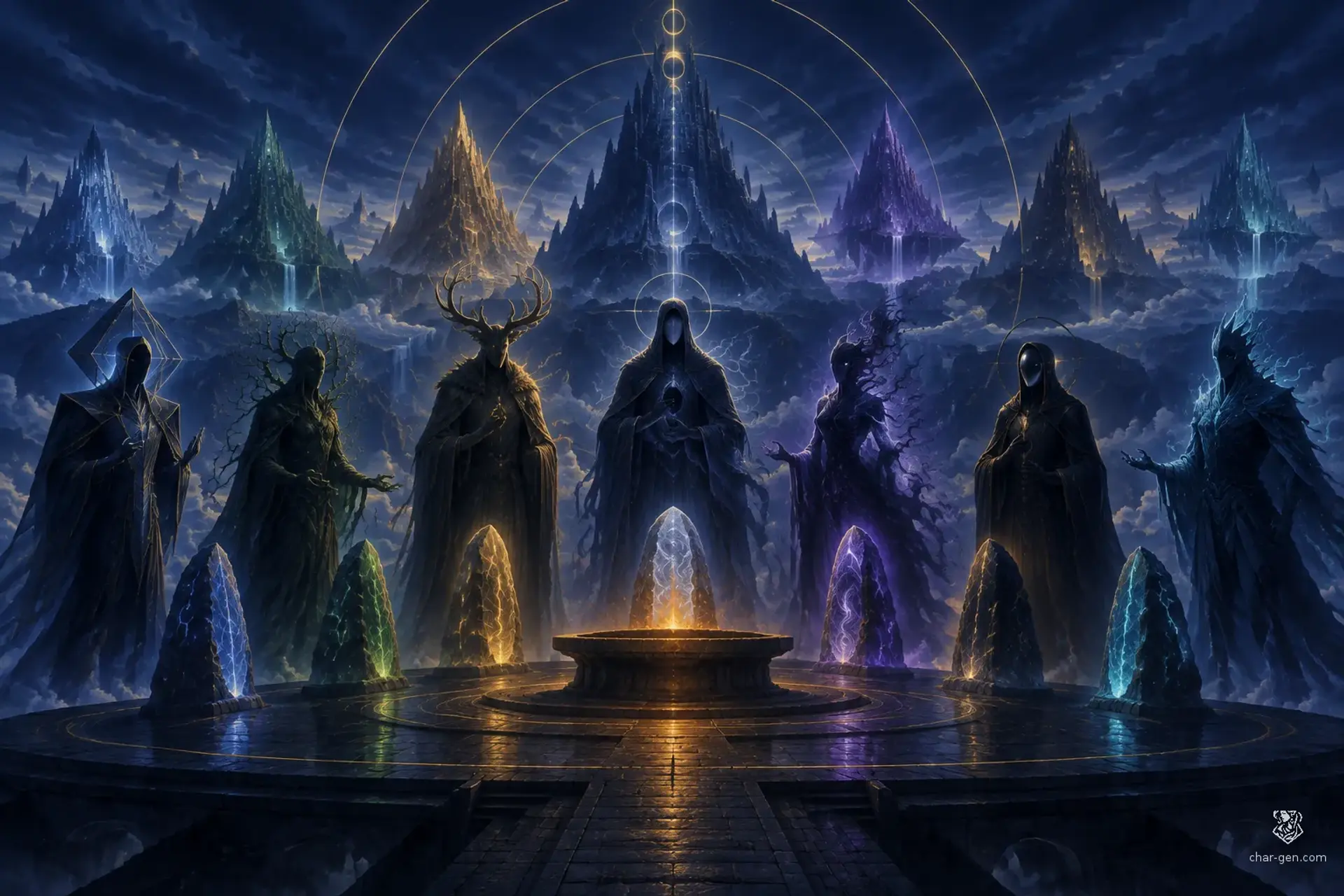
The Sevenfold Measure
The Sevenfold Measure
Invoke a god

Khartek
Keeper of Foundations
Symbol A red stone enclosed by a square outline.
Holy day The First Mark
- Keep the boundary you have sworn to keep.
- Do not confuse a wall with its purpose.
- Measure a consequence before making a rule.
The gods
7Khartek
Keeper of Foundations
Greater · Neutral
Boundaries and law, whose thresholds Besh may open but never erase. · The plane of Foundations, whose stillness Hazar measures against the others.
Patient, exacting, and difficult to persuade. Khartek sees a limit as a shelter as often as a prison, but rarely notices when the two become indistinguishable.
Faith
- Keep the boundary you have sworn to keep.
- Do not confuse a wall with its purpose.
- Measure a consequence before making a rule.
Holy dayThe First Mark, at the turning of the year, when households redraw thresholds and settle old boundaries.
Holy textThe Seven Measures, a collection of brief maxims traditionally cut into stone.
RitesMark a doorway with a removable line of chalk before beginning a new undertaking. · Set a pebble at a disputed boundary and let each party state what it protects. · Leave one gate unlatched during the First Mark.
ValuesContinuity · Proportion · Reliability
Look
SymbolA red stone enclosed by a square outline.
- Basalt gray
- Ember red
AnimalsIbex · Tortoise
AppearanceA broad-shouldered figure of dark basalt, with a face like a carved gatepost and a small, ember-red stone set beneath the breastbone. Khartek’s shadow falls in straight lines even in broken light.
Followers
WhoSurveyors, judges, builders, border wardens, and people who must keep a fragile community intact.
BeliefsFollowers believe that every stable thing depends on a boundary, but that boundaries must serve living needs. They invoke Besh when a rule has outlived its purpose.
The faith
How it began
The religion began as separate local customs around the first God Stones on Myris.
Over generations, travelers and record-keepers noticed seven recurring figures in incompatible accounts of the planes. The first shared doctrine was not that the gods were virtuous, but that each kept a necessary part of reality. The common faith retains regional rites and disputes whether the Seven chose their duties or were bound to them by the stones.
The heavens
Before the planes had names, the first God Stones fell into Myris.
They were not made by the gods; their origin is unknown. Seven living beings touched or were changed by these stones and became divine. Each now rules one Prime Plane, not as its owner but as its keeper. The planes meet at the Measure, a silent interval maintained by Hazar, where their pressures are balanced. Myris remains the mortal world, suspended among them. The stones endure within their rulers, and no mortal account agrees on whether the gods chose their transformations.
Gods and mortals
The gods are distant.
They rarely appear directly, and their clergy do not claim a reliable channel for divine speech. Most worship is practical: a threshold marked, a name recorded, a journey blessed, a season observed. Miracles are uncommon and ambiguous, often indistinguishable from the strange behavior of a God Stone. The faith discourages rulers from claiming divine endorsement; a ruler may invoke a god, but cannot speak for one.
After death
The dead pass through Serevan’s Quiet Gate, where their memories are weighed but not judged.
From there they drift to the plane most suited to the shape of their lives, or dissolve into the stillness between planes. The gods offer no promise of reunion or reward; they maintain the passages and leave the destination to the dead.
What people say, what is true
Players may hear
For the GM
Plot hooks
Conflicts
The wars
The pantheon is not at war, but its balance is not peace.
Khartek insists that boundaries must hold; Besh argues that every boundary eventually needs a door. Givran Tesk and Dato disagree over whether the living should be allowed to alter the conditions of birth and death. Sormek fears that Vezh’s transformations may loosen the planes, while Vezh considers Sormek’s preservation a slow form of ruin. Hazar keeps these disputes from becoming a single divine will, though even Hazar’s restraint is contested.
| Khartek | Besh | Givran Tesk | Dato | Sormek | Vezh | Serevan | |
|---|---|---|---|---|---|---|---|
| A | E | ||||||
| A | E | A | |||||
| A | E | A | |||||
| E | A | A | |||||
| A | E | ||||||
| E | A | A | |||||
| A | E | A |
Order of heaven
Structure
The Sevenfold Measure has no central church or supreme priest.
Local circles keep shrines to the gods most relevant to their work, while itinerant Measure-keepers preserve shared calendars and settle disputes over doctrine. A full shrine may hold seven uncarved stones around an empty center, representing the Measure. Priests are called keepers and serve specific tasks—threshold, passage, healing, cycle, silence, memory, or balance—rather than claiming authority over the pantheon as a whole. Councils convene rarely, and their decisions are advisory.
Theme
Divinity as stewardship rather than moral perfection: reality persists through distinct, limited powers and the unsettled balance among them.
Tone
Distant, restrained, and quietly uncanny.
The gods maintain reality without making it intimate or comprehensible; signs are scarce, doctrine remains incomplete, and ordinary lives continue beneath immense planes whose keepers rarely intervene.
Alignments
All seven are Neutral, as befits the Seven Neutral Gods.
Their neutrality takes different forms: restraint, reciprocity, indifference, and the preservation of necessary change. None is a moral exemplar in every matter.
Media
0 imagesNo images yet.
Turn The Sevenfold Measure into a sheet
A high-res, share-ready sheet you can post or print.