
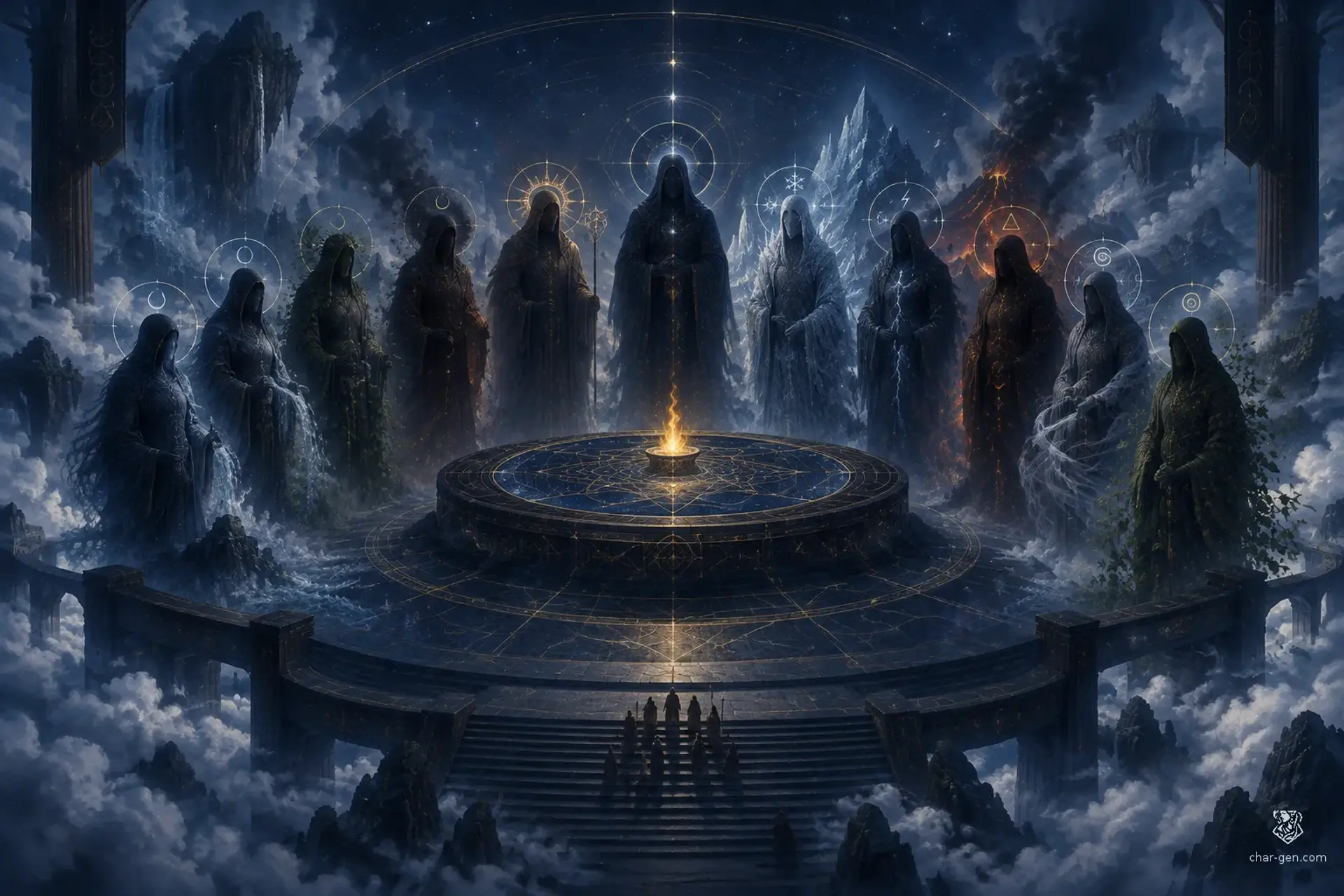
Unnamed pantheon
Unnamed pantheon
Invoke a god

Tüzet
The Unclosing Hearth
Symbol A flame enclosed by an unfinished circle.
Holy day The First Ember
- Make room for what must replace the old.
- Do not mistake destruction for justice.
- Tend the small flame before asking for a great one.
The gods
12Tüzet
The Unclosing Hearth
Greater · Chaotic Neutral
Fire and transformation, in tension with Urdak's waters and in accord with Zselya's cycles of regrowth.
Impatient, splendid, and heedless of the cost of change; she regards restraint as a temporary virtue.
Faith
- Make room for what must replace the old.
- Do not mistake destruction for justice.
- Tend the small flame before asking for a great one.
Holy dayThe First Ember, observed on the year's coldest night.
Holy textThe Cinder Leaves, a collection of brief parables scratched onto fired clay.
RitesLight a shared hearth without speaking. · Burn a written account of a finished chapter of life. · Leave a coal safely banked for a stranger.
ValuesCourage · Change · Craft
Look
SymbolA flame enclosed by an unfinished circle.
- Vermilion
- Charcoal
AnimalsSalamander · Red kite
AppearanceA towering woman of ember-veined basalt, crowned by a crownless plume of flame that bends against the wind.
Followers
WhoSmiths, midwives, revolutionaries, cooks, and those beginning again after loss.
BeliefsHer faithful believe fire is neither kind nor cruel: it reveals what can endure and clears space for what cannot.
The faith
How it began
According to the oldest temple tradition, distinctions arose in the Unshaped Expanse when the first heat met the first water.
Their opposition produced air, life, stone, and the remaining powers. No scripture agrees on which deity awakened first; even Tüzet and Urdak's oldest myths name the other as already present.
The heavens
Before time, there was the Unshaped Expanse, neither void nor matter.
Twelve powers emerged as its first distinctions: heat, water, air, life, stone, frost, storm, light, shadow, metal, dream, and ending. Their separation made the world possible, and their uneasy interdependence keeps it from dissolving. The gods inhabit remote elemental reaches that overlap the mortal world only at rare conjunctions.
Gods and mortals
The gods are distant: they answer through omens, unusual weather, dreams, and the occasional impossible coincidence, not casual appearances.
Mortal temples are local and practical, tending hearths, wells, roads, groves, archives, and burial grounds. Rival priesthoods often cooperate during disasters despite their gods' conflicts, while no single church claims authority over the entire assembly.
After death
The dead pass into the Still Interval, a remote expanse between the gods' realms.
There, Kártek weighs no souls: each spirit is drawn toward the element it most resembles, or wanders until a mortal rite calls it home. Vezdra tends the paths of returning life, while Orsik keeps the final silence. The gods rarely intervene, and reunion is a hope rather than a promise.
What people say, what is true
Players may hear
For the GM
Plot hooks
Conflicts
The wars
The assembly maintains a cold balance rather than peace.
Kártek's stone dams the floods of Urdak, while Urdak's waters slowly undermine Kártek's foundations. Zselya's green abundance presses against the consuming fire of Tüzet, and both claim that the other misunderstands renewal. Fúvár carries the distant voice of Hólt, whose silence threatens to end every cycle. These rivalries are ancient, intermittent, and usually expressed through weather, migration, and scarcity rather than direct divine appearances.
| Tüzet | Urdak | Fúvár | Zselya | Kártek | Hólt | Várko | Gromek | Sárvek | Nappal | Köd | Orsik | |
|---|---|---|---|---|---|---|---|---|---|---|---|---|
| E | A | A | E | |||||||||
| E | A | E | ||||||||||
| A | E | E | A | |||||||||
| E | A | E | A | |||||||||
| A | E | E | A | |||||||||
| E | E | A | A | |||||||||
| A | A | E | E | |||||||||
| E | E | A | A | |||||||||
| E | A | E | A | |||||||||
| A | E | E | ||||||||||
| A | E | E | A | |||||||||
| E | A | E | A |
Order of heaven
Structure
The religion has no central hierarchy.
Each settlement maintains shrines to whichever powers its people need, with a circle of keepers convening for seasonal rites and emergencies. The Twelvefold Assembly is a teaching framework, not a command structure: priesthoods preserve their own customs, exchange calendars, and settle disputes through councils of witnesses. Funerary keepers associated with Orsik are commonly granted neutral status.
Theme
Elemental interdependence, cosmic distance, and mortal responsibility in a world shaped by powers too vast to offer easy answers.
Tone
Distant and numinous.
Divine power is real, but personal guidance is rare; nature's beauty and danger feel immense, and mortals must interpret signs without certainty.
Alignments
Varied: the assembly includes benevolent, impartial, volatile, and predatory powers.
Alignment describes divine temperament, not a simple division into good and evil; even the kindest gods remain distant.
Media
0 imagesNo images yet.
Turn Unnamed pantheon into a sheet
A high-res, share-ready sheet you can post or print.