
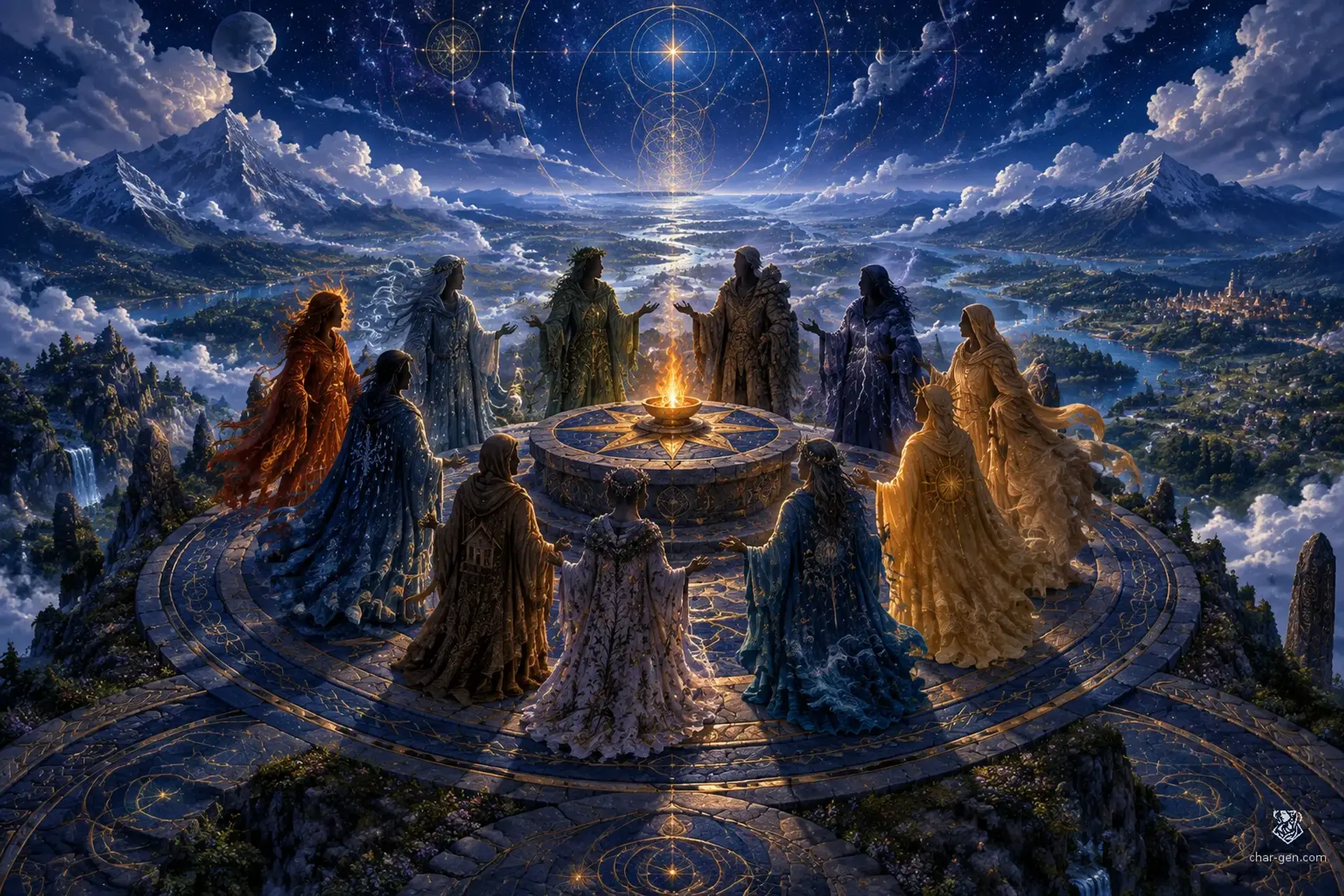
the elemental court
the elemental court
Invoke a god

Kettan
Keeper of the Kindly Flame
Symbol A three-tongued flame cupped by two hands.
Holy day First Ember
- Share warmth before wealth.
- Make useful things with care.
- Never leave a fire unattended.
The gods
12Kettan
Keeper of the Kindly Flame
Greater · Neutral Good
Hearthfire and craft, tended in friendship with Sella · Renewal through heat, balanced by Vaska
Patient, generous, and exacting about safety; he believes a well-tended flame is a promise kept.
Faith
- Share warmth before wealth.
- Make useful things with care.
- Never leave a fire unattended.
Holy dayFirst Ember, the winter evening when households share their last logs with neighbors.
Holy textThe Book of Coals, a collection of hearth tales and practical blessings.
RitesLight a household flame from a neighbor’s fire at First Ember. · Leave a small offering of clean fuel at public hearths.
Valuesgenerosity · craft · safety
Look
SymbolA three-tongued flame cupped by two hands.
- copper
- deep red
Animalsred fox · fire salamander
AppearanceA broad-shouldered man with ember-bright eyes, soot-dark hands, and a cloak that glows like banked coals.
Followers
WhoSmiths, cooks, potters, healers, and anyone who keeps a communal hearth.
BeliefsFollowers believe a shared fire can make strangers kin, and that destruction should be followed by patient rebuilding.
The faith
How it began
According to the oldest shared account, the world began as a quiet darkness.
The twelve gathered around a single spark and each gave it something: heat, rain, wind, root, stone, storm, sand, sunlight, sea, shelter, and the turning of seasons. Their gifts did not agree at first, but Sella’s dawn revealed how each could sustain the others.
The heavens
The world rests in a living balance called the Woven Round.
Below it, Neris gathers the deep waters; above it, Oru carries clouds and voices; within it, Goran raises stone and Vaska tends the roots. Kettan’s fire gives warmth and change, while Sella’s light reveals the patterns between them. None made the world alone: each took a different strand in shaping it.
Gods and mortals
The court is worshipped across villages, cities, and traveling communities.
Most people honor several deities according to need: a household may keep Kettan’s flame, ask Neris for clean water, and leave a bowl for Vaska’s garden. Temples commonly serve as shared kitchens, shelters, wells, or meeting halls. Clergy are expected to mediate disputes and offer practical help without requiring conversion.
After death
The dead travel along the Quiet Current, guided by Sella’s lanterns through Neris’s waters to the Hearth Beyond.
There, each soul may rest, remember, and choose whether to return to the world as a breeze, seed, or spark. The court teaches that no soul is forced to return.
What people say, what is true
Players may hear
For the GM
Plot hooks
Conflicts
The wars
Kettan’s insistence that every flame be contained clashes with Vaska’s belief that wildfire can renew a forest.
Oru’s sudden gales unsettle Neris’s careful tides, though they often cooperate to break droughts. Tuili objects when Goran’s mountains block her rain, while Goran argues that patient stone makes springs possible. Sella mediates these disputes, and Dain insists that every judgment leave room for mercy.
| Kettan | Vaska | Neris | Ailo | Tuili | Goran | Oru | Jorvik | Sella | Eiran | Dain | Pekko | |
|---|---|---|---|---|---|---|---|---|---|---|---|---|
| A | A | E | A | |||||||||
| E | A | A | A | |||||||||
| A | A | E | A | |||||||||
| A | E | A | A | |||||||||
| A | A | AE | ||||||||||
| A | A | E | ||||||||||
| A | E | A | A | |||||||||
| E | A | A | A | |||||||||
| A | AE | A | ||||||||||
| E | A | A | A | |||||||||
| A | A | E | A | |||||||||
| A | A | E | A |
Order of heaven
Structure
The religion has no supreme priest.
Its twelve branches are gathered in local circles called Hearthmeetings, where clergy share food, settle practical disputes, and plan seasonal rites. Each circle appoints a rotating speaker, while traveling mediators known as Waykeepers carry news between shrines. The court’s differences are openly taught; cooperation, not uniform doctrine, is the measure of devotion.
Theme
Interdependence: elemental powers can be gentle or dangerous, but life flourishes when difference is met with care, preparation, and shared responsibility.
Tone
Kind and hopeful.
Natural forces can bring hardship, but the religion emphasizes mutual aid, restorative justice, hospitality, and the possibility of renewal.
Alignments
The court includes kindly lawful, neutral, and freedom-loving powers, alongside stern and unpredictable deities.
Their differences are treated as necessary weather in a shared sky, not proof that any one god is wholly wicked.
Media
0 imagesNo images yet.
Turn the elemental court into a sheet
A high-res, share-ready sheet you can post or print.