
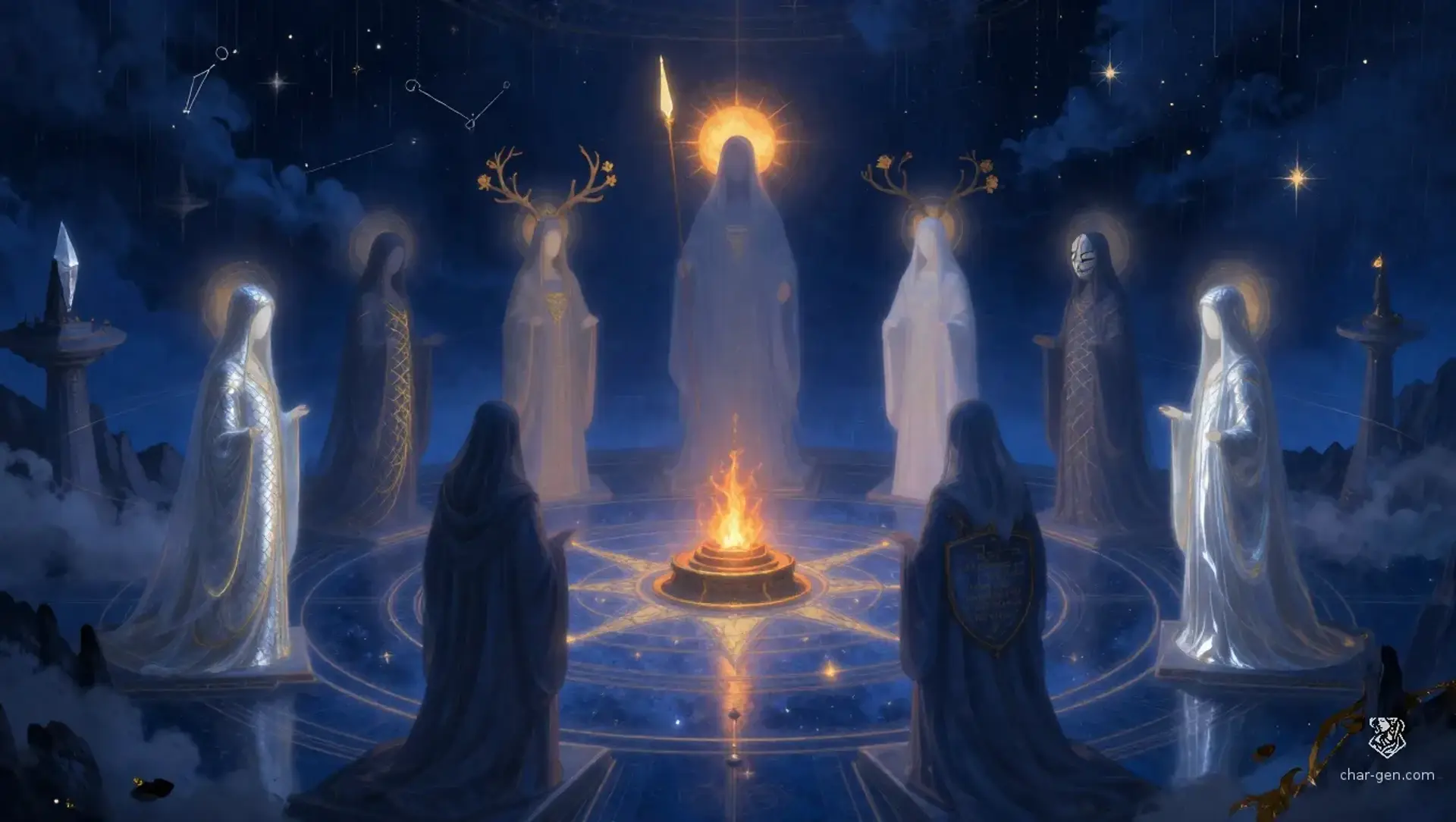
The Far Lantern Assembly
Origin
The pantheon arose when the first mortal communities looked into the starless sky and assigned meaning to nine forms of survival: law, dreaming, beginning, growth, shelter, understanding, joy, sacrifice, and passage. According to temple doctrine, the gods were not created by worship, but worship gave them clearer voices and separated their once-unified purpose into distinct persons.
Cosmology
The world is a lantern suspended over the Sea Without Stars. The gods do not dwell within the world but look upon it from nine remote stations in the celestial dark. The Platinum Arbiter sits at the lantern's axis, where every promise becomes a thread. Around that axis turn the Dreaming Veil of the Silken Dreamer, the eastern fire of the Dawnbreaker, the root-gardens of the Verdant Mother, the warm window of the Hearth-Keeper, the crystal observatory of the Azure Scholar, the many-colored theater of the Laughing Muse, the iron memorial of the Shield of the Fallen, and the silver current of the River Maiden. Their influence arrives as coincidence, weather, inspiration, endurance, and dreams rather than direct miracles in the open world.
Structure
The religion is organized as nine interlocking traditions rather than a single hierarchy. Each major temple has a Flame, a Scale, a Veil, a Root, a Book, a Mask, a Shield, a Ferry, or a Dawn as its central emblem, but all maintain guest-altars for the other eight. Senior clergy meet in rare Convergences to settle disputes, and no decision is considered legitimate unless at least three traditions agree. Traveling priests called Lantern-Bearers carry a small set of nine tokens and mediate between temples, villages, armies, and the dead. Heresies generally arise when one deity is declared the only true god, especially when the authority of The Platinum Arbiter or the visions of The Silken Dreamer are used to silence the others.
Mortal Relations
The pantheon is worshipped as a distant assembly rather than a family of intimate patrons. Temples tend to honor one primary deity while maintaining small shrines to the others, and clergy often describe divine disagreement as a useful model for mortal ethics. Clerics and paladins may serve a single deity, a paired tradition, or the pantheon as a whole. Miracles are subtle: a door found unlocked, a fever breaking at dawn, a remembered name, a dream that prevents a disaster, or a river revealing a safe crossing. The gods rarely appear bodily, and when they do, the encounter is usually symbolic, brief, and difficult to interpret.
Afterlife
The dead awaken on the Far Shore, where the River Maiden ferries them beneath the watch of the Platinum Arbiter. The worthy are guided toward the Dawn Beyond by the Dawnbreaker, while the lost may rest in the Hearth-Keeper's quiet halls. Souls burdened by unresolved cruelty are not destroyed; the Shield of the Fallen and the Verdant Mother shelter them until judgment, remembrance, or return. The Silken Dreamer alone knows how many dead still walk within dreams.
Turn The Far Lantern Assembly into a sheet
A high-res, share-ready sheet you can post or print.