
The Seven Beyond the Veil
Origin
The religion claims that mortal sages first learned the gods’ names from dreams during an age when the stars vanished for seven nights. Each dream revealed one divine power, but no dream showed the gods standing together. The earliest priests concluded that the pantheon was not a family but a set of distant forces whose conflicts shaped the world.
Cosmology
The world began as a silent darkness inhabited by Kage. Morketh stirred within that darkness as the first living hunger, and from the clash between fear and instinct came the seasons of Nym. Riva emerged when the first creature died. Lei’mavi taught the heavens to remember through song, while Eressi became the east wind that carries courage into mortal hearts. K’Rosh arose from the first deliberate act of violence and has haunted civilization ever since. The gods rarely intervene directly, believing mortal lives must unfold beneath the pressure of fate, weather, fear, desire, and war.
Structure
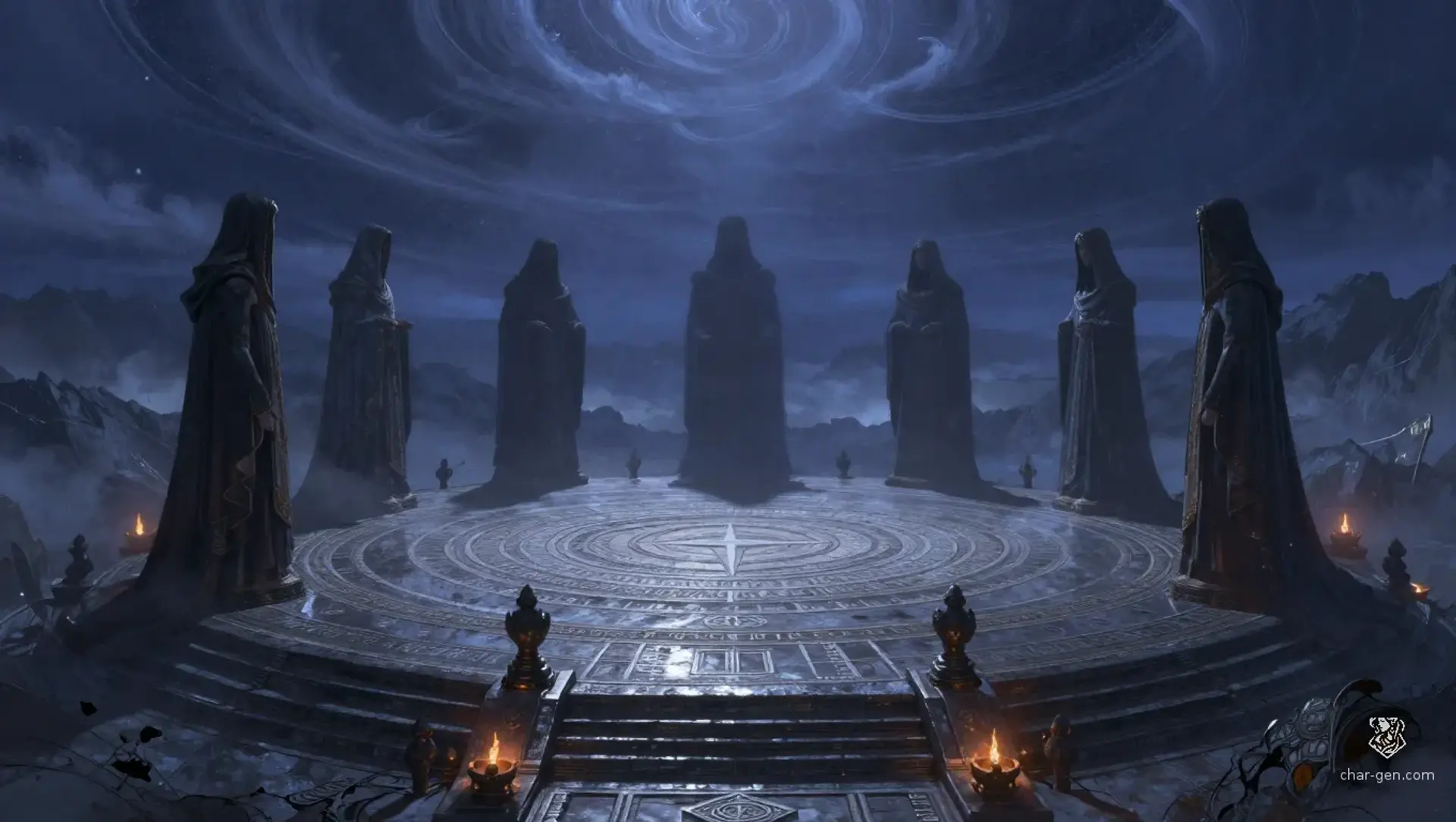
The pantheon is understood as seven divine pressures rather than a harmonious family. Its worship is decentralized, regional, and often contradictory. Public religion favors Eressi, Nym, Riva, Lei’mavi, and Morketh; K’Rosh and Kage are treated as adversarial powers whose names are invoked cautiously or only in protective rites. Priests are expected to acknowledge the other gods, even when opposing them. A common temple may contain seven alcoves, with the central altar left empty to symbolize the gods’ distance from mortal certainty.
Mortal Relations
The faith has no universally accepted central church. Instead, each deity is served by independent temples, shrines, wandering priests, seasonal circles, military chapels, bardic houses, funerary orders, and secret cults. Most communities honor several gods according to circumstance: Eressi before danger, Nym during planting and harvest, Riva at funerals, Lei’mavi during festivals and hardship, and Morketh when dealing with the wilderness. K’Rosh and Kage are officially condemned but remain influential through hidden orders, corrupt rulers, mercenary bands, and frightened households. Clerics may choose domains associated with their patron, while paladins commonly swear oaths inspired by Eressi, Riva, or Lei’mavi.
Afterlife
The dead pass beneath Riva’s veiled moon into the Quiet Vast, where fate is revealed as a road already walked. Lei’mavi’s songs guide worthy souls toward distant constellations, while K’Rosh claims those who died seeking glory through cruelty. Kage’s realm lies beyond the last star, a place of endless fear reserved for oathbreakers and murderers.
Turn The Seven Beyond the Veil into a sheet
A high-res, share-ready sheet you can post or print.