
The Far Assembly
Origin
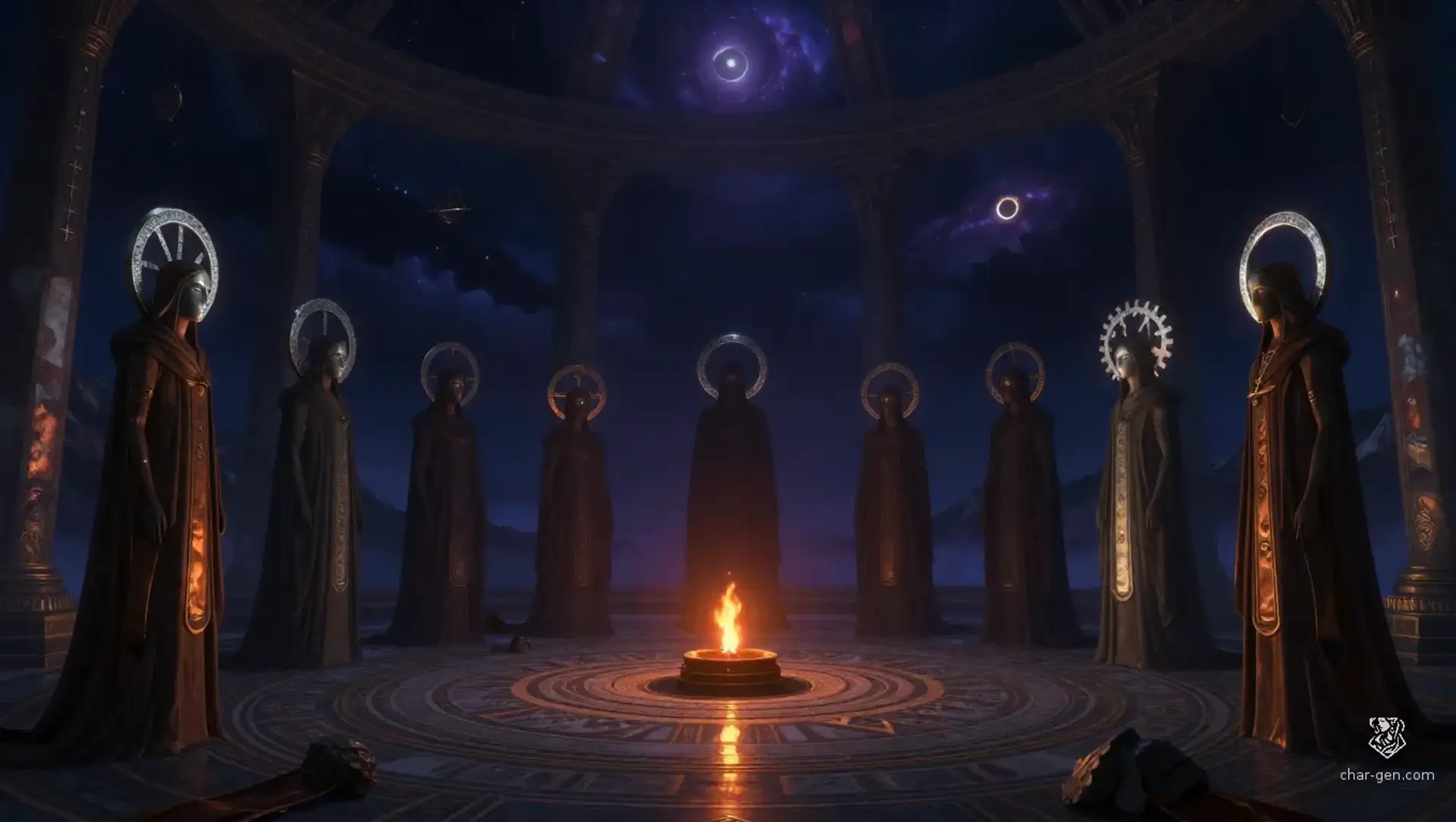
At the first instant of the world, eight ancient beings awoke around a thing they did not remember making. They divided its mysteries among themselves, gave names to their opposing impulses, and withdrew into separate domains. Since then, some have walked among mortals in disguise, while others remain beyond the sky, watching through eclipses, dreams, and the slow failure of stars.
Cosmology
Before time, the Eight awakened in a soundless expanse and found a single unfinished world turning beneath them. Hadrik shaped its substance, Veyra gave it memory, Tömur measured its cycles, and Sava opened paths through it. Ojuna kindled living change, Orun established endings, Kesten taught beings to speak across distance, and Galkor discovered that all created things could be unmade. The gods have never agreed whether creation was an act of love, necessity, accident, or imprisonment. They remain alive because the world still contains unanswered questions.
Structure
The religion has no central church. Instead, it is a web of shrine-houses, traveling priesthoods, household rites, craft guilds, burial societies, roadside custodians, and secret ruin-cults. Most communities recognize all eight gods while favoring one or two. Theologians call the pantheon the Far Assembly, though ordinary people more often say the Eight, the Old Witnesses, or simply the Distant Ones. Priests settle doctrine through seasonal councils, but every council is temporary and every ruling may be overturned by a new omen. Galkor's cults are officially condemned, yet some communities preserve them as a necessary warning against rigid order.
Mortal Relations
The gods rarely manifest openly. They act through dreams, coincidences, inherited customs, altered weather, impossible letters, and brief encounters with strangers who may be divine. Temples are usually local and practical: workshops for Hadrik, archives for Veyra, roadside stones for Sava, gardens for Ojuna, silent houses for Orun, counting rooms for Tömur, message halls for Kesten, and ruined shrines for Galkor. Mortal priests often disagree more sharply than the gods do, because each deity's distant signs can support several interpretations.
Afterlife
The dead arrive at the Quiet Verge, a shore beyond the world where distance has no measure. Orun keeps the gates but does not judge. The dead are summoned, one by one, by the deity whose influence shaped their final choice: Veyra records them, Tömur weighs their promises, Hadrik hears their last work, Sava of the Far Step guides them onward, and the remaining gods may claim no soul outright. Some spirits remain as distant lights; others return as dreams, omens, or nameless guardians.
Turn The Far Assembly into a sheet
A high-res, share-ready sheet you can post or print.