
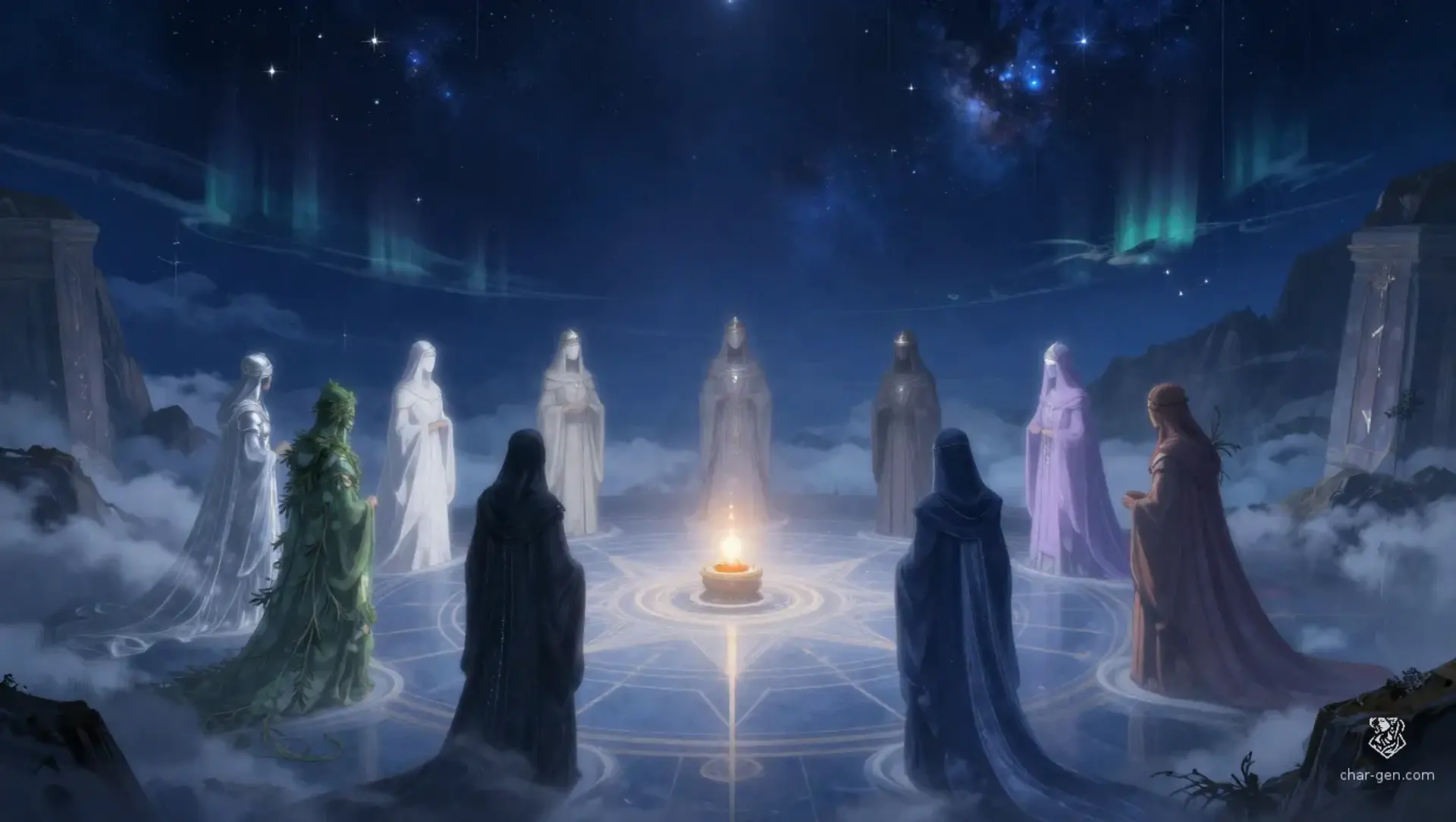
The Ninefold Covenant
Origin
The earliest surviving priests teach that the pantheon formed when the world faced its first great wound. The Platinum Arbiter gave the wound a boundary, The Silken Dreamer gave survivors the ability to sleep, The Dawnbreaker opened an escape, The Verdant Mother restored what could grow, The Hearth-Keeper gathered the displaced, The Azure Scholar studied the cause, The Laughing Muse returned courage, The Shield of the Fallen guarded the weak, and The River Maiden carried the wounded toward tomorrow. Whether this story describes literal creation or a later mortal interpretation is unknown.
Cosmology
The gods dwell beyond the visible heavens in the Ninefold Distance, a realm mortals can perceive only through eclipses, dreams, miracles, and moments of impossible clarity. The world is said to be a living covenant: law gives it shape, dreams give it meaning, dawn gives it motion, growth gives it endurance, hearths give it belonging, learning gives it understanding, art gives it courage, sacrifice gives it protection, and rivers give it passage. No deity created existence alone. According to temple teaching, The Azure Scholar discovered the first laws, The Verdant Mother awakened them, and The River Maiden taught them how to flow.
Structure
The religion has no supreme god and no centralized church. Instead, it is organized as nine interlocking traditions known collectively as the Covenant Houses. Each House maintains its own clergy, rites, symbols, and charitable duties, while traveling Concordants mediate disputes between them. Most communities appoint a Hearth-Keeper to oversee daily welfare, an Arbiter-priest to settle disputes, and a River Maiden officiant to guide births, marriages, departures, and funerals. The other Houses appear according to local need. Clerics may serve one deity exclusively, but the religion teaches that honoring one divine virtue while despising the others creates imbalance.
Mortal Relations
The pantheon is distant rather than absent. Clerics and paladins receive power through alignment with divine principles, sacred relics, dreams, omens, and rare miracles rather than constant personal conversation. Temples tend to be practical institutions: courts and oath-halls for The Platinum Arbiter, hospices for The Silken Dreamer, refuge networks for The Dawnbreaker, gardens for The Verdant Mother, inns for The Hearth-Keeper, libraries for The Azure Scholar, theaters for The Laughing Muse, memorial forts for The Shield of the Fallen, and bridgeside shrines for The River Maiden. A single town may honor all nine, but each deity’s clergy interprets goodness differently.
Afterlife
The faithful believe the dead cross a silent threshold into the Far Hall, a distant realm divided into nine horizons. The Platinum Arbiter weighs each soul, while The Silken Dreamer reveals its deepest memories, The River Maiden carries it onward, and The Shield of the Fallen bars the way against devouring spirits. Souls who lived well may dwell near the deity whose virtue they embodied, though all horizons remain joined by roads of starlight. The gods rarely speak directly to the dead; instead, signs, dreams, and strangely familiar strangers offer guidance.
Turn The Ninefold Covenant into a sheet
A high-res, share-ready sheet you can post or print.