
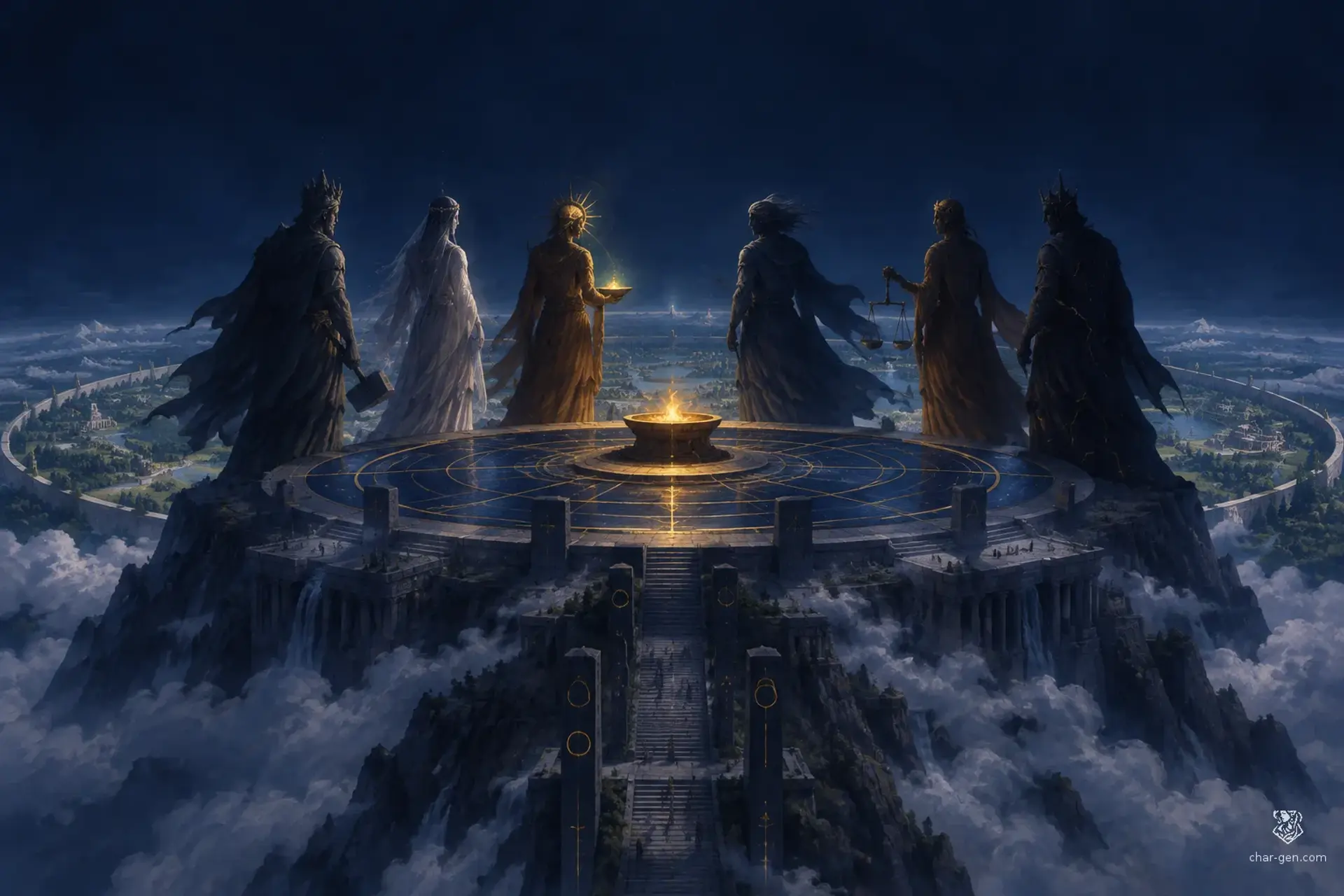
The Assembly of the Far Shore
The Assembly of the Far Shore
Invoke a god

Sythra
Keeper of the Last Threshold
Symbol A closed eye above a narrow doorway.
Holy day The Last Lantern
- Honor the dead without pretending they can be recalled.
- Keep the boundary between the living and the dead.
- Let mourning have its season, then return to the living.
The gods
6Sythra
Keeper of the Last Threshold
Greater · Lawful Neutral
Death and passage: Sythra keeps the final threshold that Bran Keld's stone roads lead toward.
Patient, unsentimental, and never cruel by design. Sythra considers grief sacred but does not mistake it for a power that can reverse death.
Faith
- Honor the dead without pretending they can be recalled.
- Keep the boundary between the living and the dead.
- Let mourning have its season, then return to the living.
Holy dayThe Last Lantern, held on the year's longest night.
Holy textThe Book of Quiet Measures, a collection of short funeral verses and instructions for the tending of graves.
RitesLeave a lamp at the threshold on the night of a death. · Speak the deceased's name once at burial, then keep a period of silence. · Mark a grave with a small doorway carved in stone or wood.
ValuesDignity · Measure · Remembrance
Look
SymbolA closed eye above a narrow doorway.
- Silver
- Deep blue
AnimalsMoth · White heron
AppearanceA tall figure veiled in layered silver cloth, with a face that is always half-obscured and eyes like reflected stars.
Followers
WhoUndertakers, hospice keepers, grave-tenders, and those who help communities endure loss.
BeliefsFollowers believe Sythra receives the dead but does not decide whether their lives were good; that judgment belongs to the living who remember them.
The faith
How it began
According to the oldest temple account, the six gods found the world adrift in the dark.
Bran Keld anchored it, Aodwen measured its bounds, Eiluned kindled its warmth, and Sythra established the limit of mortal life. Veyr opened roads between the first settlements. Drom, who would not accept any boundary, was cast beyond the ordered world and became its patient adversary.
The heavens
The world is a bounded garden set within a starless expanse.
The gods did not create it from nothing: they found its raw substance, named its limits, and set its cycles in motion. The sun follows a road laid by Aodwen; Sythra marks the threshold where every life ends; and the untamed spaces beyond Bran's mountains remain open to Drom's influence.
Gods and mortals
The gods are distant and seldom answer prayers with unmistakable signs.
Clerics and other devoted mortals may receive power, but visions are rare, symbolic, and open to doubt. Temples tend to be civic institutions, roadside sanctuaries, or family shrines rather than centers of constant divine spectacle.
After death
The dead travel to the Quiet Shore, a distant realm beyond the stars.
There, Sythra weighs the echoes of each life while Bran keeps the gate. The worthy may linger among ancestral shades; others pass into the deep dark, where even the gods do not claim to know what becomes of them.
What people say, what is true
Players may hear
For the GM
Plot hooks
Conflicts
The wars
Aodwen insists that every oath has a rightful measure, but Drom breaks measures whenever they serve the powerful.
Sythra guards the boundary between life and death, a charge Orianne quietly contests when grief threatens to become a law of its own. Bran maintains the stubborn foundations of the world, while Veyr argues that even foundations must sometimes be overturned.
| Sythra | Bran Keld | Eiluned | Veyr | Aodwen | Drom | |
|---|---|---|---|---|---|---|
| A | A | E | ||||
| A | A | A | E | |||
| A | A | E | ||||
| A | E | A | ||||
| A | E | |||||
| E | E | E | A |
Order of heaven
Structure
Worship is organized through local temples, family shrines, and traveling rites rather than a single universal hierarchy.
A temple may honor the full assembly while keeping a particular deity's sanctuary at its heart. Clerics of different gods cooperate on civic ceremonies, funerals, and seasonal observances, but doctrinal disputes are settled locally. Drom has no lawful public clergy; his rites survive in hidden cells and personal bargains.
Theme
A classical divine assembly whose distant powers embody the necessary tensions of civilization: law and freedom, memory and renewal, endurance and change.
Tone
Distant, contemplative, and quietly mythic.
The gods shape the world through old boundaries, inherited customs, and rare signs rather than frequent intervention; mortals must make consequential choices without certainty that heaven is watching.
Alignments
The six gods span lawful good, neutral good, lawful neutral, chaotic good, neutral, and chaotic evil.
Their differences are treated as necessary tensions in the order of the world, not as a moral consensus.
Media
0 imagesNo images yet.
Turn The Assembly of the Far Shore into a sheet
A high-res, share-ready sheet you can post or print.