
Unnamed pantheon
Unnamed pantheon
Invoke a god

Asterion
Keeper of the Measure
Symbol A straight bronze rod laid across an open square.
Holy day The First Measure
- Keep the promises that protect the vulnerable.
- Make laws public, comprehensible, and answerable to the people they bind.
- Restrain power before it learns to call itself necessity.
The gods
6Asterion
Keeper of the Measure
Greater · Lawful Good
Law and civic duty, which Asterion sets against Kivuli's distrust of lasting commands · Oaths and just rule, balanced by Nalia's judgment of what those promises cost
Patient, exacting, and sincerely protective, though prone to treating living communities as problems that can be solved by sound design. He respects Nalia's discernment and distrusts Varo's easy bargains.
Faith
- Keep the promises that protect the vulnerable.
- Make laws public, comprehensible, and answerable to the people they bind.
- Restrain power before it learns to call itself necessity.
Holy dayThe First Measure, held at the year's opening, when communities renew public promises and repair shared boundaries.
Holy textThe Measures of Asterion, a set of brief civic maxims copied onto temple walls and courthouse lintels.
RitesSpeak a public oath before a plain stone measure. · Set aside one day each season to mend a road, well, or common wall. · Read the names of those harmed by a broken law before revising it.
Valuesjustice · stability · public duty
Look
SymbolA straight bronze rod laid across an open square.
- white
- bronze
Animalscrane · ox
AppearanceA tall, bronze-skinned figure in a plain white mantle, carrying a measuring rod and a closed book. Asterion's face is composed and remote, like a statue glimpsed from the far end of a sanctuary.
Followers
WhoJudges, civic stewards, builders, oath-witnesses, and rulers who accept limits on their authority.
BeliefsFollowers believe that order is a mortal craft, not a gift handed down complete from the heavens. They honor Nalia's judgment as a necessary check on Asterion's certainty.
The faith
How it began
In the oldest temple account, the world emerged when a single dark expanse reflected a point of light.
Asterion measured the first horizon, Nalia lit a lamp for the first dead, and Oru began the first record. Kivuli kept the unspoken remainder; Tavi brought rain to the new land; Varo arrived later, claiming that creation had left something unpaid. The account is understood as sacred poetry, not settled history.
The heavens
The world rests on the back of no creature and was not made for mortal comfort.
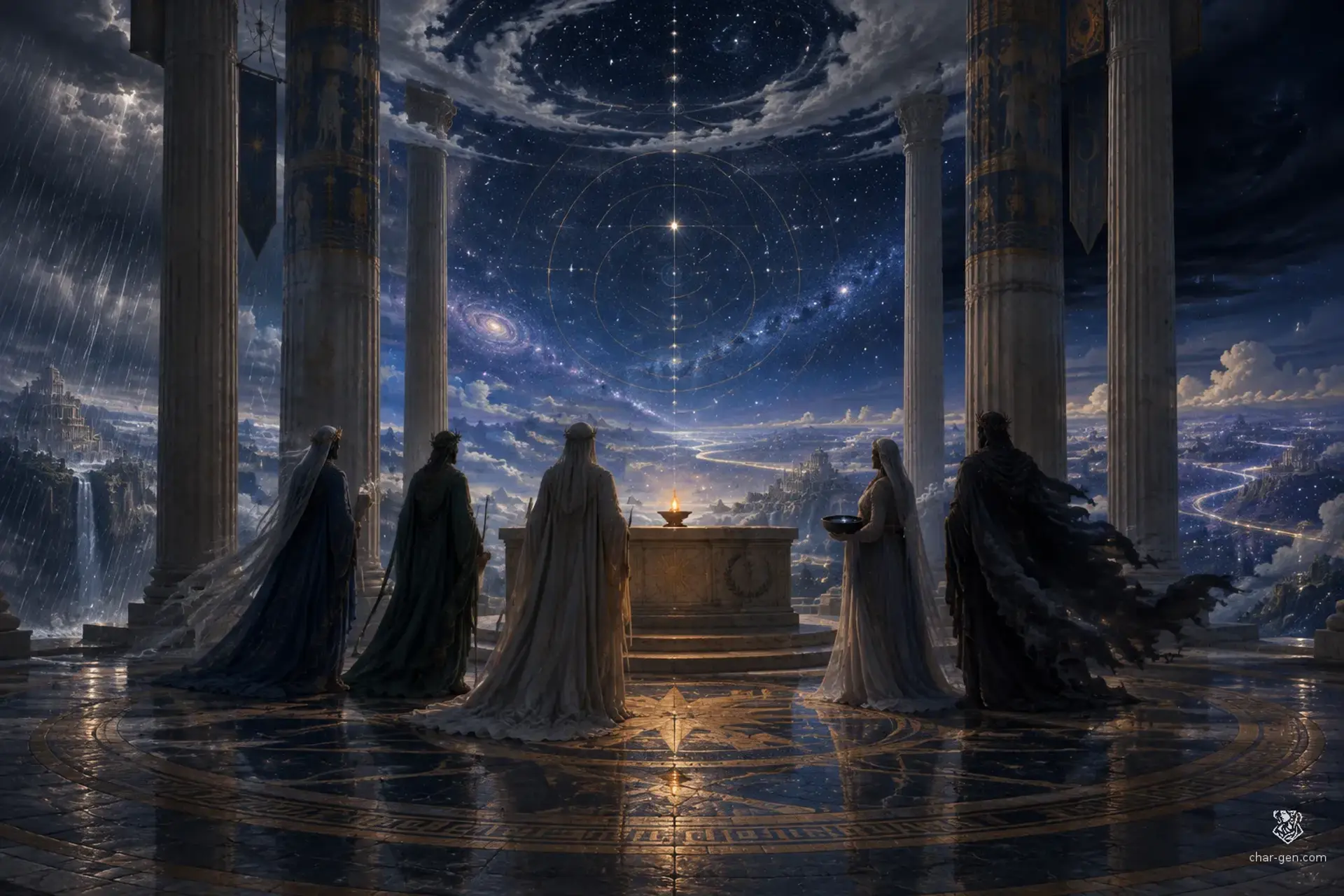
It is a small, bright province between the upper firmament and the deep country of the dead. The gods dwell beyond the visible heavens in a remote assembly hall called the High Porch; they rarely descend, preferring to send signs through weather, dreams, eclipses, and the stubborn endurance of old stones.
Gods and mortals
The gods are distant patrons rather than constant guardians.
Temples serve as civic institutions, hospices, archives, weather shrines, and places of refuge. Priests interpret signs but cannot compel divine attention, and a miracle is rare enough to reshape local history.
After death
The dead descend to the Quiet Courts, a far-off country of pale roads and closed bronze gates.
There, Nalia weighs the shape of a life, while Oru keeps the names of those whose deeds still matter to the living. Most souls eventually cross the grey river and become lights in the upper dark; a few are recalled by oath, unfinished duty, or the intervention of a deity.
What people say, what is true
Players may hear
For the GM
Plot hooks
Conflicts
The wars
Asterion insists that mortal cities need laws sturdy enough to outlast their founders, while Kivuli argues that no law should survive its purpose.
Nalia and Oru dispute whether the dead should be remembered for their choices or their consequences. Tavi's storms repeatedly undo the boundaries Asterion draws, and Zuberi welcomes the resulting upheaval when it weakens the powerful. Varo, who feeds on ambition without regard for its cost, quietly fans every dispute.
| Asterion | Nalia | Oru | Kivuli | Tavi | Varo | |
|---|---|---|---|---|---|---|
| A | A | E | E | |||
| A | A | E | ||||
| A | A | E | ||||
| E | A | A | E | |||
| E | A | |||||
| E | E | E | E | A |
Order of heaven
Structure
Worship is organized through local temple houses rather than a single church.
Most settlements maintain a shared sanctuary with six alcoves, though individual communities emphasize different deities. Priests are elected, inherited, or appointed according to local custom; the High Porch grants no universal hierarchy. Councils of clergy meet irregularly to settle disputes, but their decisions bind only those who accept them.
Theme
A classical divine assembly concerned with order, mortality, memory, change, secrecy, and ambition, whose remote gods offer no simple guarantee of justice.
Tone
Distant, stately, and quietly uncanny.
Divine presence is felt through old rites and immense natural forces, while ordinary life remains largely in mortal hands.
Alignments
The six span lawful good, neutral good, lawful neutral, true neutral, chaotic neutral, and chaotic evil.
Their disagreements are genuine, but no single moral order governs the assembly.
Media
0 imagesNo images yet.
Turn Unnamed pantheon into a sheet
A high-res, share-ready sheet you can post or print.