
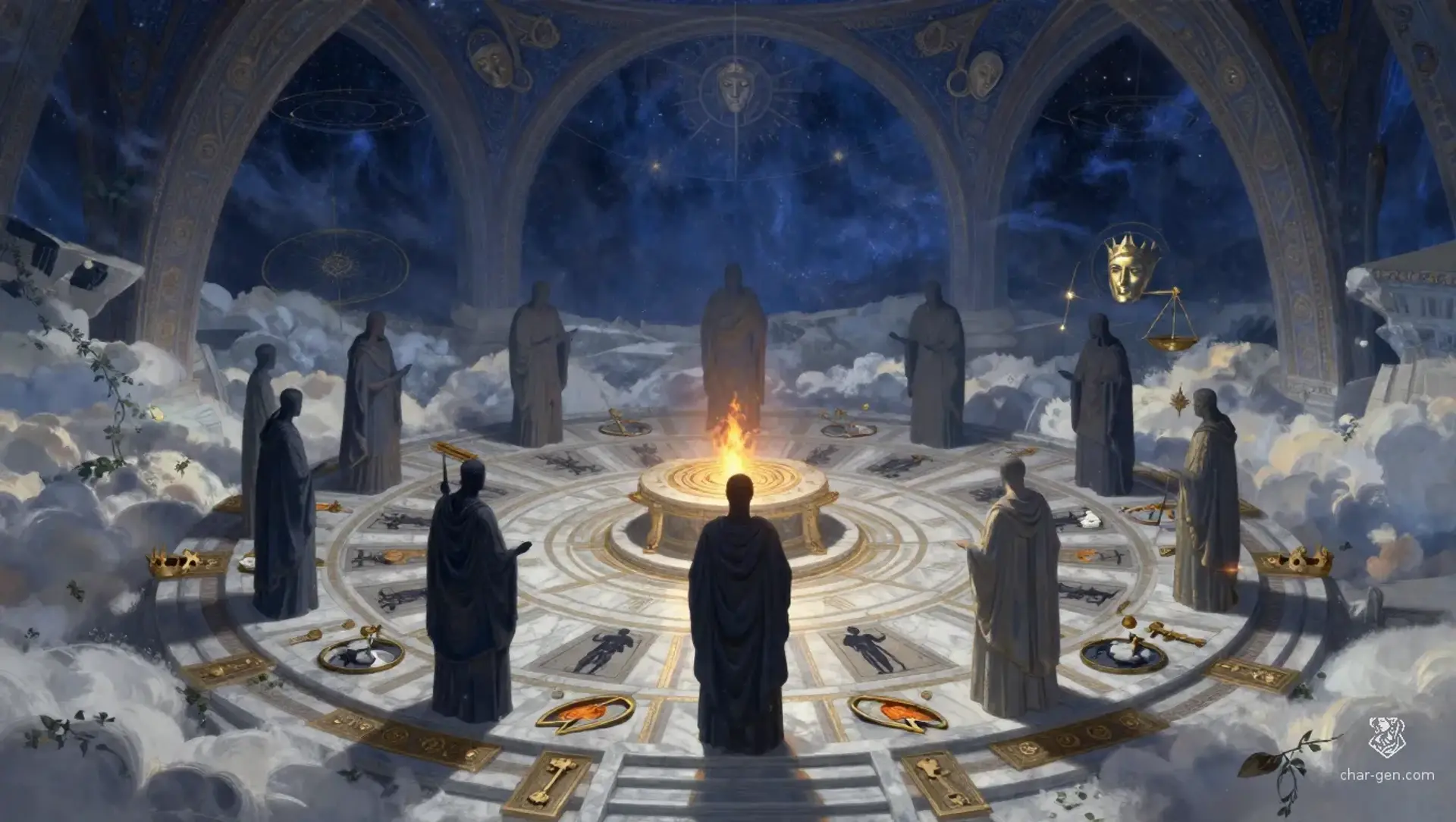
The Ninefold Concord
Origin
The pantheon formed when the first mortal civilization attempted to divide the mysteries of existence into understandable faces. Whether the gods existed before worship or were shaped by it is a forbidden question. Aeteron claims the Nine were eternal, while Vaul’s hidden records suggest that mortals gave them names after witnessing nine different shadows cast by the same cosmic fire.
Cosmology
The world began when Aeteron spoke the First Measure into the void. His word created the celestial vault, but the echo became Kharos, the force that gives every structure a breaking point. From the space between their voices came Ilyra, who made time meaningful by giving all things an ending. Namar emerged from the first forgotten name, while Othren shaped language, law, and remembrance. Seraphel kindled the sun and sacred fire; Thessa filled the world with living breath and compassion; Vaul gathered secrets into the deep places; and Lyssara set fate spinning through chance, storm, and transformation.
Structure
The religion has no single earthly hierarchy. Instead, it is organized into nine interlocking traditions called Houses: the Measure, the Broken Crown, the Open Hand, the Unbroken Word, the Dawn Flame, the Turning Wheel, the Last Account, the Veiled Key, and the Empty Star. Each House maintains its own rites, clergy, symbols, and sacred sites, while councils of nine settle disputes between them. In practice, temples often combine several Houses, reflecting the belief that no deity alone explains the world.
Mortal Relations
The Nine rarely manifest openly. Their influence arrives through omens, dreams, inherited relics, sudden changes in fortune, prophetic inscriptions, and the actions of chosen champions. Most settlements honor several deities pragmatically: Aeteron and Othren at courts, Thessa in homes and fields, Seraphel in workshops, Ilyra at funerals, Lyssara at crossroads, Vaul in libraries, and Namar in hidden places. Religious conflict is usually political or philosophical rather than openly miraculous, allowing player characters to serve one deity while bargaining with another.
Afterlife
The dead arrive at the Hall Beyond the Last Door, where Ilyra weighs their choices, Othren records their names, and Vaul determines whether their spirits return as ancestors, dissolve into the cosmic river, or pass into the keeping of another deity. No god claims absolute ownership of the dead; even Namar’s darkness is only a passage.
Turn The Ninefold Concord into a sheet
A high-res, share-ready sheet you can post or print.