
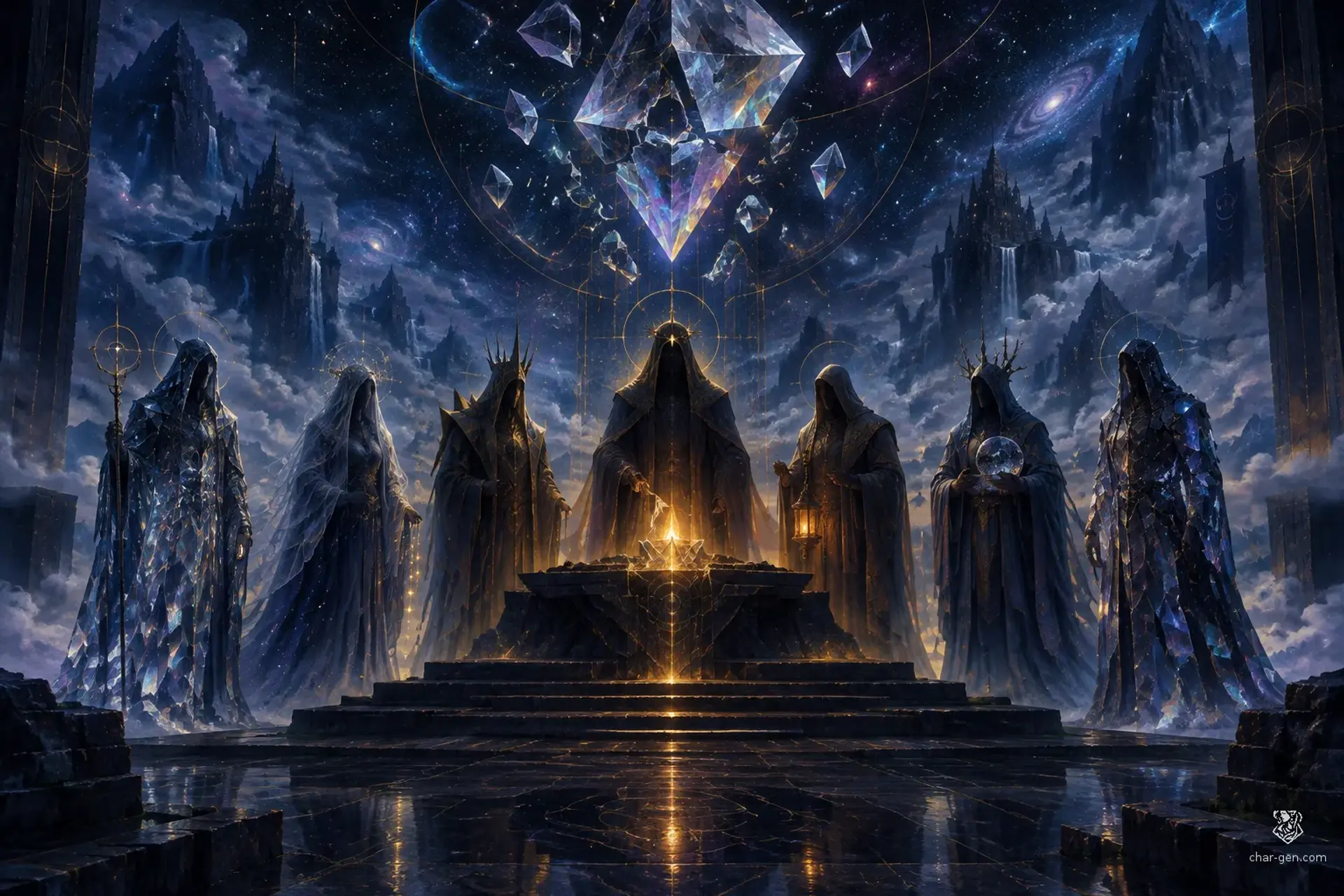
Unnamed pantheon
Unnamed pantheon
Invoke a god

Vorsk
The Unbroken Angle
Symbol A clear diamond crossed by one straight golden line.
Holy day The First Refraction
- Keep what you have sworn, even when the world changes.
- Do not mistake a breakable bond for a worthless one.
- Seek counsel from Ilyat before punishment becomes vengeance.
The gods
7Vorsk
The Unbroken Angle
Greater Deity · Lawful Good
Continuity, held in tension with Ilyat's compassion · Oaths, whose consequences Qadren records
Patient, formal, and almost unbearably remote. Vorsk values a promise kept even when its fulfillment hurts, and regards Ilyat's mercy as beautiful but dangerous.
Faith
- Keep what you have sworn, even when the world changes.
- Do not mistake a breakable bond for a worthless one.
- Seek counsel from Ilyat before punishment becomes vengeance.
Holy dayThe First Refraction, observed on the year's longest night.
Holy textThe Measure of the First Light
RitesMark a vow on clear glass and leave it where dawn can pass through. · At a broken oath, speak the names of those harmed before seeking forgiveness.
Valuessteadfastness · accountability · measured duty
Look
SymbolA clear diamond crossed by one straight golden line.
- clear
- gold
Animalswhite stag · glasswing moth
AppearanceA tall, remote figure of clear crystal, with a narrow gold line running through its heart. Its face reflects whoever looks upon it, but never their expression.
Followers
WhoJudges, treaty-keepers, bridge-builders, and rulers who fear that their authority will outlive their wisdom.
BeliefsFollowers believe every promise creates a real strand in the world's hidden geometry. Vorsk does not guarantee that vows will be rewarded, only that they matter.
The faith
How it began
In the first silence, the Prism Eternal contained every element, emotion, and future within one consciousness.
It imagined a world beyond itself. The future in which it remained whole collided with the futures in which it changed, and the Prism broke. Seven great fragments awoke as Vorsk, Ilyat, Qadren, Skel, Odrava, Tzurik, and Hesh; lesser shards became stars, seas, spirits, and mortal souls. The gods remember the event differently, and none agrees on whether it was birth, catastrophe, or sacrifice.
The heavens
Before time, the Prism Eternal held all possibility within one consciousness.
When it tried to imagine a world beyond itself, its incompatible futures collided and shattered it. Each fragment became a divine power; the splinters between them became matter, life, chance, and time. The world is therefore neither a finished design nor an accident alone, but an ongoing refraction. The gods rule far-separated aspects of reality and rarely gather in one place. Their common meeting ground is the Lattice, a silent expanse of interlocking planes said to be the Prism's inner geometry.
Gods and mortals
The gods are distant, and most mortals encounter them through customs, shrines, and rare omens rather than clear answers.
Local communities often honor several deities: Vorsk at a treaty, Ilyat at a sickbed, Odrava at a funeral. Temples are usually modest observatories, hospices, archives, or roadside sanctuaries rather than grand centers of political power. Religious disagreements concern how to live among the fragments, not whether the Shattering happened.
After death
The dead travel as motes of color through the Veil Between, where Odrava weighs the lives they lived and Hesh keeps their memories from dissolving.
Most are gathered into the Prism's scattered light, not as conscious souls but as patterns that may someday recur. Those who swear themselves to a deity may instead linger in that god's distant country, though no god can promise a mortal will remain unchanged.
What people say, what is true
Players may hear
For the GM
Plot hooks
Conflicts
The wars
Vorsk insists the Shattering was a necessary beginning, while Ilyat grieves the unity it destroyed.
Qadren seeks to measure every consequence of the break; Skel would rather sever the remaining ties between the fragments. Odrava resists Skel's doctrine of final separation, and Tzurik repeatedly tries to bend Vorsk's laws of change for private gain. Hesh guards the secrets that might explain the Prism's final moment, frustrating Qadren and tempting Ilyat.
| Vorsk | Ilyat | Qadren | Skel | Odrava | Tzurik | Hesh | |
|---|---|---|---|---|---|---|---|
| A | E | A | E | ||||
| A | E | A | |||||
| A | A | E | |||||
| E | E | A | E | A | |||
| A | E | E | A | ||||
| E | A | A | E | ||||
| A | A | E |
Order of heaven
Structure
The Seven are a loose assembly, not a ruling council.
Vorsk and Qadren tend the patterns that make a stable cosmos possible; Ilyat and Odrava care for mortal suffering and endings; Tzurik presses the world toward change; Skel calls for separation; and Hesh guards the knowledge that might reconcile or deepen these disputes. Their worship is decentralized, with overlapping shrines and local customs. Priests may honor one deity while acknowledging the others as necessary fragments of a larger, irrecoverable whole.
Theme
THE CREATION MYTH — THE SHATTERING OF THE PRISM: all existence descends from a singular, conscious Prism Eternal, whose fracture turned impossible potential into a plural and imperfect world.
The gods are both its shards and the arguments those shards have with one another.
Tone
Distant and contemplative.
The divine is vast, beautiful, and rarely attentive to individual lives; signs are ambiguous, sacred places feel older than their worshippers, and mortals must choose how to live without expecting the gods to settle their disputes.
Alignments
The Seven span principled, compassionate, pragmatic, and destructive creeds: two are good, two lawful but impartial, two neutral, and one openly cruel.
Their alignments describe divine priorities, not simple mortal morality.
Media
0 imagesNo images yet.
Turn Unnamed pantheon into a sheet
A high-res, share-ready sheet you can post or print.