
The Bronze Concord
The Bronze Concord
Invoke a god

Korran
The Shield-Lord
Symbol A bronze shield crossed by a straight spear.
Holy day The First Muster
- Keep formation when fear breaks the ranks.
- Honor surrender when it is given in good faith.
- Obey a lawful command, but never conceal a crime committed under its authority.
The gods
3Korran
The Shield-Lord
Greater · Lawful Neutral
War, with Sytha's laws of command and Meret's rites for the fallen
Stern, patient, and exacting. Korran admires Sytha's strategic mind but believes Meret's mercy can prolong wars and cost more lives.
Faith
- Keep formation when fear breaks the ranks.
- Honor surrender when it is given in good faith.
- Obey a lawful command, but never conceal a crime committed under its authority.
Holy dayThe First Muster, held at the start of spring campaigning season.
Holy textThe Bronze Articles, a collection of battlefield laws and military vows.
RitesSoldiers touch their shield to the ground before battle and speak the names of their unit. · Commanders swear their orders aloud before witnesses. · After a victory, captured standards are displayed beside the names of the dead.
ValuesDiscipline · Courage · Loyalty
Look
SymbolA bronze shield crossed by a straight spear.
- Bronze
- Deep red
AnimalsEagle · Boar
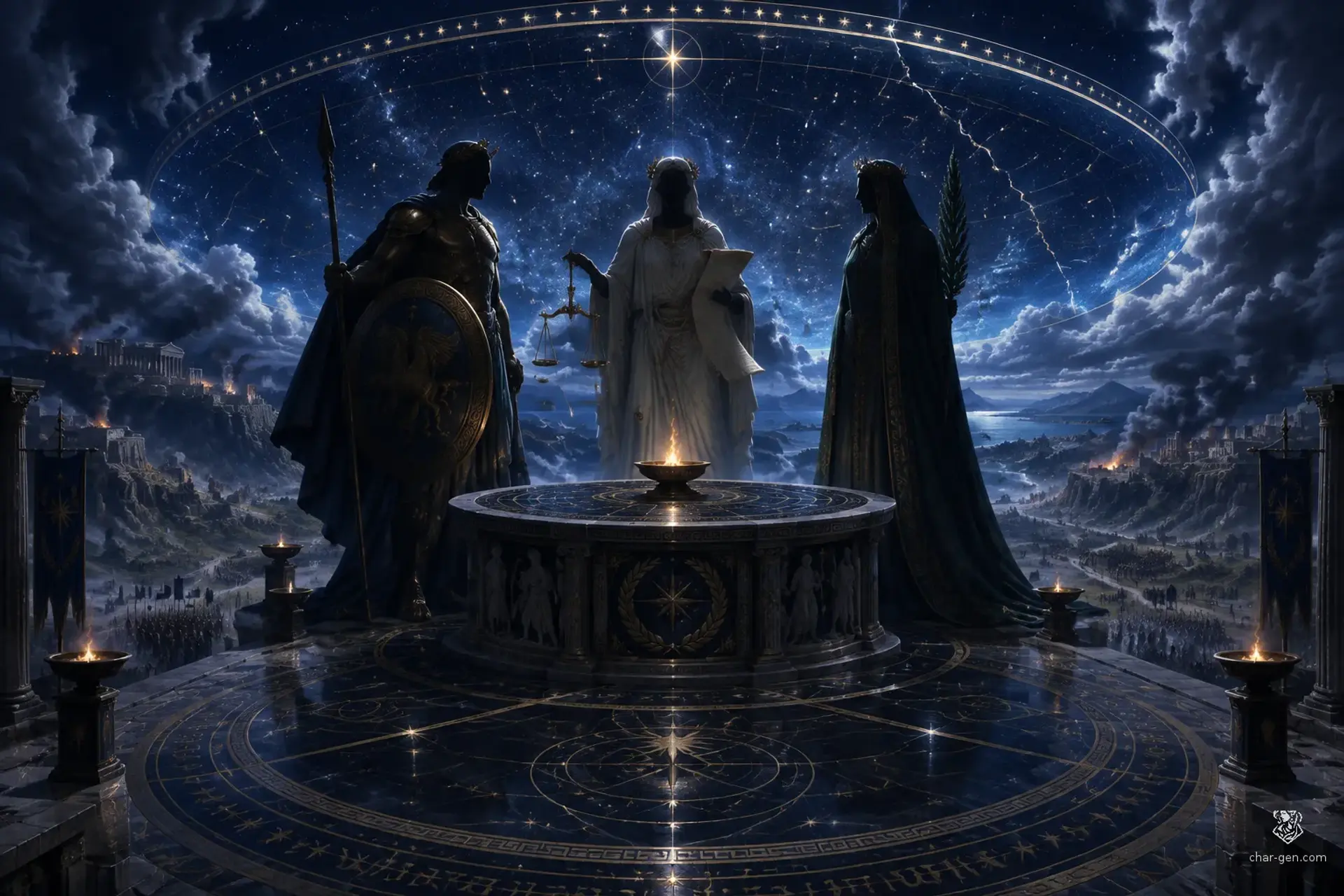
AppearanceA broad-shouldered warrior in bronze scale, crowned with a plain iron circlet. His face is scarred but calm, and his shield bears the names of cities that stood together.
Followers
WhoSoldiers, generals, city guards, mercenaries who honor their contracts, and rulers preparing for war.
BeliefsKorran's followers believe victory is a civic duty, not a private glory. They teach that Sytha's laws make armies dependable and that Meret's remembrance gives sacrifice meaning.
The faith
How it began
In the first age, when scattered tribes fought over a barren plain, Korran raised a shield against the storm, Sytha marked its rim with stars, and Meret called grass and water from beneath its shadow.
They bound themselves to govern the new world together. Their covenant gave civilization its first laws, but their unresolved arguments also gave war its enduring shape.
The heavens
The world rests upon the Shield of Heaven, forged by Korran from the first mountain.
Sytha set the stars into its rim as lamps and measures of time, while Meret breathed life into the lands beneath it. The shield is cracked by every broken oath; should it split, the mortal world will become a battlefield between the ordered heavens and the chaos beyond.
Gods and mortals
The pantheon is worshipped across rival city-states whose armies share temples, calendars, and battlefield customs even as their rulers compete.
A soldier might invoke Korran before a charge, ask Sytha to witness an oath, and pray to Meret over a fallen comrade. Temples often host both treaty negotiations and memorial rites, making them neutral ground that is respected but never entirely safe.
After death
The dead cross the Bronze Ford into the Hall of Muster, where their deeds are weighed by all three gods.
Those who kept faith with their oaths join the eternal companies; the dishonored are sent back as nameless shades until their debts are paid. Korran commands the muster, while Sytha records each soul and Meret judges its courage.
What people say, what is true
Players may hear
For the GM
Plot hooks
Conflicts
The wars
The gods agree that war must be governed by law, but their rival doctrines keep the mortal world aflame.
Korran demands decisive victory, Sytha insists that treaties and measured force preserve civilization, and Meret declares that no peace is just until the fallen are honored and the living protected. Their disputes are fought through mortal armies, contested omens, and rival interpretations of ancient vows.
| Korran | Sytha | Meret | |
|---|---|---|---|
| A | E | ||
| A | E | ||
| E | AE |
Order of heaven
Structure
The religion is called the Bronze Concord and has no single supreme priest.
Each city maintains a triad of temples governed by a Shield Prior of Korran, a Star Judge of Sytha, and a Namekeeper of Meret. In peacetime, the Star Judge usually chairs civic rites; during war, the Shield Prior directs public observances; after a disaster, the Namekeeper leads relief and mourning. Their shared festivals preserve a fragile unity among peoples otherwise divided by war.
Theme
Duty and mercy contending within a shared code; the gods make war inevitable, but demand that mortals answer for how they wage it.
Tone
Warring classical fantasy: bronze-armored armies, proud city-states, contested treaties, and sacred customs that temper violence without ending it.
Alignments
All three deities are Lawful Neutral: they uphold order, duty, and the binding force of promises, though they disagree fiercely about what those principles demand.
Media
0 imagesNo images yet.
Turn The Bronze Concord into a sheet
A high-res, share-ready sheet you can post or print.