
The Seven Far Lights
Origin
Before history, the sky was said to be empty except for one vast mind circling the world. When that mind fractured while trying to understand mortal choice, seven divine bodies emerged, each carrying one contradiction: order, mercy, record, change, freedom, secrecy, and despair. The first priests mistook the fragments for separate creators. The gods have never corrected them.
Cosmology
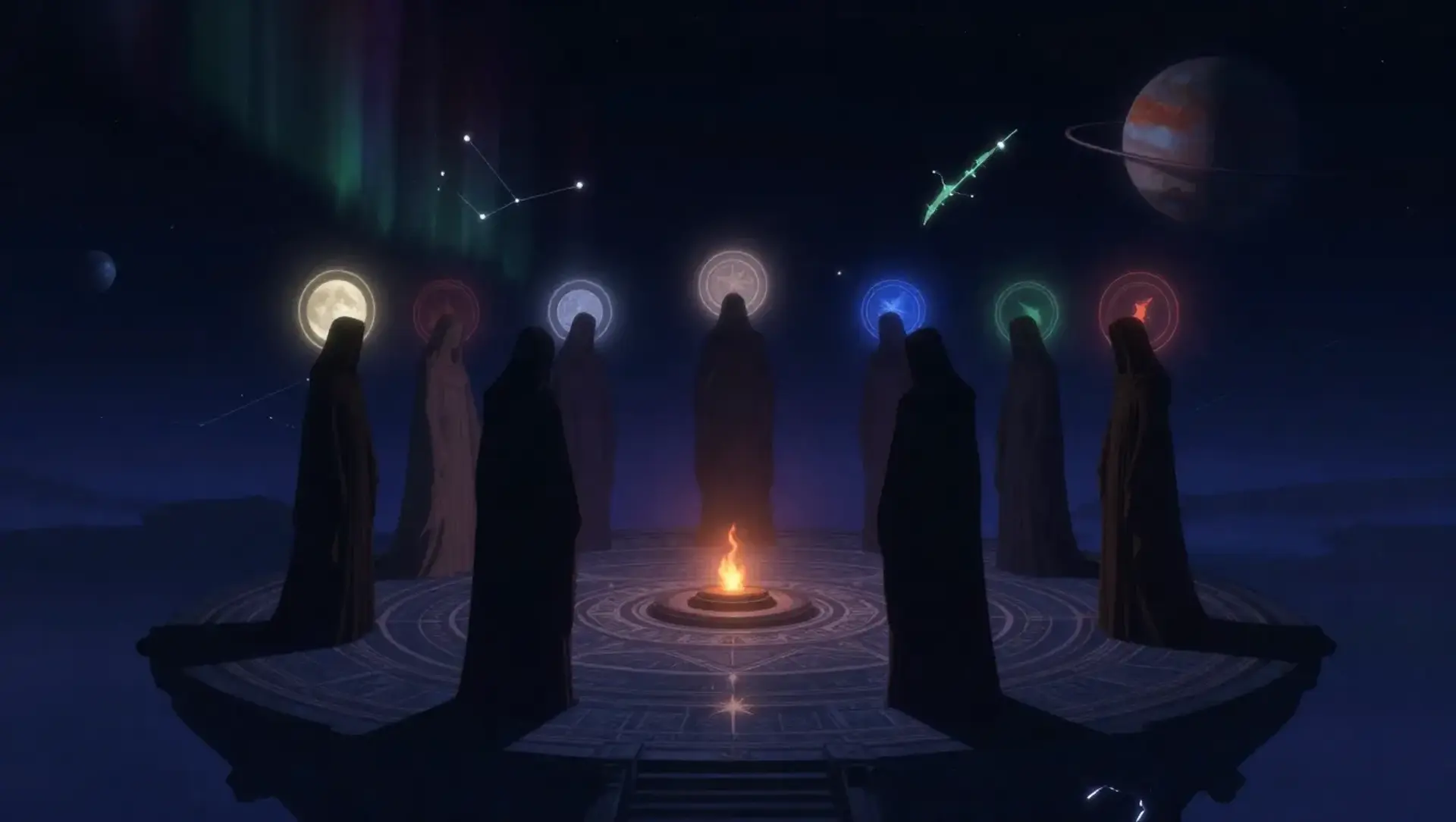
The world hangs inside the Vast Dark, a silent ocean crossed by seven divine bodies. Each deity is simultaneously a celestial presence and a will: some appear as moons or planets, others as comets, fixed stars, or wandering lights. The mortal world is the innermost sphere, circling a hidden center called the Unlit Heart. Oruneth claims the Heart is a source of law; Shaveth claims it is a sealed prison; Tovesh says neither claim can be proven.
Structure
The religion has no single hierarchy. It is a constellation of related traditions called the Far-Lighted Observance. Each temple serves one deity, but every major rite acknowledges all seven through seven lamps, seven bells, or seven marked stones. The highest religious authorities are the Keepers of Meridian, neutral astronomer-priests who maintain calendars and mediate disputes between sects. Local traditions vary widely: Bhelan's houses welcome strangers, Sahrun's sanctums preserve records, Shaveth's chapels conceal initiation chambers, and Dromai's shrines are often found in ruined settlements. Conflicts between temples are common, yet destroying another deity's shrine is considered dangerous because the celestial balance may retaliate.
Mortal Relations
Most mortals worship one primary deity while acknowledging the others through seasonal rites, oath formulas, burial customs, and navigational prayers. Temples are usually observatories, hospice-houses, courts, archives, roadside shrines, or concealed chambers rather than grand centralized cathedrals. Clerics may serve a single god, while paladins often swear to a tension between Oruneth and Bhelan, Sahrun and Shaveth, or Qoruun and Dromai. The gods are distant enough that divine magic feels like alignment with a celestial principle rather than a personal conversation.
Afterlife
The dead drift beyond the seven lights into the Far Meridian, where Sahrun records their final orbit. Souls are not judged once but gradually clarified: Tovesh strips away fear, Bhelan preserves memory, and Qoruun weighs promises. Those who find no true path become pale wanderers between the stars, visible only during eclipses.
Turn The Seven Far Lights into a sheet
A high-res, share-ready sheet you can post or print.