
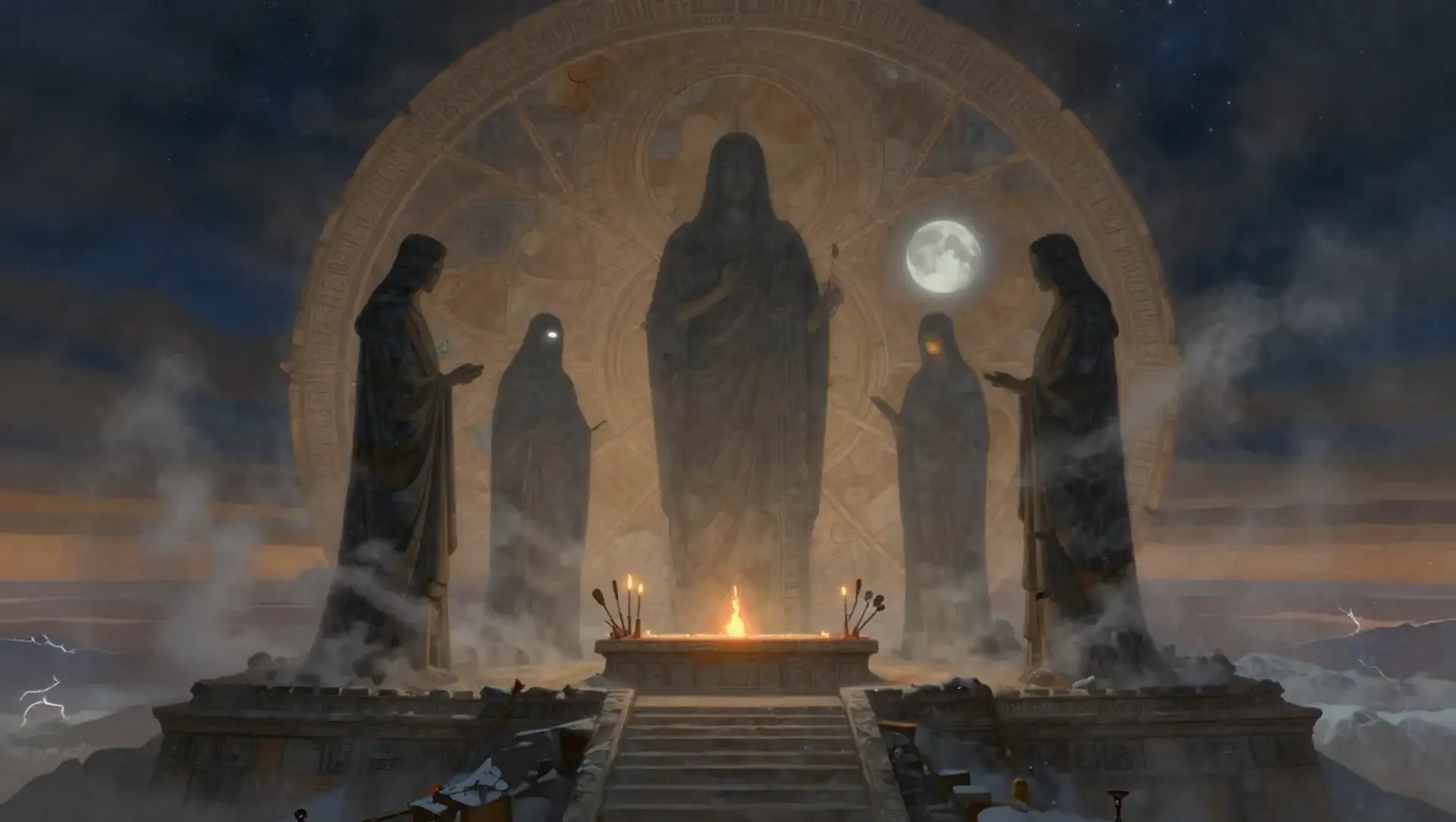
Echo of the Ancestors
Origin
The faith began after the First Banishment, when mortals awoke in a world that resembled the Elysian Fields but lacked their warmth, dead, and divine presence. Shargaas had deceived them into believing they had already inherited paradise, then turned their certainty into a prison. Gruumsh taught the first survivors to perform deeds that could not be denied. Luthic withdrew her blessing until they rebuilt bonds of kinship. Ilneval preserved their names and stories, while Bahgtru taught them to construct lasting shelters against the unreal night. The first Echo-Keepers discovered that when a deed, a story, a bond, and a crafted relic converged, the boundary to the afterlife briefly trembled.
Cosmology
Reality is layered like an immense ancestral echo. At the highest remove lies the Elysian Fields, a silent realm of perfect belonging. Beneath it lies the mortal world, severed from its source and distorted by Shargaas's illusion. Beneath the mortal world lies the Hollow, a void where discarded memories, forgotten names, and unfinished deaths collect. Divine influence travels through echoes: deeds awaken Gruumsh, kinship invokes Luthic, stories reach Ilneval, crafted works call Bahgtru, and despair opens a door for Shargaas.
Structure
The religion is a fivefold path of restoration. Gruumsh represents the deed, Luthic the bond, Ilneval the memory, Bahgtru the enduring work, and Shargaas the ever-present temptation to abandon meaning. Most communities are led by a council of five Echo-Keepers, though one may be absent if the settlement is small or the Veil of Shargaas is considered too dangerous to approach. Initiates choose a primary discipline but are expected to complete rites associated with the other four. Major religious ceremonies combine a public deed, a communal vow, a spoken account, and a lasting creation; the Shargaas station is symbolically sealed throughout. Religious disputes are resolved by asking which choice preserves the greatest number of future echoes.
Mortal Relations
The religion is organized into distant, semi-independent hearths rather than a centralized church. Each community maintains a shrine with five stations: the Eye of Gruumsh for deeds, the Hearth of Luthic for birth and death, the Veil of Shargaas kept sealed or hidden, the Archive of Ilneval for memory and teaching, and the Anvil of Bahgtru for craft and defense. Priests are called Echo-Keepers and usually serve one deity while acknowledging all five. Religious authority comes from demonstrated service, reliable testimony, and works that protect future generations. Orcs remain the faith's ancestral core, but Luthic's doctrine of chosen family welcomes non-orcs, while Ilneval and Bahgtru attract followers from nearly every culture. Public worship is restrained and solemn; dramatic acts are reserved for moments when a community must create an echo powerful enough to reach the dead.
Afterlife
The Elysian Fields are not destroyed but sealed behind a veil of ancestral memory. The dead dwell there in distant silence, watching mortal deeds as one watches stars through cloud. Those who accomplish deeds of sufficient greatness, sacrifice, or dramatic consequence may be remembered clearly enough to cross the veil. Luthic alone can forgive the ancestral sin, but Gruumsh, Ilneval, and Bahgtru teach the means by which mortals may become worthy of remembrance. Shargaas promises escape from judgment through oblivion, though his roads lead only into false afterlives and undeath.
Turn Echo of the Ancestors into a sheet
A high-res, share-ready sheet you can post or print.