
Unnamed pantheon
Unnamed pantheon
Invoke a god

Thesuun
The Uncrossed Measure
Symbol A closed circle crossed by a single line that stops just short of its edge.
Holy day The Still Interval
- Keep the boundary you have sworn to keep.
- Do not mistake a pattern for its maker.
- Measure twice before changing what cannot be restored.
The gods
5Thesuun
The Uncrossed Measure
Greater · Lawful Neutral
Law and boundaries, which Thesuun sets against Khaiveth's dissolving influence · Time's measured intervals, shared uneasily with Zhemi
Patient, exacting, and almost entirely indifferent to individual lives. Thesuun answers questions with limits rather than explanations.
Faith
- Keep the boundary you have sworn to keep.
- Do not mistake a pattern for its maker.
- Measure twice before changing what cannot be restored.
Holy dayThe Still Interval, observed at the year's darkest midnight, when no bells are rung.
Holy textThe Measure of Empty Things, a collection of diagrams whose margins contain more text than their pages.
RitesMark a boundary in chalk, then leave one segment deliberately unfinished. · Keep a silent vigil over a written oath. · At the Still Interval, record one rule that ought never be broken.
ValuesRestraint · Precision · Continuity
Look
SymbolA closed circle crossed by a single line that stops just short of its edge.
- Ivory
- Black
- Dull silver
AnimalsMoths that circle unlit lamps · Blind cave eels
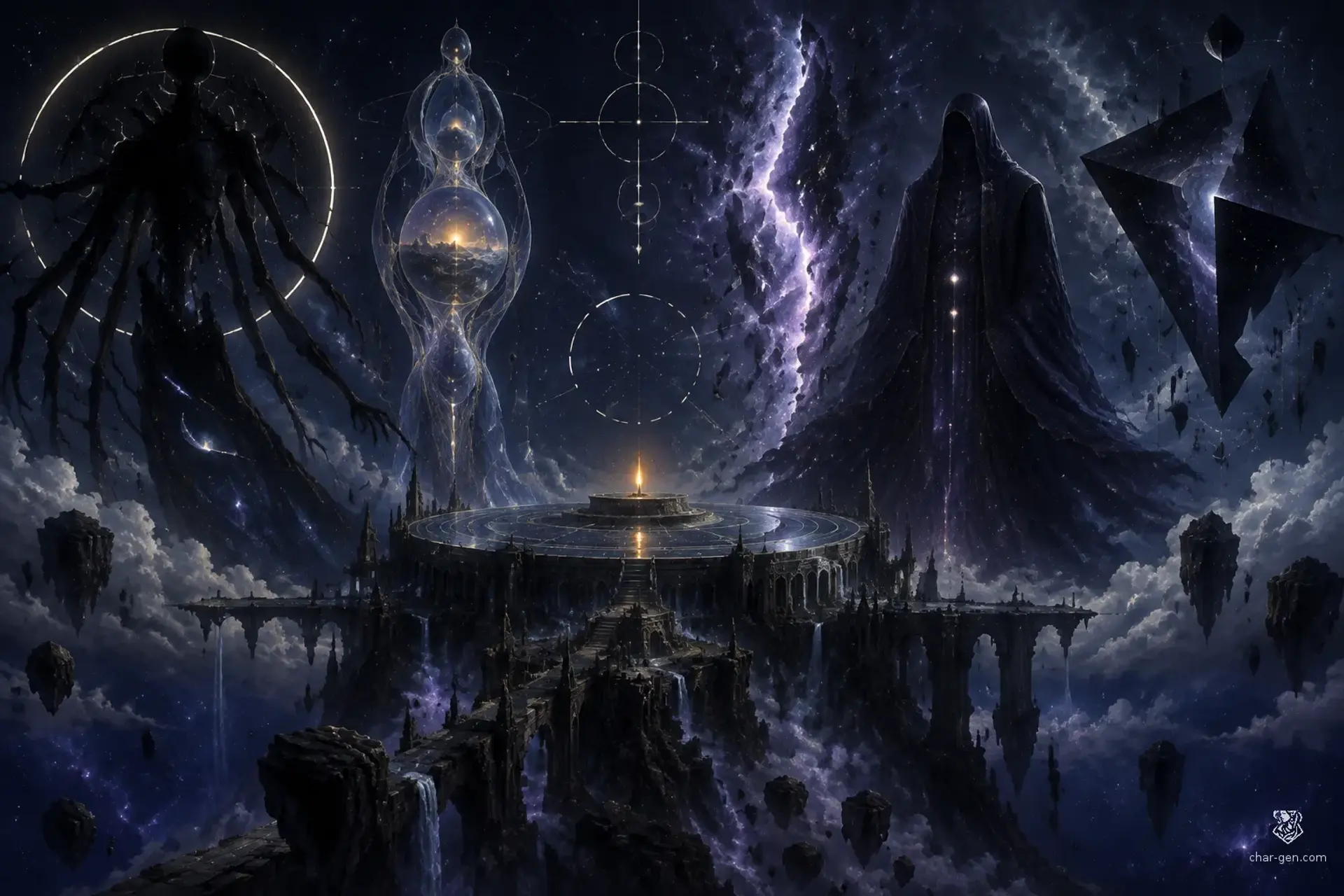
AppearanceA vast, many-jointed outline seen only where stars vanish in straight lines; a pale ring turns around its absent face.
Followers
WhoArchivists, oath-keepers, judges, and astronomers who believe that stable rules protect fragile lives.
BeliefsFollowers believe that reality survives because Thesuun maintains distinctions between things. They accept that Oruva supplies matter, but teach that matter without limits would become an undivided and uninhabitable whole.
The faith
How it began
No canonical creation story survives.
A widespread account claims that the five powers became distinguishable when the first reality separated into a world, an observer, a boundary, a living substance, and an ending. Priests disagree over whether this was a beginning or simply the first event mortals could perceive.
The heavens
Reality is a temporary agreement among five powers.
Thesuun gives it boundaries; Oruva gives it substance; Khaiveth opens its seams; Pärun receives what falls through; and Zhemi observes the whole arrangement from beyond time. None claims to have made the others, and the pantheon offers no answer to what lies outside it.
Gods and mortals
The gods do not commonly appear in person.
Their attention is inferred from impossible dreams, local changes in natural law, or sudden alterations to familiar objects. Most worshippers belong to small, independent congregations; temples are rare, and no unified clergy can claim to speak for the assembly.
After death
The dead do not travel to a realm so much as become impressions in the Quiet Margin, a border between realities watched by Pärun.
Those who lived in harmony with the pantheon may retain a faint, dreamlike selfhood; others dissolve into unrealized possibility. The gods offer no promise of reunion or reward.
What people say, what is true
Players may hear
For the GM
Plot hooks
Conflicts
The wars
Thesuun insists that creation requires stable laws, while Khaiveth delights in loosening them.
Oruva quietly repairs the damage, sometimes undoing changes Pärun made to keep the dead from disturbing the living. Zhemi urges the others to leave mortal history untouched, yet its own distant interventions have drawn Thesuun's suspicion.
| Thesuun | Oruva | Khaiveth | Pärun | Zhemi | |
|---|---|---|---|---|---|
| A | E | ||||
| A | E | A | |||
| E | E | ||||
| A | E | ||||
| A |
Order of heaven
Structure
The religion has no supreme priesthood.
Local circles tend one deity or, more commonly, observe several through household rites and seasonal customs. The Measure-Keepers of Thesuun preserve oaths and boundaries; Oruva's Open Hands maintain gardens, workshops, and places of care; Pärun's Quiet Attendants oversee funerals and records. Zhemi's readers gather privately to compare dreams, while Khaiveth's adherents are scattered and often hidden. Shared worship is possible, but each tradition keeps its own rites and does not claim that the gods are united in purpose.
Theme
A remote, uncanny pantheon whose members create, destroy, measure, mourn, and observe reality without offering mortals a reassuring cosmic purpose.
Tone
Distant and uncanny.
Divine influence is rare, indirect, and unsettling; even benevolent acts may have vast consequences that no god explains.
Alignments
Varied: two lawful, one neutral, and two chaotic deities span good, neutral, and evil.
These labels describe their dealings with mortals, not a shared moral code.
Media
0 imagesNo images yet.
Turn Unnamed pantheon into a sheet
A high-res, share-ready sheet you can post or print.