
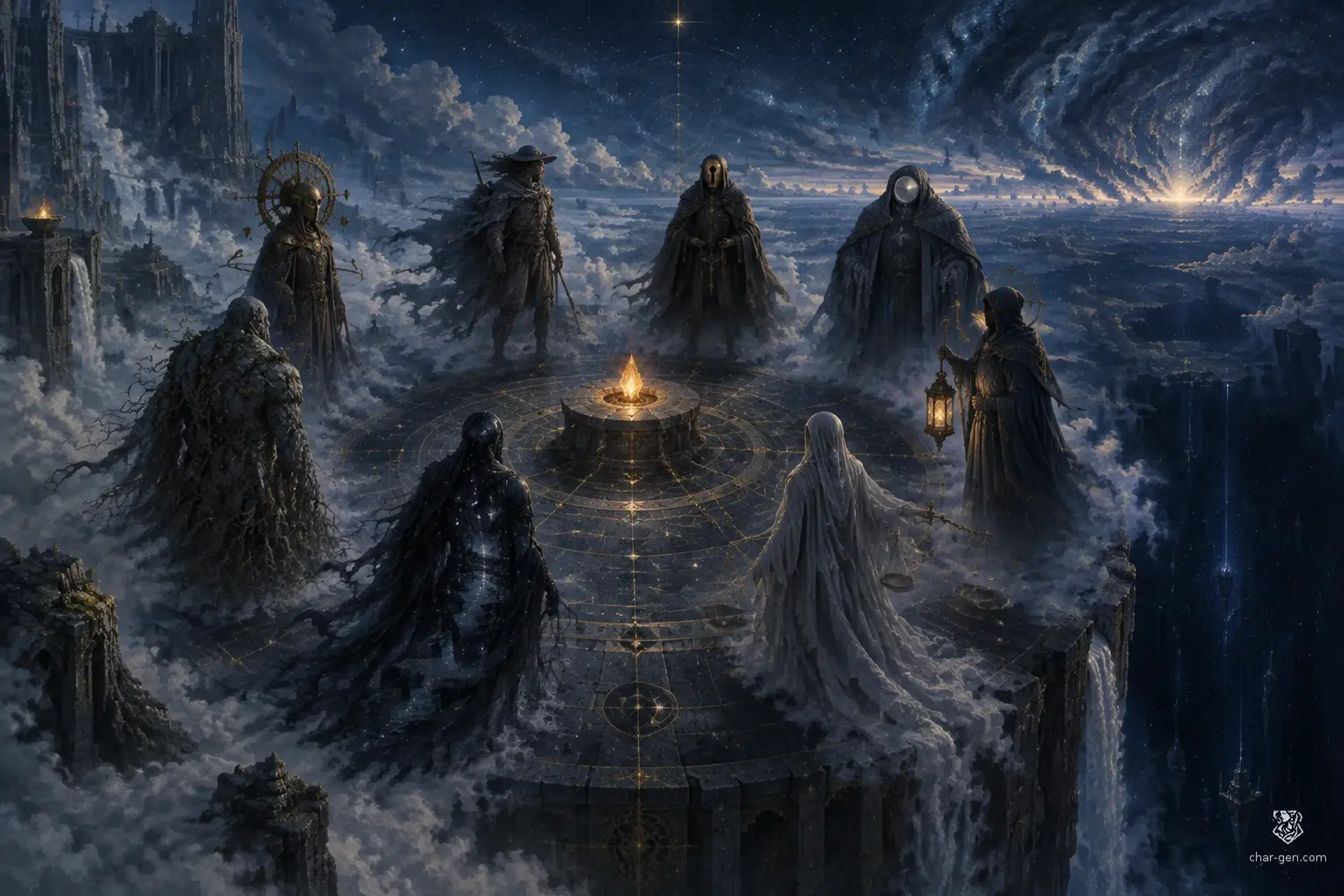
The Assembly at the Meridian
The Assembly at the Meridian
Invoke a god

Azhkel
Keeper of the Measured Hour
Symbol A ring divided by one straight, unbroken line
Holy day The Turning Mark
- Know the cost before you choose.
- A promise is a tool, not an ornament.
- Do not confuse a painful consequence with an unjust one.
The gods
8Azhkel
Keeper of the Measured Hour
Greater · Lawful Neutral
Fate and measured consequence, which Azhkel records beside Oruva's judgments · Calendars, contracts, and the thresholds where Serevi's laws are tested
Patient, exacting, and capable of genuine tenderness toward those who accept responsibility. Azhkel can also be chillingly indifferent to suffering that seems necessary to preserve a larger pattern.
Faith
- Know the cost before you choose.
- A promise is a tool, not an ornament.
- Do not confuse a painful consequence with an unjust one.
Holy dayThe Turning Mark, held at the year's first new moon, when contracts are renewed or deliberately broken.
Holy textThe Ledger of Unfinished Hours
RitesMark a chosen date on a strip of bronze and keep it until the intended work is done. · At a crossroads, state aloud one consequence you are willing to accept. · Leave a blank line in important records for a future correction.
ValuesAccountability · Continuity · Deliberation
Look
SymbolA ring divided by one straight, unbroken line
- Bronze
- Dusk blue
AnimalsCrane · Mole
AppearanceAzhkel appears as a tall figure in a segmented bronze mask, with a narrow ring of tiny gears turning behind the head. Its shadow always points toward the nearest crossroads.
Followers
WhoJudges, record-keepers, navigators, and people who must make decisions affecting many others.
BeliefsFollowers believe Azhkel can reveal the shape of a choice but never remove the burden of making it. They often consult Ilyume's signs when the Ledger offers more than one possible future.
The faith
How it began
According to the oldest temple account, the eight met at the edge of the Still Meridian when the first mortal asked why the world had no single keeper.
They divided its unanswered questions among themselves rather than appointing a ruler. Azhkel claimed consequence, Ilyume possibility, Tovek secrets, Serevi common duty, Nemei passage, Oruva judgment, Vask memory, and Khorun the ground beneath every choice. Whether this was a pact, a convenience, or a dispute that never ended is unclear.
The heavens
The world is a small, inhabited ledge between the High Quiet, where the gods convene, and the Deep Unmaking, which erases names, memories, and eventually matter.
The eight deities did not create existence from nothing; they found it already turning and divided its burdens among themselves. The sky is the ceiling of the High Quiet, the sea a dark mirror of the Deep Unmaking, and every mortal life briefly bridges the two.
Gods and mortals
The gods rarely answer prayers directly.
Their influence arrives through dreams, weather, coincidence, recovered memories, and the choices of mortal institutions. Temples usually honor the whole assembly while emphasizing one patron; most clergy acknowledge the others as necessary powers, not rivals to be denied. A village may ask Serevi for fair law, Nemei for safe mourning, and Khorun for sound foundations without expecting the gods to agree about what the village needs.
After death
The dead travel to the Still Meridian, a vast shore beneath a starless sky.
There, Oruva weighs no soul; instead, the deceased choose a road. Those who seek rest follow Nemei into quiet gardens, those who seek answers descend toward Vask, and those who cannot choose remain as faint lights on the horizon. The gods may guide or obstruct these passages, but none can claim the dead outright.
What people say, what is true
Players may hear
For the GM
Plot hooks
Conflicts
The wars
Azhkel wants to bind the unpredictable tides of fate, while Ilyume insists that uncertainty is a necessary freedom.
Tovek sells secrets that Vask would rather keep buried. Nemei protects the dead from Oruva's uncompromising judgment, though Oruva believes mercy can become a second injustice. Khorun and Serevi contest whether civilization should be defended or allowed to change beyond recognition. These rivalries are old, but none has become an open divine war.
| Azhkel | Ilyume | Tovek | Serevi | Nemei | Oruva | Vask | Khorun | |
|---|---|---|---|---|---|---|---|---|
| E | E | A | A | |||||
| E | A | A | E | |||||
| AE | E | A | ||||||
| A | E | E | A | |||||
| A | A | E | E | |||||
| A | E | E | A | |||||
| A | A | E | E | |||||
| A | E | A | E |
Order of heaven
Structure
The religion has no central church.
It is organized into local houses of the Meridian, each maintaining a shared shrine with eight distinct places of observance. A house may specialize in one deity, but its keeper is expected to know the rites of all eight. Councils of clergy gather irregularly to settle disputes over doctrine; their decisions bind only those who accept them. Pilgrims often travel between houses to mark major life transitions, and mixed rites are common.
Theme
The gods are neither entirely good nor entirely evil in their personalities.
Each possesses virtues and failings, and each can help mortals for reasons that are noble, selfish, or difficult to separate.
Tone
Distant and contemplative.
Divine presence is real but seldom intimate; signs are ambiguous, miracles uncommon, and the gods' motives remain only partly legible.
Alignments
The assembly ranges from compassionate and principled to selfish, unpredictable, and cruel.
No alignment is treated as a guarantee of kindness: even benevolent gods can demand painful sacrifices, while hostile ones may honor a bargain faithfully.
Media
0 imagesNo images yet.
Turn The Assembly at the Meridian into a sheet
A high-res, share-ready sheet you can post or print.