
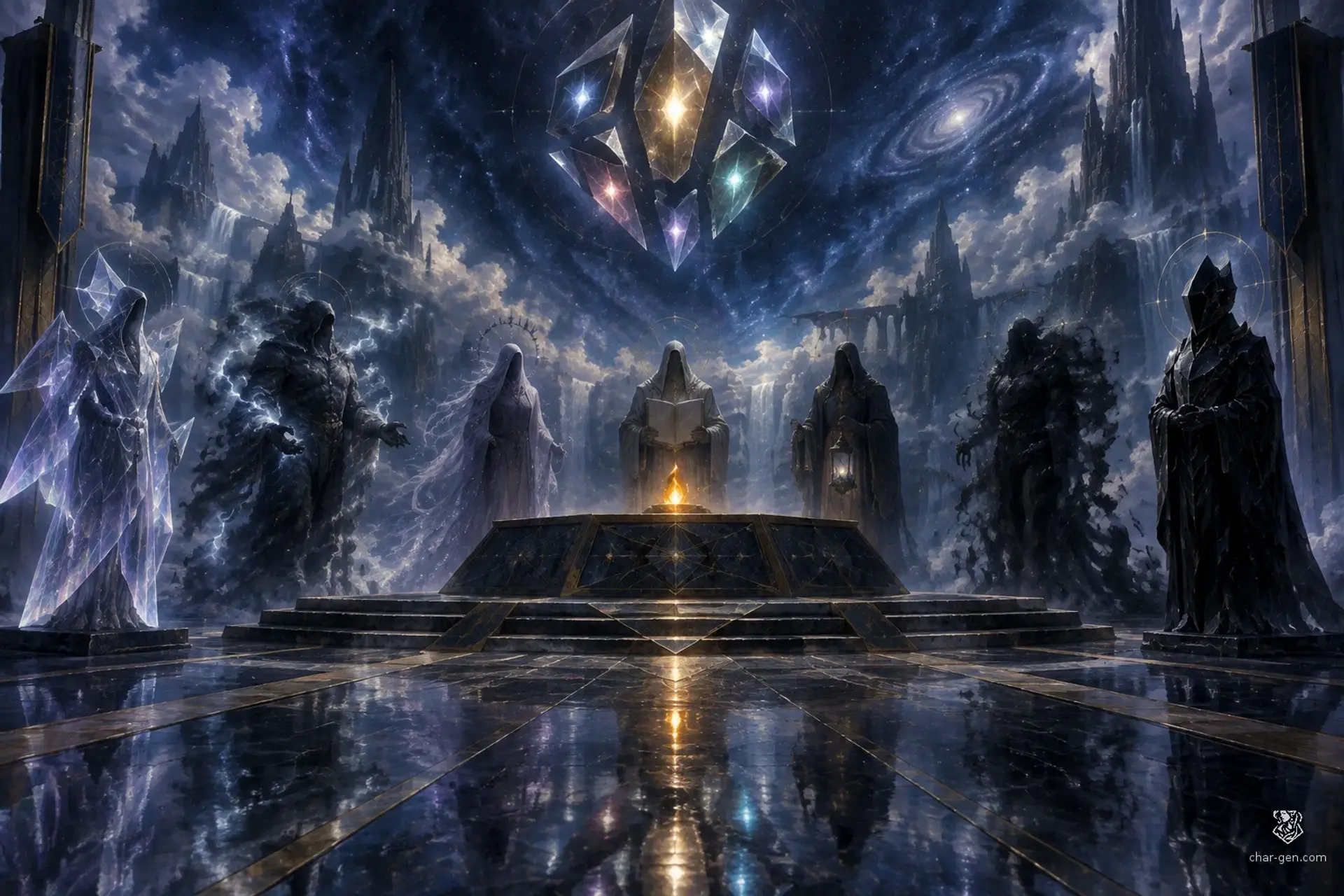
The Sevenfold Remnant
The Sevenfold Remnant
Invoke a god

Varkesh
The First Edge
Symbol A straight line dividing a circle of many colors.
Holy day The First Edge
- Give each thing a boundary it can keep.
- Do not mistake freedom from limits for freedom.
- Make no promise whose shape you cannot sustain.
The gods
7Varkesh
The First Edge
Greater · Lawful neutral
Creation’s first boundary, set against Zsenn’s unmaking · Form and measure, recorded by Suthra
Patient, remote, and exacting; Varkesh treats limits as the conditions that let anything exist.
Faith
- Give each thing a boundary it can keep.
- Do not mistake freedom from limits for freedom.
- Make no promise whose shape you cannot sustain.
Holy dayThe First Edge, observed at the turning of the year with a silent procession around a seven-sided stone.
Holy textThe Measure at the Rim
RitesMark a threshold in silence before beginning important work. · Set seven stones in a line to settle disputes over land or duty.
ValuesMeasure · Continuity · Responsibility
Look
SymbolA straight line dividing a circle of many colors.
- Vermilion
- Clear
AnimalsIbex · Crane
AppearanceA tall figure of translucent planes, each face reflecting a different horizon; its features are always just beyond focus.
Followers
WhoSurveyors, judges, builders, and those who must make difficult distinctions.
BeliefsVarkesh’s followers believe that the world survives because its parts are distinct, and that even compassion needs a clear shape to endure.
The faith
How it began
Before time, the Prism Eternal held all emotions, elements, and possible futures within one consciousness.
When it shattered, seven great facets became the deities now named by mortals. Their fragments seeded the world, but none retained the whole memory of what happened.
The heavens
The Prism Eternal contained all possible worlds within a single consciousness.
When it shattered, its seven greatest facets became deities, while lesser splinters became matter, time, feeling, and unrealized possibilities. The void remains beyond creation: not evil, but profoundly indifferent. The gods shape the world from afar, and their attention is as rare as it is consequential.
Gods and mortals
The gods rarely answer prayer directly.
Their influence appears as coincidences, dreams, altered weather, or a sudden inability to ignore a choice. Temples function as quiet civic institutions: keeping records, tending the dead, marking boundaries, and sheltering those displaced by change. Clergy disagree openly about the Shattering and do not claim a single authorized interpretation.
After death
At death, a soul becomes a shard of color and drifts beyond mortal sight.
The faithful say the shards gather around Suthra, who weighs no one, but keeps their last memories from dissolving. Some shards return as new lives; others remain distant stars. No priest can promise which fate awaits.
What people say, what is true
Players may hear
For the GM
Plot hooks
Conflicts
The wars
The pantheon’s oldest dispute is whether the Shattering was a sacrifice or an escape.
Varkesh insists that separation made existence possible; Oruq mourns the lost unity. Suthra preserves evidence neither can comfortably claim. The conflict between Varkesh and Oruq is contained by Ilyat’s measured laws, though Zsenn’s storms repeatedly undo their careful boundaries.
| Varkesh | Zsenn | Oruq | Ilyat | Suthra | Khez | Draz | |
|---|---|---|---|---|---|---|---|
| E | E | A | A | ||||
| E | A | E | |||||
| E | A | A | E | ||||
| A | E | A | E | ||||
| A | E | A | E | ||||
| A | E | A | E | ||||
| A | E | E | A |
Order of heaven
Structure
The faith has no supreme priesthood.
Seven traditions maintain separate sanctuaries, with local councils convening only when concerns overlap. A council’s decisions are advisory, and disagreement is considered an honest echo of the original Shattering. Lay custodians, rather than ordained authorities, usually oversee communal rites.
Theme
The Shattering of the Prism: creation emerged when a singular, all-containing consciousness broke into seven facets.
Difference makes the world possible, but no facet can restore the whole.
Tone
Distant and contemplative: divinity is immense, difficult to interpret, and rarely intimate.
The gods shape mortal life through echoes and consequences rather than direct intervention.
Alignments
Varied: two lawful, two neutral, two chaotic, and one neutral-evil deity.
The Prism’s fragments retained incompatible impulses, and the faith does not claim they reconcile.
Media
0 imagesNo images yet.
Turn The Sevenfold Remnant into a sheet
A high-res, share-ready sheet you can post or print.