
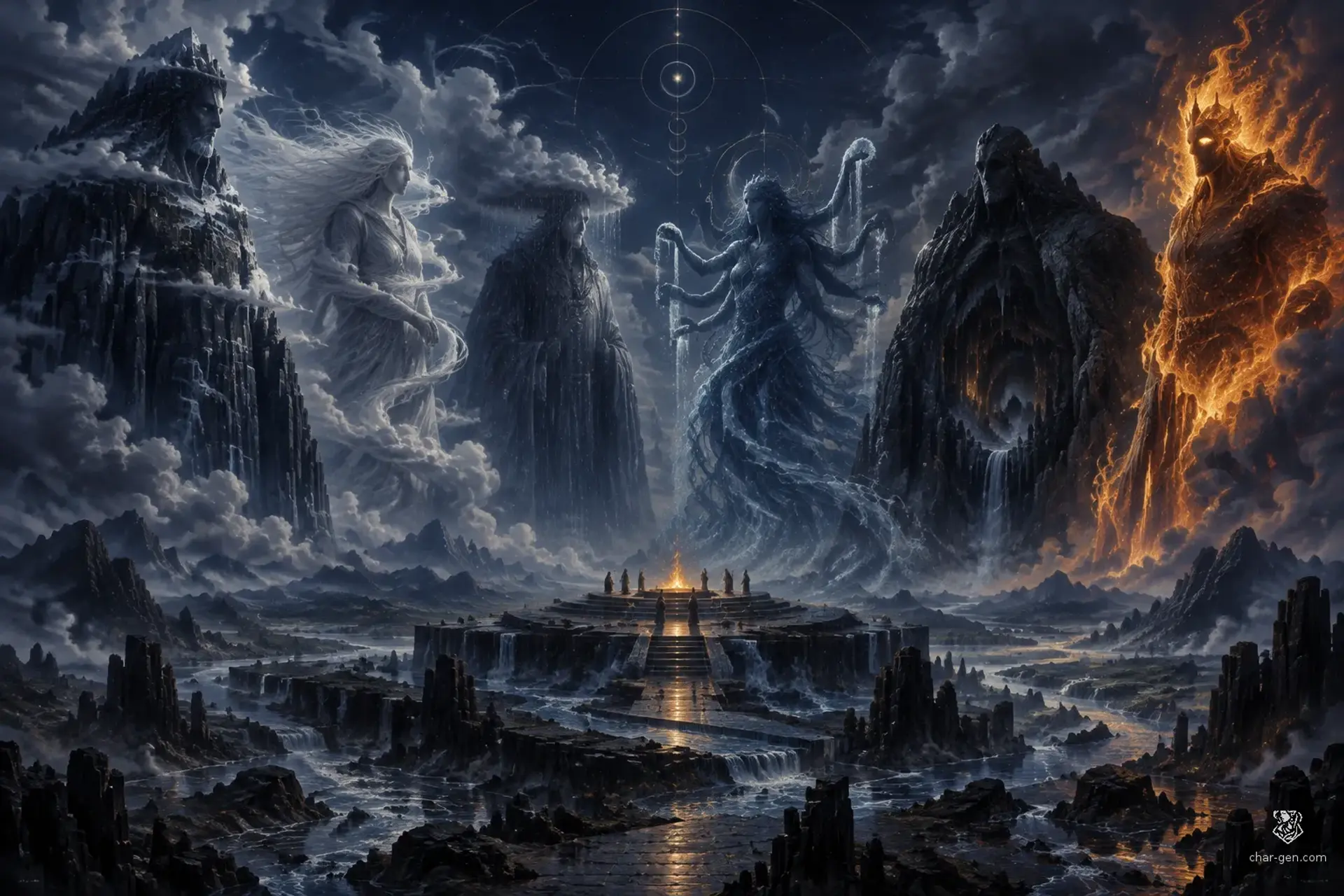
The Sixfold Vast
The Sixfold Vast
Invoke a god

Kesh
The Unmoved Foundation
Symbol A square split by a descending, uneven line.
Holy day The Still Measure
- Endure without mistaking endurance for virtue.
- Build with respect for what was already here.
- Do not demand that the land remember you.
The gods
6Kesh
The Unmoved Foundation
Greater · True Neutral
Earth and endurance; Kesh raises the ground that Tömür’s waters divide and that Yelai’s fires reshape.
Patient beyond comprehension, neither kind nor cruel. Kesh treats a city and a fallen pebble as changes of comparable scale, though Oruun alone can persuade Kesh to remember a particular ruin.
Faith
- Endure without mistaking endurance for virtue.
- Build with respect for what was already here.
- Do not demand that the land remember you.
Holy dayThe Still Measure, observed when the first frost settles; worshippers sit in silence until dawn.
Holy textThe Layers Without End, a collection of stone rubbings whose order changes as the rock erodes.
RitesPress a palm to bedrock before beginning construction. · Leave one foundation stone unworked. · Record a landslide without assigning blame.
ValuesPatience · Continuity · Weight
Look
SymbolA square split by a descending, uneven line.
- Basalt gray
- Quartz white
AnimalsMountain goat · Blind cave salamander
AppearanceA horizon-high figure of stratified slate, with ridges for shoulders and seams of quartz that slowly migrate across its body. Kesh’s shadow falls differently in every age.
Followers
WhoStonecutters, miners, architects, hermits, and communities who settle near old fault lines.
BeliefsFollowers believe Kesh neither protects settlements nor punishes trespass; a mountain’s stability is a condition, not a promise. They look to Oruun for signs of what lies under the oldest stone.
The faith
How it began
The oldest account says the continent emerged where six elemental powers pressed against one another.
Kesh hardened the first ground, Tömür found its low places, Suyana gathered above it, Veyru crossed the open sky, Oruun smoldered beneath, and Yelai flared wherever those forces met. The account insists that these are not events in a sequence: each power was already present when the others became visible.
The heavens
The continent rests on the sleeping body of no creator; it is simply a place where six vast powers meet.
Kesh raises and fractures the land, Suyana draws vapor into cloud, Tömür carries water through every hollow, Veyru moves air and weather, Oruun holds the buried heat, and Yelai kindles flame and renewal. None made the others, and none can end them. Time is an effect of their changing contact, not a force they command.
Gods and mortals
The gods rarely answer prayers in words, and signs are usually ambiguous: a dry riverbed, a sudden gust, a warm stone.
Worship is less a bargain than a practice of living alongside forces too large to negotiate with. Priests tend watersheds, fires, quarries, and weather records; they are valued as interpreters and stewards, not as agents who can command divine intervention.
After death
The dead do not travel to a single kingdom.
Their memories loosen into the continent’s elements: some become warmth in the deep stone, some mist over the eastern sea, some a brief wind through grass. The gods do not judge this passage. Priests say that Oruun keeps no ledger, while Suyana sometimes carries a mortal’s name far enough for the living to hear it once more.
What people say, what is true
Players may hear
For the GM
Plot hooks
Conflicts
The wars
Kesh and Oruun contend over whether old stone should endure or be broken into new ground.
Suyana’s rains feed Tömür’s rivers, yet Tömür resents how the sea takes them back. Veyru’s winds scatter the ash that Kesh would settle, and Oruun’s long silences frustrate Suyana, who hears every lost name.
| Kesh | Veyru | Suyana | Tömür | Oruun | Yelai | |
|---|---|---|---|---|---|---|
| E | A | A | E | |||
| E | A | E | A | |||
| A | A | E | ||||
| A | A | E | ||||
| A | E | E | A | |||
| E | A | E | A |
Order of heaven
Structure
The religion has no central church or universal hierarchy.
Local shrines are tended by keepers, seasonal councils, and traveling interpreters who maintain records of elemental signs. Sixfold assemblies meet rarely, usually after a disaster, and their decisions are advisory. Many communities honor all six while giving special attention to the element on which their livelihood depends.
Theme
Elemental divinities are immense, enduring presences whose interactions shape a continent and its sense of time, while mortal lives remain brief, meaningful locally, and cosmically unremarked.
Tone
Distant and contemplative.
Divine signs are real but seldom personal; landscapes, seasons, and slow geological changes express the gods more reliably than miracles or direct speech.
Alignments
The six range from lawful to chaotic and from good to evil, with most standing outside mortal moral categories.
Their alignments describe how their power tends to behave, not how much they care about mortals.
Media
0 imagesNo images yet.
Turn The Sixfold Vast into a sheet
A high-res, share-ready sheet you can post or print.