
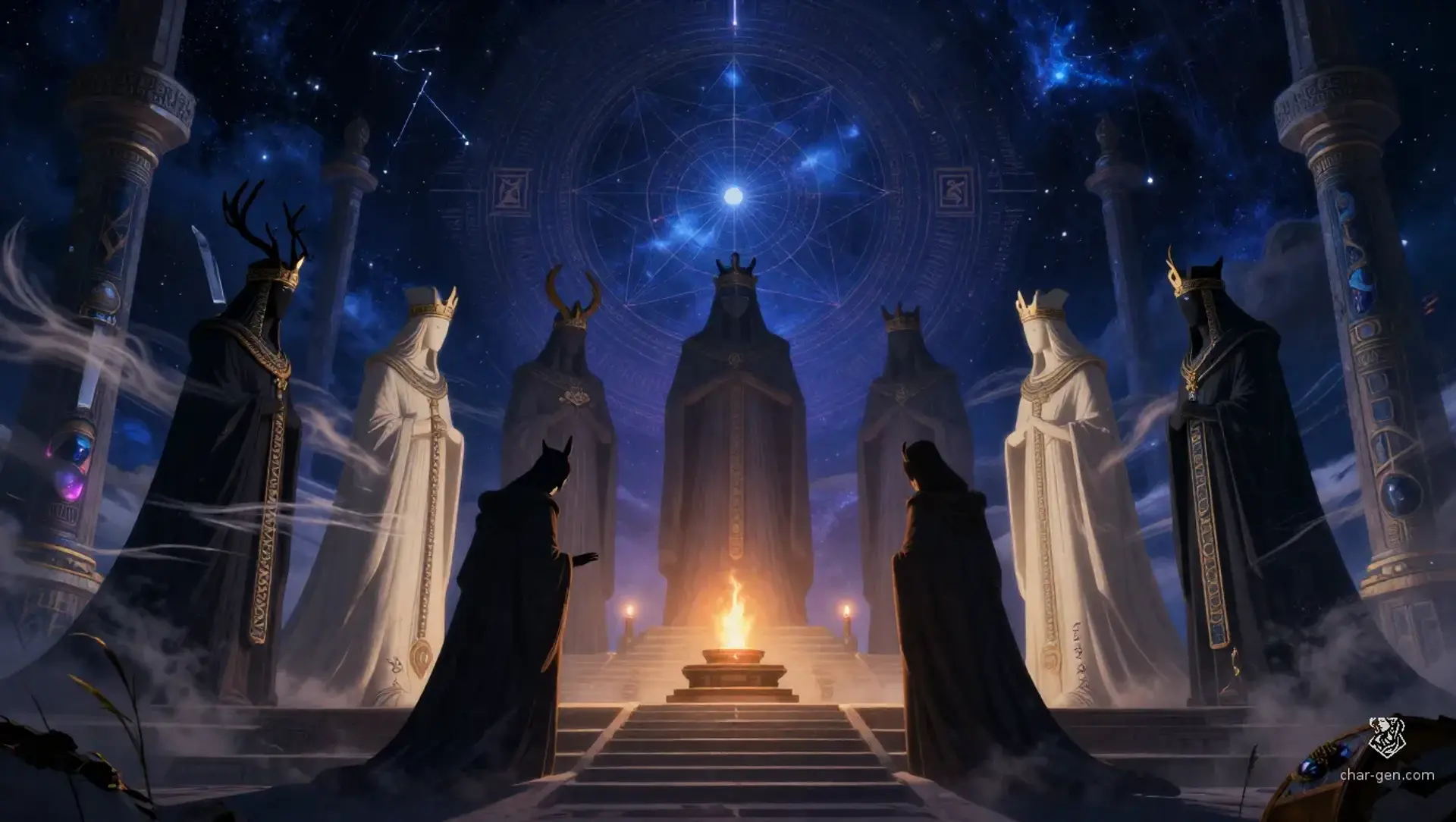
The Ninefold Covenant
Origin
The religion began when the first river settlements discovered nine divine signs carved into a black meteorite: an eye, antlers, a cord, a crooked blade, an open bowl, a doorway, a lightning fork, a sealed jar, and a broken pillar. The signs were interpreted as the covenant between mortal communities and the powers that shaped their world. No single prophet founded the faith; instead, its earliest traditions emerged from hunters, mourners, judges, healers, and farmers comparing visions across distant lands.
Cosmology
In the beginning there was the Silent Expanse, until Ketuq struck the darkness with a stone of blue fire. The impact became the sun, the moon, and the nine divine sparks. Ogtak shaped the first laws from the stone's straight edges; Tazri filled them with memory; Sanku poured water through their gaps; Ilyat breathed life into the wet clay; Drek cracked it open so choice could exist; Zun scattered its fragments into wild places; Vask taught all things to end; and Ghoru hid beneath the first shadow, feeding on what the gods refused to name. The world is therefore both crafted order and sacred accident.
Structure
The religion is a covenant tradition rather than a centralized church. Its sacred communities are called Circles, each led by a council of specialized keepers: a Line-Keeper for Tazri, a Herd-Keeper for Ketuq, a Knot-Reader for Ogtak, a Spark-Speaker for Drek, a Well-Mother or Well-Father for Sanku, a Road-Keeper for Ilyat, a Storm-Caller for Zun, a Jar-Bearer for Ghoru, and a Pillar-Warden for Vask. Most Circles omit Ghoru's keeper publicly but maintain hidden rites to guard against his influence. Major decisions require three voices: one for the living, one for the dead, and one for what has not yet happened. Festivals, funerals, judgments, harvests, initiations, and rebellions all invoke different combinations of the Nine.
Mortal Relations
The gods are physically present in the world through avatars, sacred animals, ancestral dreams, weather, omens, and rare direct appearances. Temples are usually communal compounds containing shrines to several allied deities. Tazri's courts, Ketuq's seasonal festivals, Sanku's public wells, Ilyat's burial roads, and Drek's hidden meeting houses are common institutions. Ogtak and Vask are respected even by those who fear them, while Ghoru's cults infiltrate guilds, prisons, noble estates, and famine-struck settlements. Mortal priests often mediate divine conflicts rather than merely preaching obedience.
Afterlife
The dead travel through the Ninefold Current, guided by Ketuq along the star-road. At the Gate of Weighing, Ogtak measures each soul against the deeds remembered by Tazri. The worthy enter the Reed-Circle, where they hunt, feast, craft, and counsel the living through dreams. Those who betrayed every bond are claimed by Ghoru and dissolved into the First Dark, though even there Vask keeps watch for a spark of repentance. Souls chosen by Ilyat become ancestral guardians, while the restless may be bound into service by priests of Tazri or released by the mercies of Sanku.
Turn The Ninefold Covenant into a sheet
A high-res, share-ready sheet you can post or print.