
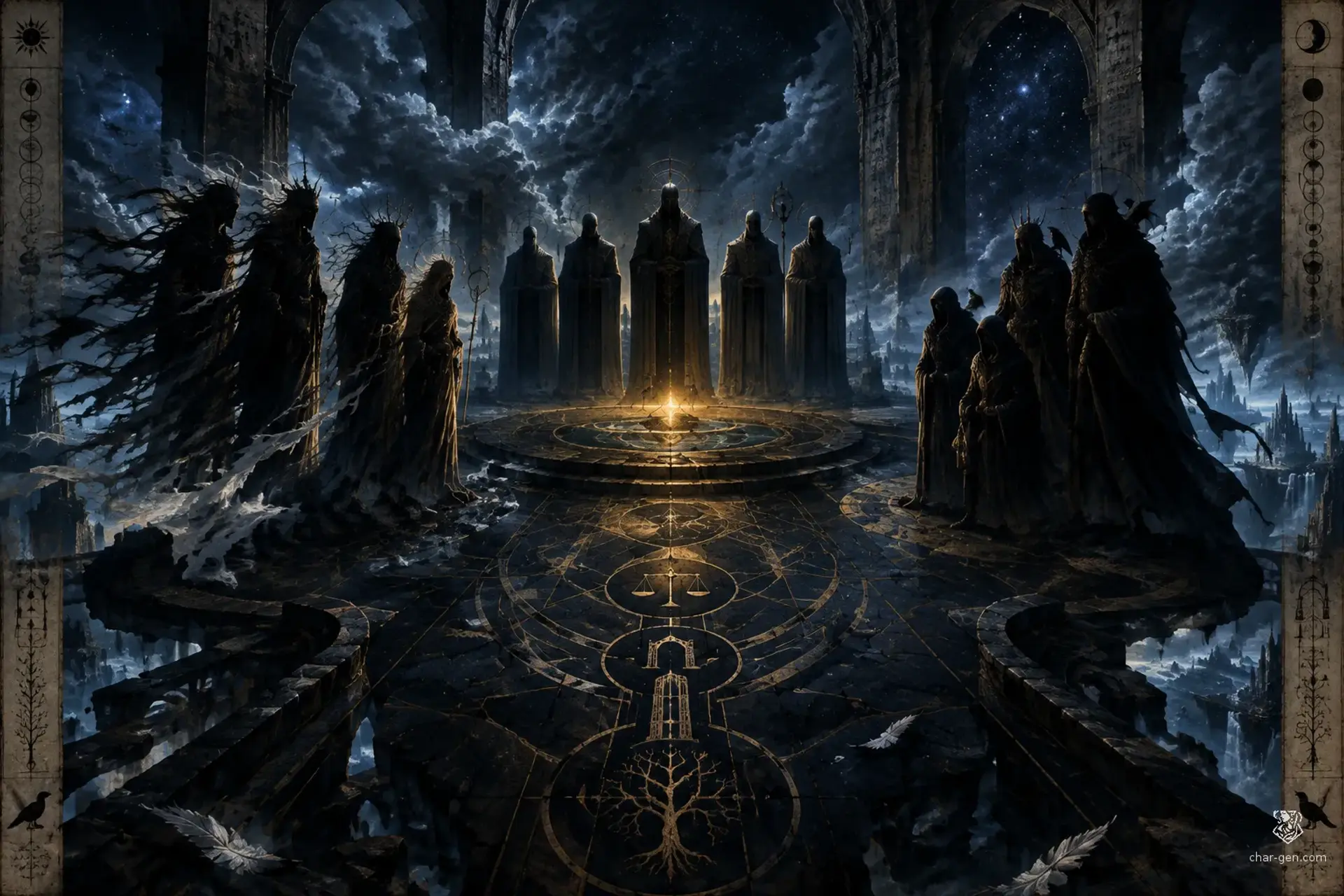
The Unsettled Twelve
The Unsettled Twelve
Invoke a god

Auvessa
She Who Loosens
Symbol A broken circle crossed by three wind-lines.
Holy day The Unmooring
- Do not mistake a boundary for a truth.
- Let the old structure fall when it cannot bend.
- Never promise what the wind may carry away.
The gods
12Auvessa
She Who Loosens
Greater · Chaotic Neutral
Storms and upheaval; her gales regularly test Edrik's borders.
Restless and remote, she prizes change without promising improvement. She admires Brzhal's appetite for destruction but distrusts his wish to rule what remains.
Faith
- Do not mistake a boundary for a truth.
- Let the old structure fall when it cannot bend.
- Never promise what the wind may carry away.
Holy dayThe Unmooring, observed when the first autumn gale tears something loose.
Holy textThe Unwritten Gale
RitesRelease a written grievance into the wind. · Leave one door or shutter unlatched during a storm.
Valueschange · freedom · disruption
Look
SymbolA broken circle crossed by three wind-lines.
- storm-white
- violet
Animalskite · moth
AppearanceA many-veiled figure whose face is alternately a storm cloud, a laughing mask, or empty sky.
Followers
WhoExiles, sailors, rebels, and people whose homes have already been swept away.
BeliefsHer followers believe that fixed arrangements eventually become cages, though many accept that freedom can be cruel.
The faith
How it began
In the oldest account, the world was a dark plain without roads or borders.
Auvessa opened it with a gale, Edrik marked the torn edges, and Iorun claimed that the first shelter belonged to those who had built it. The remaining gods arrived as competing answers to the question of who should survive what came next. The account is disputed by every temple.
The heavens
The world was not created so much as caught between three vast impulses: the unraveling, the binding, and the claim of each people to survive.
Auvessa opened the first breach in the dark; Edrik set a boundary around it; Iorun declared that neither act belonged to all peoples equally. The heavens remain a cold, distant architecture of rival jurisdictions.
Gods and mortals
The gods seldom answer prayer directly.
Their shrines offer omens, disputed laws, practical bargains, and dangerous relics rather than reliable miracles. Communities generally favor one or two powers according to local need, while priests, rulers, and adventurers negotiate across rival temples. A village may honor Gwelan for its crops, Haskel for its gates, and still leave a coin for Kesh when the harvest fails.
After death
The dead drift first to the Grey Margin, where Edrik's measures weigh their deeds and Auvessa's winds try to scatter their names.
Those claimed by a deity pass into that power's remote domain; the rest become dim lights beyond the world. Iorun teaches that no judge can say whether this is mercy or mere indifference.
What people say, what is true
Players may hear
For the GM
Plot hooks
Conflicts
The wars
Auvessa's storms unravel Edrik's decrees, while Brzhal's fires threaten Haskel's ordered granaries.
Cethryn and Fhoss contest who may name the dead. Drazh and Gwelan struggle over whether borders are sacred or merely useful. The neutral powers—especially Iorun, Jorvath, Kesh, and Luthair—shift their support according to the safety and advantage of their own peoples.
| Auvessa | Brzhal | Cethryn | Drazh | Edrik | Fhoss | Gwelan | Haskel | Iorun | Jorvath | Kesh | Luthair | |
|---|---|---|---|---|---|---|---|---|---|---|---|---|
| A | E | E | A | |||||||||
| A | A | E | E | |||||||||
| A | E | E | A | |||||||||
| A | A | E | E | |||||||||
| E | E | A | A | |||||||||
| E | A | A | E | |||||||||
| E | E | A | A | |||||||||
| E | E | A | A | |||||||||
| A | E | E | A | |||||||||
| E | E | A | A | |||||||||
| A | E | E | A | |||||||||
| E | A | A | E |
Order of heaven
Structure
There is no central church.
The Twelve are arranged in three rival tendencies—Unbinding, Measure, and Near Claim—rather than a unified hierarchy. Temples are local, priesthoods are small, and doctrine is preserved in competing ledgers, chants, and customs. Edrik's judges seek common measures, while the neutral cults insist that no law can erase a people's obligations to its own. Greater deities command wide, impersonal influence; lesser powers and demigods are more likely to appear in local legend or through a relic.
Theme
Chaos, law, and the hard neutrality of peoples who place their own survival before the claims of strangers.
Tone
Distant, grim, and morally unsettled.
The gods are real but rarely kind, and their rivalries offer no guarantee that mortal suffering serves any higher purpose.
Alignments
Four deities embody chaos, four embody law, and four are neutral powers who put themselves and their own peoples first.
The balance is deliberate: no faction can prevail without bargaining, betrayal, or mortal intervention.
Media
0 imagesNo images yet.
Turn The Unsettled Twelve into a sheet
A high-res, share-ready sheet you can post or print.