
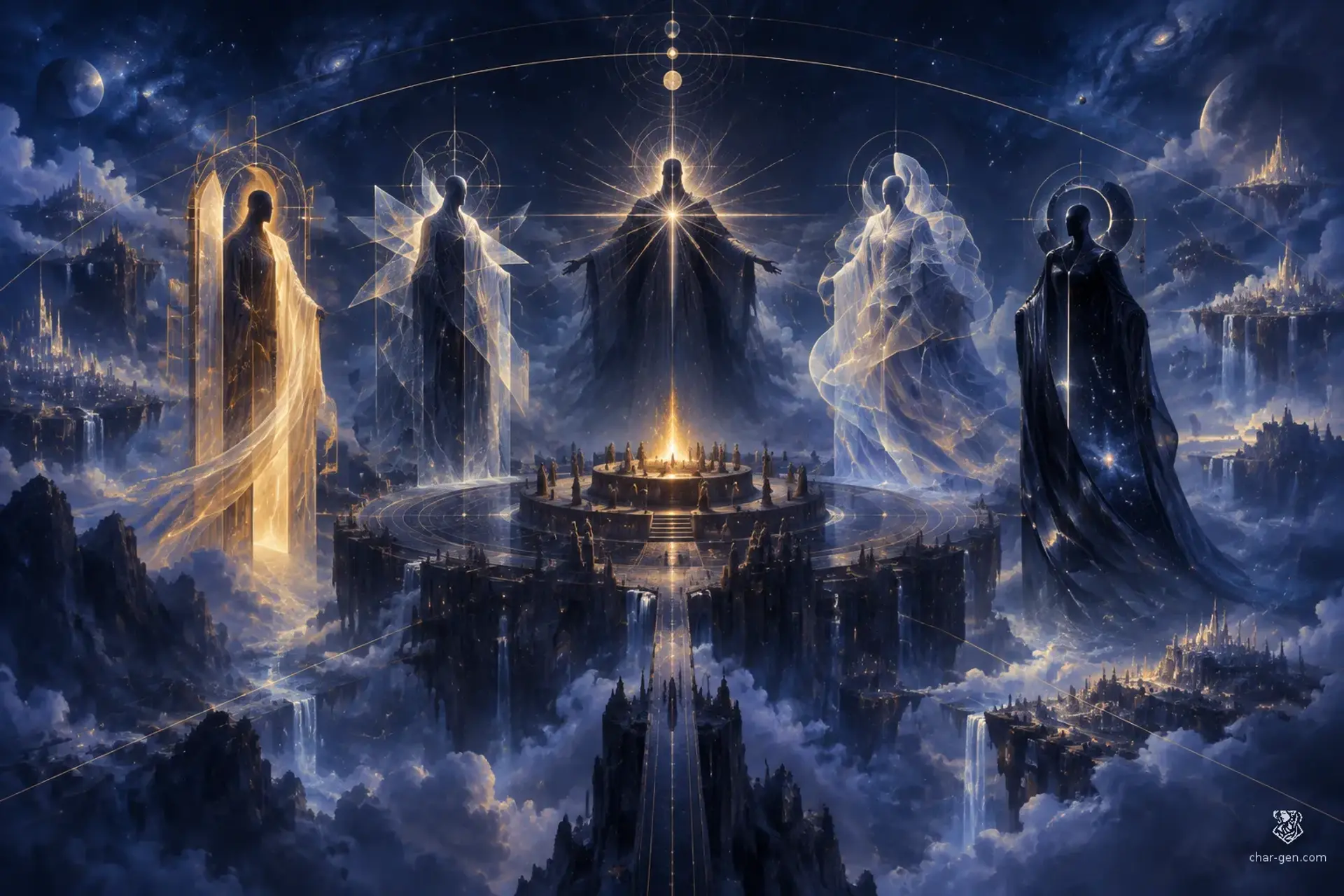
The Assembly of the Golden Land
The Assembly of the Golden Land
Invoke a god

Oruun
Keeper of the Far Threshold
Symbol A narrow golden doorway with an unlit space at its center.
Holy day The Hour Without Shadow
- Keep faith with those placed in your care.
- Do not open a gate without understanding what may pass through.
- A boundary can shelter, but it must never become an excuse for cruelty.
The gods
5Oruun
Keeper of the Far Threshold
Greater · Lawful good
Thresholds and guardianship, which Keth's laws define and Brann's beacons sometimes open.
Patient, grave, and compassionate at a distance. Oruun sees protection as a sacred duty, but can mistake isolation for mercy.
Faith
- Keep faith with those placed in your care.
- Do not open a gate without understanding what may pass through.
- A boundary can shelter, but it must never become an excuse for cruelty.
Holy dayThe Hour Without Shadow, observed at the turning of the local year's longest day.
Holy textThe Book of the Unclosed Gate, a collection of boundary parables attributed to Oruun and annotated by Ilyr.
RitesMark a doorway with a line of gold dust, then erase it before crossing. · Keep one night watch in silence for someone unable to guard themselves. · Recite a promise twice: once for the one protected, once for the protector.
Valuescustody · patience · discernment
Look
SymbolA narrow golden doorway with an unlit space at its center.
- pale gold
- ivory
Animalswhite crane · glass-winged moth
AppearanceA still figure of translucent gold, whose face resembles a window looking toward a sunrise no mortal can see. The outline of a gate moves behind the figure rather than around it.
Followers
WhoGatewardens, contemplatives, angelic envoys, and mortals who protect secluded sanctuaries.
BeliefsFollowers believe that care begins with attention and that some truths must be approached slowly. They honor Brann's compassion but fear that unguarded access could imperil the Golden Land and the worlds beyond it.
The faith
How it began
Before any mortal chronicle, the Golden Land existed as a plane apart within the [[Thigrora-1012]] universe.
The first angels arose there, and the five deities became the assembly that defines how its light is kept, measured, carried, renewed, and wielded. The faith holds that the assembly did not create the plane; it inherited obligations shaped by its existence.
The heavens
The Golden Land is an isolated, hyper-dimensional plane within the [[Thigrora-1012]] universe, a reality of absolute perfection and celestial light.
It is the origin and home of all angelic entities, yet it is not the universe's creator and does not encompass every afterlife. Its apparent horizons are folds in space, and its radiant cities are more like settled laws than buildings. Oruun holds its central threshold, Keth measures its immutable harmonies, and Brann's distant beacons mark the few paths by which angels may depart.
Gods and mortals
The gods rarely answer mortals directly.
Their influence arrives through angelic messengers, dreams of distant light, uncanny coincidences, and the teachings of mortal religious houses. The faith has no universal hierarchy: threshold monasteries favor Oruun, legal colleges favor Keth, beacon shrines honor Brann, hospices follow Ilyr, and discreet courts cultivate Sova. These traditions share rites and texts but often disagree about whether the Golden Land should remain distant.
After death
The dead do not automatically enter the Golden Land: it is the home of angels, not a reward-house for mortals.
The faithful imagine their souls passing into the Quiet Margin, a still place beyond mortal time where Oruun weighs their lives. Those judged fit may serve as brief-lived guests in the radiance of the Golden Land; most are returned to the wider cosmos, carrying a memory of its light. Keth teaches that this return is no punishment, while Ilyr insists that no soul is ever beyond repair.
What people say, what is true
Players may hear
For the GM
Plot hooks
Conflicts
The wars
Oruun guards the Golden Land's boundaries, while Brann argues that its light must reach the suffering beyond them.
Keth maintains the laws that keep the plane intact, but Sova exploits their silences to bargain for influence. Ilyr seeks to reconcile them, though Keth distrusts Ilyr's willingness to revise ancient judgments. Their disputes are conducted across immense spans of time, and mortal worshippers may wait generations for an answer.
| Oruun | Keth | Brann | Ilyr | Sova | |
|---|---|---|---|---|---|
| A | E | A | E | ||
| A | E | E | A | ||
| E | E | A | |||
| A | E | A | A | ||
| E | A | E | A |
Order of heaven
Structure
The faith is a loose communion of five traditions rather than a single church.
Shared sanctuaries use an open ring to represent the assembly, with one gap left for the unknown. Each tradition appoints its own teachers and ritual keepers. Councils convene only when a crisis affects multiple traditions; Oruun's wardens keep the meeting boundaries, Keth's recorders preserve the proceedings, and Ilyr's mediators prevent disputes from becoming schisms. Sova's adherents are officially unwelcome at some councils, though their influence is often suspected.
Theme
The tension between celestial perfection and imperfect responsibility: whether the holy should remain untouched, impose order, or risk itself by reaching outward.
Tone
Distant, numinous, and restrained.
The Golden Land is majestic but emotionally remote; divine attention is rare, indirect, and consequential. Its light inspires awe more readily than comfort, and even benevolent gods may seem separated from mortal urgency by unimaginable scale.
Alignments
The assembly is deliberately varied: Oruun is lawful good, Keth lawful neutral, Brann chaotic good, Ilyr neutral good, and Sova neutral evil.
Their disagreements are genuine, though none can wholly escape the Golden Land's shared purpose.
Media
0 imagesNo images yet.
Turn The Assembly of the Golden Land into a sheet
A high-res, share-ready sheet you can post or print.