
Unnamed pantheon
Origin
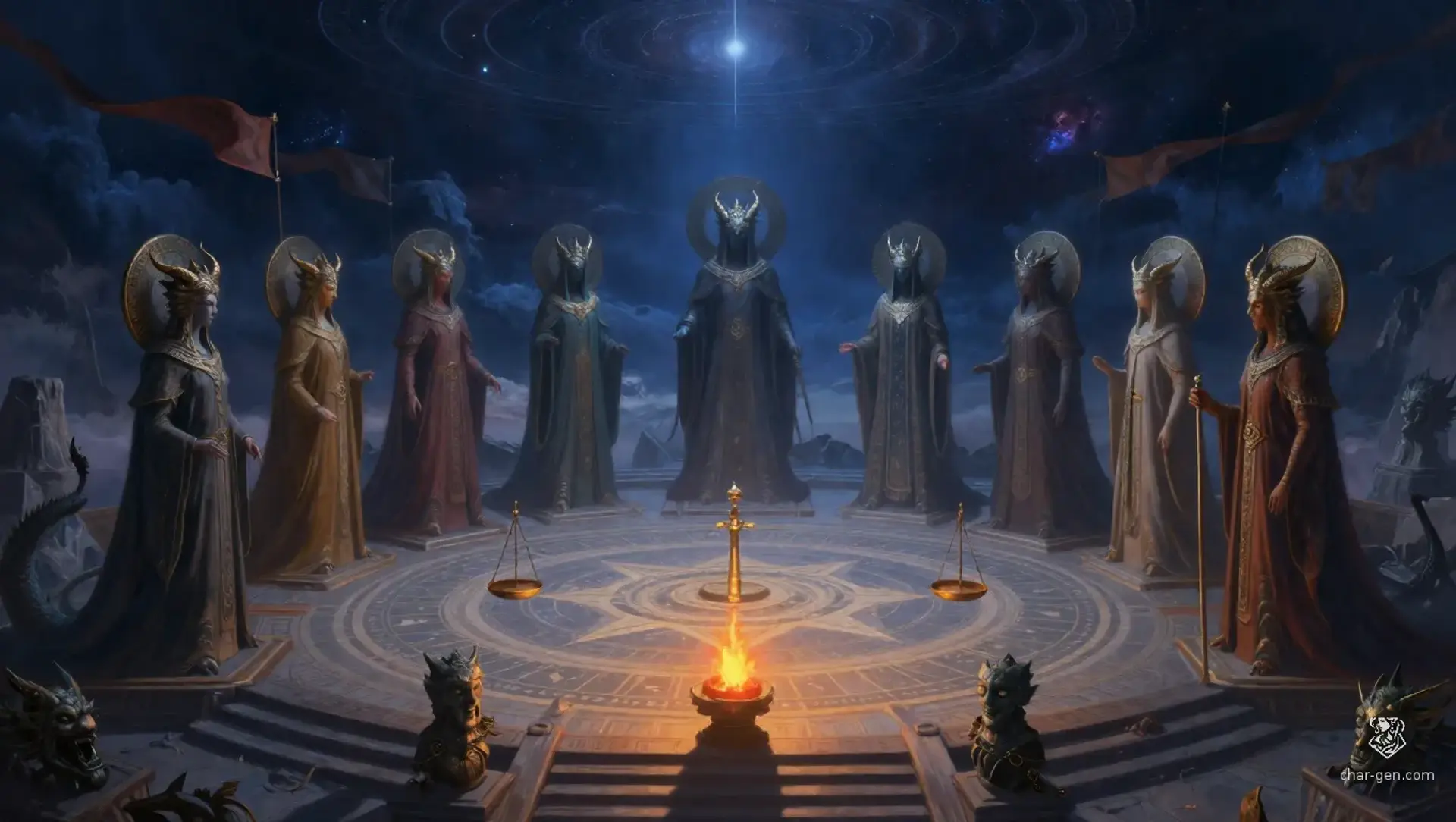
Ten ancient dragons emerged from the broken First Egg and ruled the newborn world through instinctive dominion. When mortals learned to name their emotions, the dragons were transformed by that collective recognition into gods. Their worship began not with submission but with negotiation: mortals offered stories, vows, sacrifices, and remembrance, while the dragons offered protection, prophecy, passion, and power.
Cosmology
The world was hatched from the First Egg, a star-metal shell cracked by the breath of an unnamed primordial dragon. Ten dragons emerged, each embodying a force within mortal hearts. They later took mortal forms after drinking from the Well of Names, gaining empathy, limitation, and the ability to be worshiped. The heavens are Orun's vast observatory, the earth is Toma's patient body, and every mortal emotion is a spark passed between the ten divine descendants.
Structure
The religion has no universal hierarchy. Instead, it is organized as the Assembly of Ten, a loose network of temples, household shrines, traveling priests, mystery cults, warrior lodges, merchant houses, and village keepers. Most communities recognize a local Triad: one god of survival, one god of social order, and one god of personal desire. Senior theologians called Knot-Speakers interpret contradictions between divine teachings. The largest temples belong to Galt, Toma, and Seki, while Ulgu, Tok, Baat, and Drek are often worshiped in private or through secret societies. Holy days are frequently shared, causing festivals to become sites of both alliance and theological conflict.
Mortal Relations
The gods remain intensely involved in mortal life. They appear in dreams, possess willing champions, answer public rites with omens, and occasionally walk the roads in mortal guise. Temples are not merely places of worship but courts, hospitals, barracks, guildhalls, theaters, observatories, and hidden meeting places. Most communities honor several gods, choosing one household patron while acknowledging that every emotion belongs somewhere in the divine assembly.
Afterlife
The dead arrive at the Gate of Keth, where Galt weighs their strongest unmastered emotion. Those who faced themselves may travel onward into the Star-Roads of Orun; those who denied themselves are claimed by the aspect they fed most. The afterlife is not eternal reward or punishment, but a series of realms where souls learn what their passions made of them. Toma guards the final crossing, while Ulgu is said to tempt the dead into returning as hungry spirits.
Turn Unnamed pantheon into a sheet
A high-res, share-ready sheet you can post or print.