
The Architects Beyond the Veil
Origin
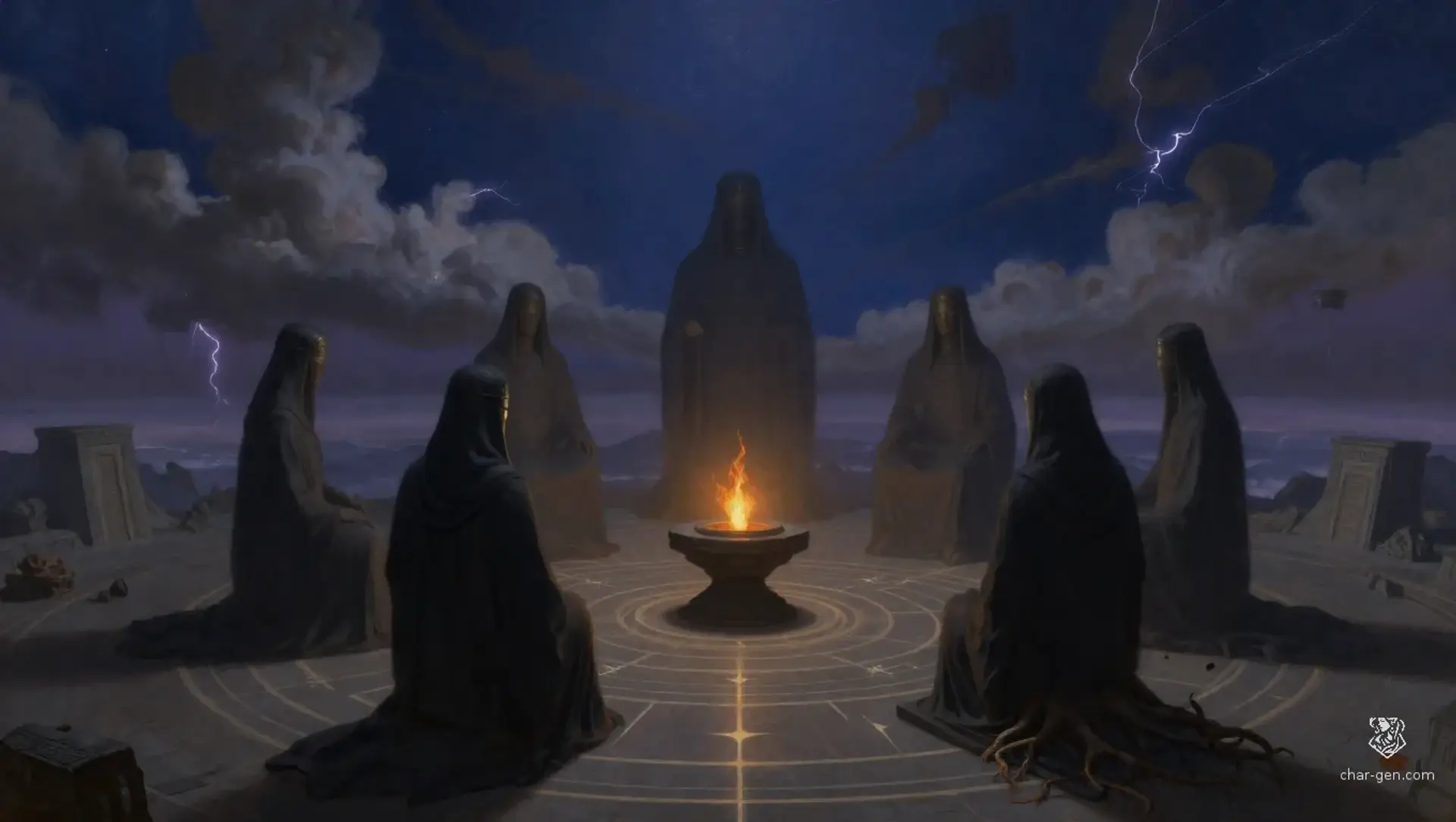
The religion began among the first mortal cities, whose builders found seven unrelated symbols carved beneath their foundations. The symbols were interpreted as a divine assembly, though each discovery suggested a different story. Over centuries, priests reconciled these fragments into the doctrine of the Seven Architects: beings who made the realm, withdrew from it, and now watch from a distance as mortals decide what their creation will become.
Cosmology
Before distance, matter, and time existed, the Seven awoke in a silent expanse called the Unmeasured Dark. Chronaeus opened the first moment; Aetherion Sol gave the newborn realm purpose; Lunthera shaped substance and life; Krathion fixed boundaries; Voltheros filled the void with motion; Emberon introduced change through fire and invention; and Morthera created endings so that beginnings would have meaning. The gods are therefore not parents in a human sense but surviving functions of the first act of creation. They rarely intervene because direct attention from them can distort the world around their worshippers.
Structure
The religion has no supreme earthly hierarchy. Instead, it is divided into seven traditions called Measures, each devoted to one creator. The Measure of the Spear serves Aetherion Sol; the Rootbound Circles serve Lunthera; the Stone Courts serve Krathion; the Open Towers serve Voltheros; the Quiet Houses serve Morthera; the Counting Archives serve Chronaeus; and the Bright Workshops serve Emberon. Every seven years, representatives gather in a neutral observatory to compare omens, settle disputes, and revise shared calendars. The assembly is intentionally temporary, since the faithful believe permanent unity would violate the nature of the gods.
Mortal Relations
The gods are distant and rarely answer direct prayers. Most miracles arrive as coincidences, altered weather, impossible survivals, prophetic dreams, or sudden insights rather than visible manifestations. Clerics and paladins interpret divine power through the deity’s principle, but no church can claim complete authority because each god’s followers preserve contradictory fragments of the original creation. Temples are often observatories, courts, gardens, memorials, storm towers, workshops, or fortified libraries rather than conventional sanctuaries.
Afterlife
The dead pass into the Quiet Architecture, a vast unfinished realm designed by all seven creators. Morthera receives each soul at the Gate of Stillness, while Chronaeus measures the life that was lived and Krathion weighs its obligations. Souls are then assigned according to their deepest allegiance: warriors may enter Aetherion Sol’s Endless Campaign, the faithful of Lunthera may return to the Living Garden, seekers of Emberon may kindle new stars, and those claimed by no divine pattern drift beyond Voltheros’s last horizon. The gods do not dwell there openly; they appear only as distant silhouettes behind impossible doors.
Turn The Architects Beyond the Veil into a sheet
A high-res, share-ready sheet you can post or print.