
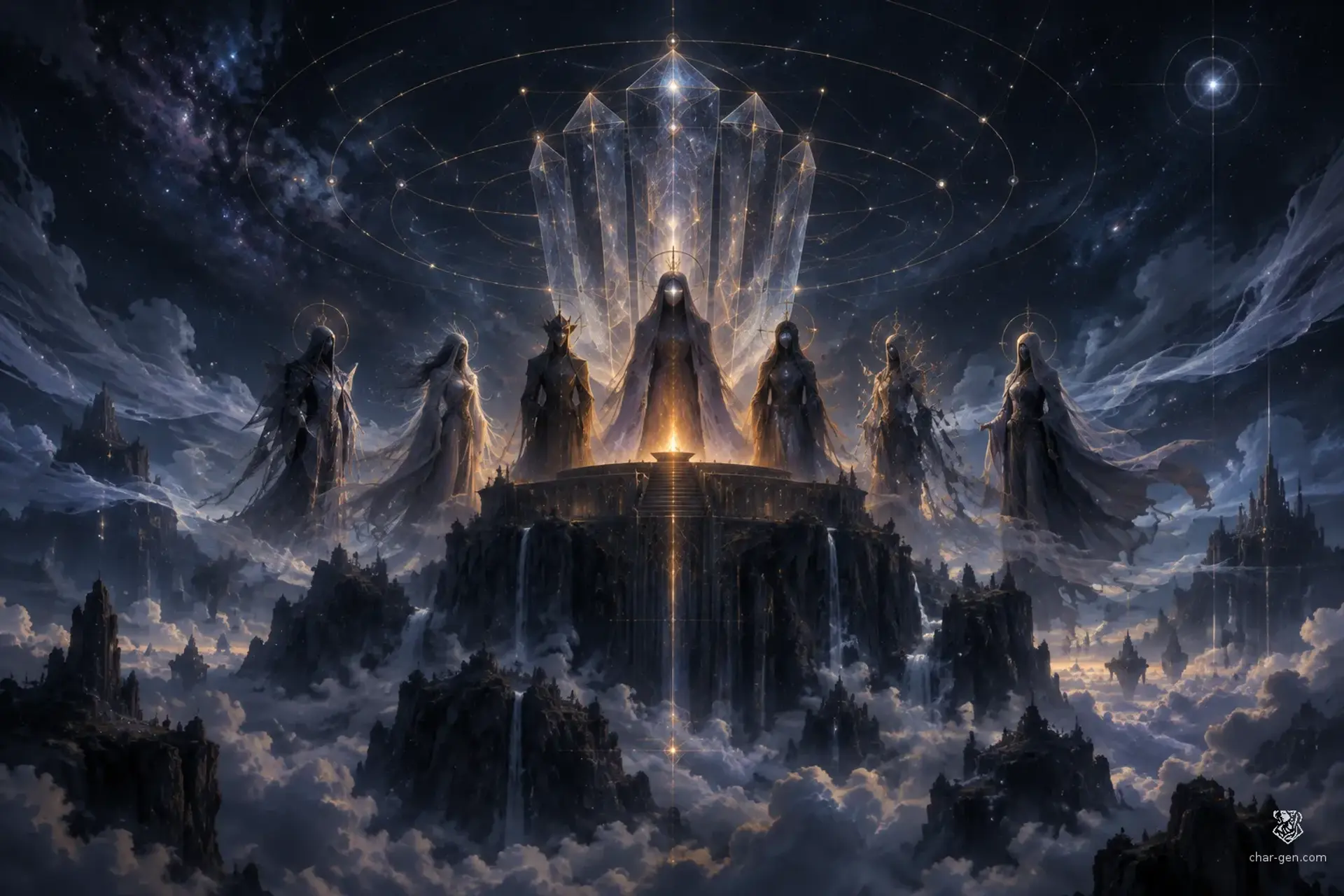
Unnamed pantheon
Unnamed pantheon
Invoke a god

Sheshet
The First Measure
Symbol A seven-sided prism crossed by a straight golden ray.
Holy day The First Alignment
- Keep the promises that make trust possible.
- Build with care, so what you make can shelter others.
- Do not mistake a flawless pattern for a perfect life.
The gods
7Sheshet
The First Measure
Greater · Lawful Good
Making and measure, which Sheshet shares uneasily with Dastan · Promises and pattern, kept in dialogue with Oru
Patient, exacting, and sincerely protective. Sheshet believes mercy must have a shape that can be relied upon, but struggles to accept that living things change beyond any plan.
Faith
- Keep the promises that make trust possible.
- Build with care, so what you make can shelter others.
- Do not mistake a flawless pattern for a perfect life.
Holy dayThe First Alignment, observed at the spring equinox with the careful setting of colored glass in windows and shrines.
Holy textThe Measure of Seven Rays, a collection of instructions, parables, and disputed diagrams attributed to Sheshet’s first priests.
RitesRenewing a public oath by passing a beam of sunlight through colored glass. · Setting one carefully made stone or pane into a communal building. · At funerals, naming one promise the deceased kept and one that the living must now carry.
Valuessteadfastness · craft · responsibility
Look
SymbolA seven-sided prism crossed by a straight golden ray.
- gold
- rose
Animalscrane · tortoise
AppearanceA tall, veiled figure whose body appears as layered panes of pale gold and rose. Sheshet’s face is always seen in profile, and each observer sees a different, solemn expression.
Followers
WhoArchitects, judges, oath-keepers, patient rulers, and people rebuilding communities after disaster.
BeliefsFollowers believe Sheshet gave the fragments their first boundaries and that every just structure echoes that act. They also teach that Oru’s acceptance of endings is essential: even the finest structure must eventually make room for change.
The faith
How it began
The religion began in scattered communities that interpreted the colors of sunrise, minerals, and stars as echoes of the Shattering.
Its oldest rites are practical acts—keeping a promise, lighting a death lamp, mapping the sky—rather than a single revelation. Over generations, these traditions were gathered into the teaching that the Seven are living fragments of the Prism Eternal, and that worship means learning how to live amid irreconcilable colors.
The heavens
The Prism Eternal contained all matter, feeling, and possible futures within itself.
When it became aware of its own solitude, it shattered—not through an attack, but through the unbearable pressure of every unrealized possibility seeking expression at once. Its seven greatest fragments became the gods; lesser splinters became stars, worlds, spirits, and the varied laws of nature. The fragments remain linked by the First Refraction, an unseen structure through which each deity feels the others’ presence. Creation is therefore neither finished nor wholly deliberate: each choice casts new colors into a cosmos still refracting the Prism’s original potential.
Gods and mortals
Most mortals honor several gods at different thresholds of life: Sheshet at an oath or building’s foundation, Ilyo in a crisis, Oru at a deathbed, and Dastan when wrongs must be addressed.
Temples are usually small, locally governed houses of colored glass rather than a universal church. The clergy of each deity cooperate in civic life but dispute theology, especially over whether justice, rest, or transformation should come first. Qem’s shrines are denied by official doctrine and quietly sought by people with dangerous questions.
After death
The dead pass through the dim spectrum called the Veilglass, where the colors of their lives slowly separate from the soul.
Those who find a settled hue travel onward to the quiet country kept by Oru; those whose colors remain tangled may linger as reflections in the world. Ilyo is said to guide such spirits toward release, while Dastan weighs whether a soul’s unfinished promises bind it still.
What people say, what is true
Players may hear
For the GM
Plot hooks
Conflicts
The wars
Sheshet wants the scattered fragments gathered into a single harmony, while Zorai insists that a second shattering would renew creation rather than destroy it.
Dastan contests Ilyo’s mercy toward souls who break their vows, and Oru refuses to let either define the final shape of the dead. Qem quietly alters the signs by which the assembly interprets the Prism’s will, drawing Velou into a dispute over whether any god can truly know the future.
| Sheshet | Oru | Zorai | Dastan | Ilyo | Velou | Qem | |
|---|---|---|---|---|---|---|---|
| A | E | A | |||||
| A | E | A | |||||
| E | A | A | |||||
| A | E | A | |||||
| A | A | E | |||||
| A | A | E | |||||
| A | AE |
Order of heaven
Structure
The faith has no supreme pontiff.
Its local glass-houses are tended by keepers, who may serve one deity or maintain a shared shrine. Once each generation, representatives meet at a neutral observatory for the Convocation of Refractions, where disputes are recorded but rarely settled. Sheshet’s schools preserve measures and vows; Oru’s houses tend the dead; Dastan’s halls keep records of obligation; and traveling circles serve Ilyo, Velou, Zorai, or Qem with little centralized oversight. Shared worship is common, but each tradition keeps its own rites and limits.
Theme
Creation through rupture: difference is the consequence and the gift of a universe made from one being’s shattering.
Order, mercy, consequence, possibility, secrecy, and change each preserve a portion of the truth, but none can restore the whole without risking the freedom that the Shattering made possible.
Tone
Distant.
The gods rarely answer plainly, and signs are often indistinguishable from coincidence. Their influence is felt through recurring colors, impossible reflections, patterns in the stars, and the choices mortals make under uncertainty.
Alignments
The Seven span lawful, neutral, and chaotic paths, with good, balanced, and cruel powers represented.
Their disagreements are considered necessary: no single color can explain the whole of existence.
Media
0 imagesNo images yet.
Turn Unnamed pantheon into a sheet
A high-res, share-ready sheet you can post or print.