
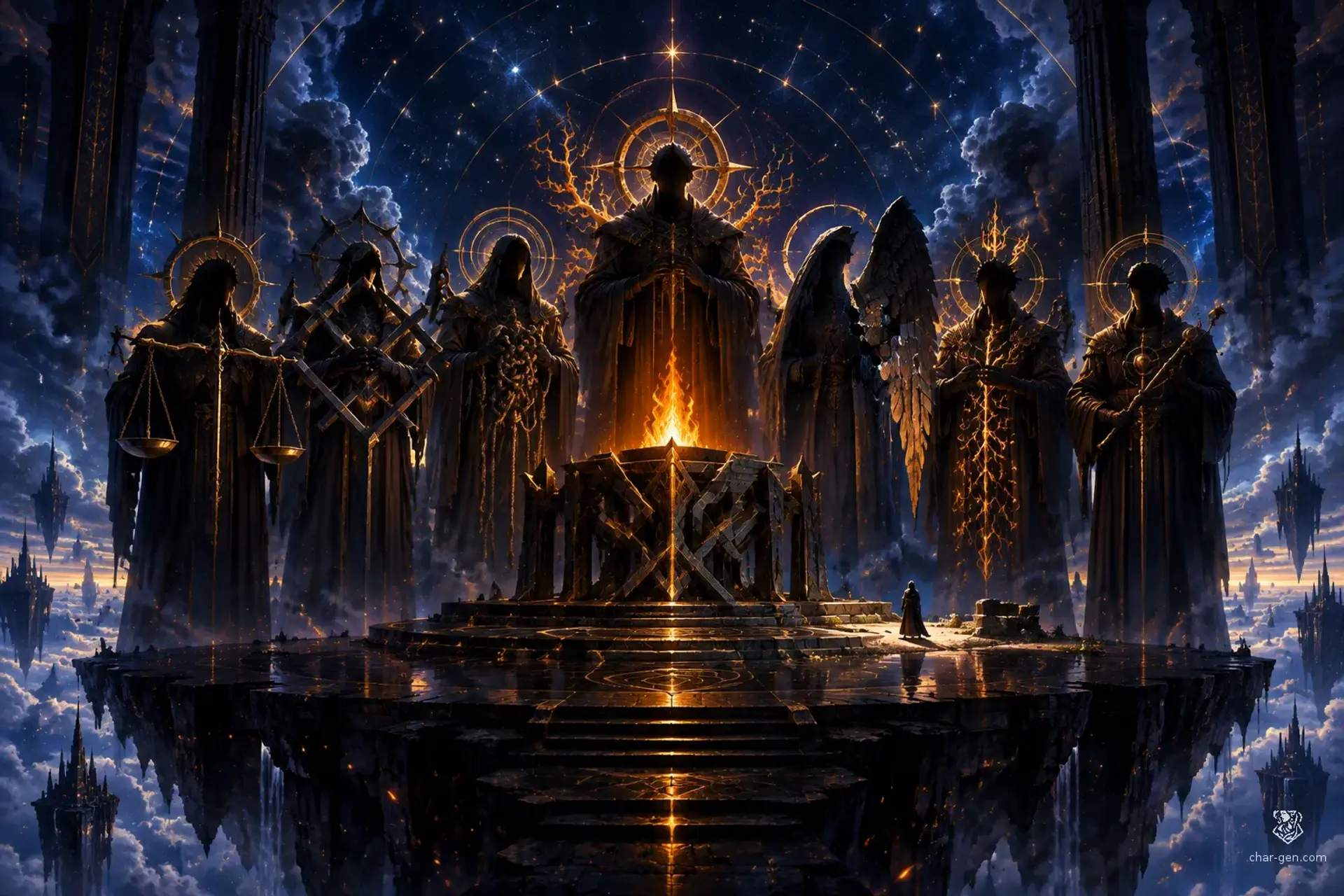
The Draconic Mandate
The Draconic Mandate
Invoke a god

Dra’Vareth, Warden Flame
The First Flame
Symbol A crowned flame enclosed by a square of four iron bars.
Holy day The Crownfire Vigil is held on the longest night
- Rule yourself before you presume to rule another.
- Keep order strong enough to protect the vulnerable.
- Let no office stand above the law that grants it power.
The gods
6Dra’Vareth, Warden Flame
The First Flame
Greater · Lawful Neutral
Law: Dra’Vareth, Warden Flame sets the first boundaries, upheld by Iriess, Keeper of Oaths. · Fire: the primal heat from which Zulvyra, Purging Radiance draws cleansing light. · Order: the hierarchy whose dead are weighed by Izelkar, Scale of Ash.
Implacable, patient, and convinced that strength is legitimate only when it serves a durable order. Dra’Vareth considers Iriess, Keeper of Oaths essential to law, but sees Nuryssa – The Broken Wing as the ruinous consequence of unchecked choice.
Faith
- Rule yourself before you presume to rule another.
- Keep order strong enough to protect the vulnerable.
- Let no office stand above the law that grants it power.
Holy dayThe Crownfire Vigil is held on the longest night. Worshippers keep lamps burning until dawn and recite the laws they have sworn to uphold.
Holy textThe First Ordinances, a canon of attributed decrees, ritual formulae, and commentaries. Its oldest passages are said to be etched on the Warden Flame’s scales.
RitesLighting a small household flame from a communal Crownfire. · Reciting civic vows before taking office or command. · Presenting broken tools or weapons for reforging as a sign of renewed duty.
Valuesdiscipline · endurance · legitimate authority · duty
Look
SymbolA crowned flame enclosed by a square of four iron bars.
- bronze
- ember red
- black
Animalscrocodile · monitor lizard · bull
AppearanceA towering dragon-shaped figure of dark bronze, with a furnace burning behind the ribs and a crown of rigid, interlocking horns. Its scales bear lines like engraved statutes.
Followers
WhoRulers, judges, soldiers, craftspeople, and people who depend on reliable laws to survive.
BeliefsFollowers believe civilization is a hard-won shelter against chaos, and that authority earns reverence only through service and accountability. They honor Izelkar, Scale of Ash as the final measure of a ruler’s deeds.
The faith
How it began
The Mandate teaches that the First Flame began as a single ember in a formless void.
Dra’Vareth, Warden Flame raised it into a law-bearing fire, and the other divine powers emerged as necessary answers to the order it created: cleansing, judgment, oath, foresight, and dissent. Its earliest mortal temples were communal hearths where law was spoken aloud and the dead were returned to flame.
The heavens
Creation began when Dra’Vareth, Warden Flame kindled the First Flame in the formless dark.
Its heat established boundaries, ranks, and the laws by which worlds endure. Zulvyra, Purging Radiance gave that flame the power to reveal and cleanse; Izelkar, Scale of Ash made endings answerable to judgment; and Iriess, Keeper of Oaths bound law to promises. Karzagon, Flame Prophet sees the branching destinies produced by those bonds. Nuryssa – The Broken Wing arose from the first refusal of a divine command, proof that even a perfect order can be broken.
Gods and mortals
The Draconic Mandate is both a religion and a public order.
Temples keep records, arbitrate disputes, oversee cremations, and advise rulers, while local congregations debate how much authority the priesthood should wield. Crownfire Vigils bind communities to shared duties; oath ceremonies mark contracts, offices, and treaties. Cremation is common, though families preserve names and deeds in local ledgers. Public acts of penance are accepted as a route to restitution but can become coercive, a danger emphasized by Iriess, Keeper of Oaths and Nuryssa – The Broken Wing. The faith’s clergy include stern legalists, reformers, seers, judges, and discreet protectors of exiles.
After death
The dead pass through Izelkar, Scale of Ash’s tribunal, where deeds are weighed against vows and the harm they caused.
The honored enter Dra’Vareth’s ordered halls beyond the last flame; the condemned are returned as ash to the world, denied memory and name. Zulvyra, Purging Radiance is said to cleanse souls whose failings can still be confessed. Nuryssa – The Broken Wing teaches that the tribunal’s verdict is not always final: some dead escape judgment through hidden roads, though this is condemned as a dangerous heresy.
What people say, what is true
Players may hear
For the GM
Plot hooks
Conflicts
The wars
Dra’Vareth, Warden Flame claims that law must precede mercy; Iriess, Keeper of Oaths argues that a lawbreaker’s promise can restore balance.
Zulvyra, Purging Radiance calls for public correction of corruption, while Nuryssa – The Broken Wing warns that purification can become persecution. Izelkar, Scale of Ash judges both sides by their deeds. Karzagon, Flame Prophet’s disputed visions alternately strengthen the Mandate and expose its rulers’ failures.
| Dra’Vareth, Warden Flame | Zulvyra, Purging Radiance | Izelkar, Scale of Ash | Iriess, Keeper of Oaths | Karzagon, Flame Prophet | Nuryssa – The Broken Wing | |
|---|---|---|---|---|---|---|
| A | A | E | ||||
| A | A | E | ||||
| A | A | E | ||||
| A | A | E | ||||
| E | A | A | ||||
| E | E | E | A |
Order of heaven
Structure
The religion has no single mortal head.
The Ember Synod, a council of temple jurists, funeral judges, oath-keepers, and fire-priests, interprets doctrine and advises rulers. Local hearth-temples retain broad autonomy, and their customs vary. The orthodox hierarchy places Dra’Vareth’s law at the center, with Zulvyra, Izelkar, and Iriess maintaining its public rites. Prophets of Karzagon are licensed only in some regions. Worship of Nuryssa – The Broken Wing is outlawed in many cities, yet tolerated in others as a necessary warning against tyranny.
Theme
A divinely sanctioned order struggles to distinguish justice from domination.
Purification, judgment, vows, and prophecy can protect a people, but each may become an instrument of fear. Rebellion is dangerous, yet unquestioning obedience can be worse.
Tone
Wrathful and ceremonially severe, with a persistent tension between communal protection and coercive authority.
Sacred fire is both hearth and threat: it offers warmth, exposes hidden wrongs, and leaves only ash when wielded without restraint.
Alignments
The assembly spans lawful, neutral, and chaotic convictions, with good, neutral, and evil interpretations of duty.
Its orthodox center favors lawful power, but Nuryssa – The Broken Wing and the more compassionate readings of Iriess, Keeper of Oaths challenge the claim that obedience is always virtue.
Media
0 imagesNo images yet.
Turn The Draconic Mandate into a sheet
A high-res, share-ready sheet you can post or print.