
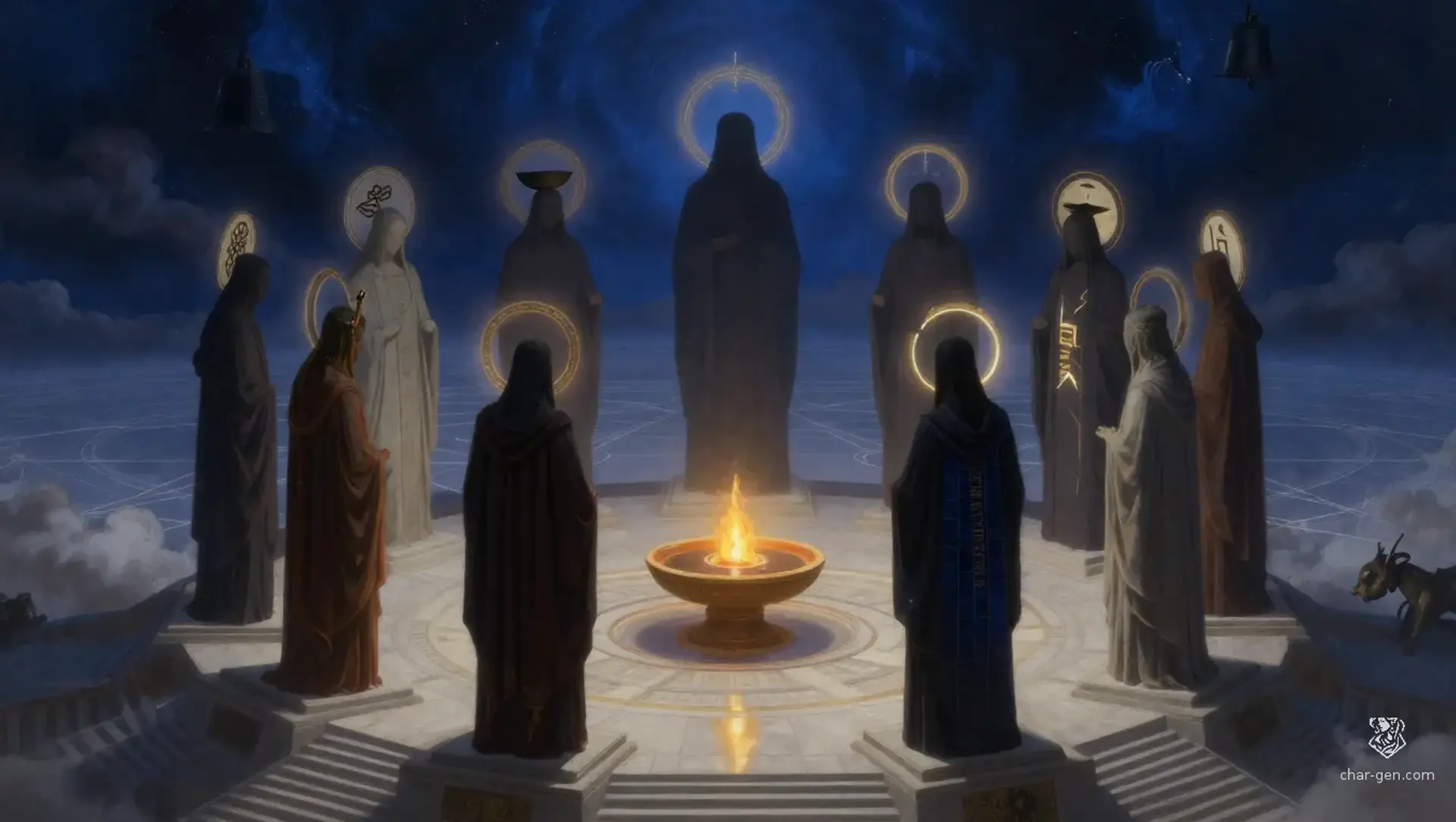
The Ninefold Assembly
Origin
According to temple teaching, the First Silence fractured when existence attempted to name itself. Nine divine principles emerged from the fracture and stabilized reality by taking vows against one another. Shangoa claims the vows created morality, Osema claims they created history, and Zhalume claims they created conflict. Mortal philosophers argue that all three are partly right.
Cosmology
The world rests upon the Ninefold Span, an unseen structure of laws, seasons, boundaries, memories, and choices. The gods did not create existence; they gave it pattern after the First Silence fractured reality into mortal time. Each deity governs one tension within that pattern. Their temples teach that the universe survives because no divine principle is complete alone.
Structure
The religion is organized as the Concord of Nine Lamps. Each major settlement maintains a circular sanctuary with nine alcoves, one for each deity, and a central basin where offerings are mixed so no god receives worship entirely alone. The nine priestly orders are independent but meet during the Triennial Convergence to settle doctrine, appoint judges, recognize saints, and decide whether a divine omen is authentic. Local priests are called Keepers, senior temple authorities are called Voices, and the highest council consists of nine Voices who deliberately rotate seats so no deity's order gains permanent precedence. Common believers typically choose one patron deity while observing the shared calendar and civic rites of the entire Assembly.
Mortal Relations
The Nine are distant, rarely appearing openly, and usually communicate through omens, dreams, coincidences, sacred animals, and the unsettling certainty that a private choice has been witnessed. Most settlements maintain a shared Ninefold shrine rather than separate temples, placing the deities in a circular arrangement with no central throne. Priests serve one deity but are expected to honor all nine during major civic rites. Religion shapes law, hospitality, mourning, travel, education, punishment, marriage, and the treatment of strangers. Heresies usually arise by elevating one deity above the others.
Afterlife
The dead enter the Quiet Vast, a distant realm divided into nine horizons. Each soul is drawn toward the deity whose virtues it most often enacted, though no god claims absolute ownership. Shangoa weighs the soul's oaths, Osema receives its memories, and Qadiri opens the final road. The worthy may return as ancestors, household spirits, or nameless lights seen above lonely roads.
Turn The Ninefold Assembly into a sheet
A high-res, share-ready sheet you can post or print.