
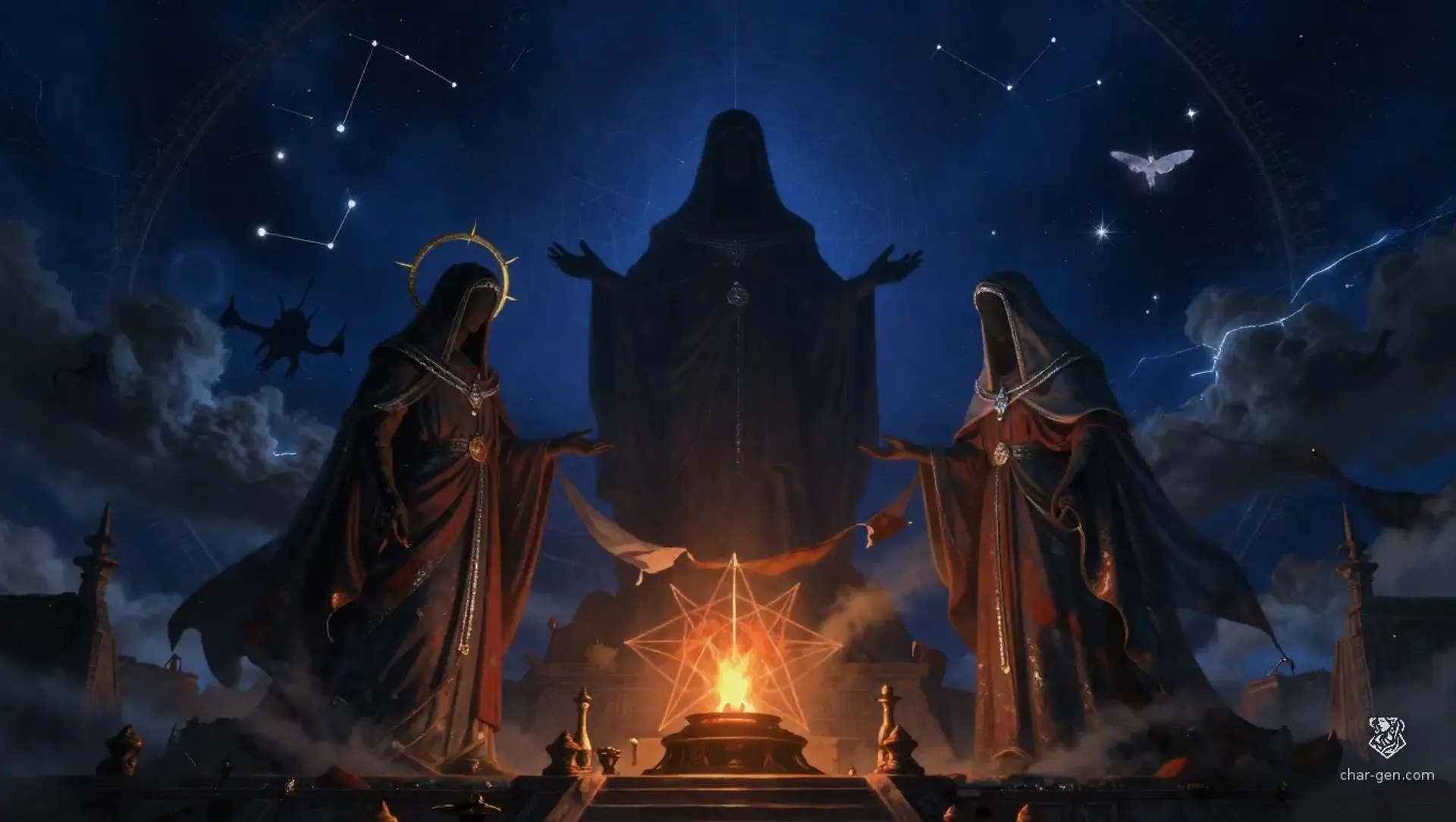
Unnamed pantheon
Origin
Before towns, rails, or written names, three mortal survivors crossed a dead plain beneath a broken sky. Khrzvek carried the measuring rod, Mett carried the last shared ration, and Shaeth carried the secret of what had killed the old world. At the horizon they found a gate made from black stars. When they opened it, divinity entered them unevenly, becoming the three powers now worshipped across the frontier.
Cosmology
The world is a disputed homestead at the edge of creation. Khrzvek hammered the roads and fixed the stars like nails in a telegraph line; Mett taught mortals to name themselves and refuse inherited chains; Shaeth seeped through the spaces between laws, dreams, and shadows. Every sunset is the frontier of the divine argument, and every mortal choice redraws the map.
Structure
The religion has no universal hierarchy. Instead, it is organized into three overlapping traditions. Khrzvek’s Trackwardens maintain temples, courts, roads, and records. Mett’s Open Hands travel in loose bands of lay preachers, healers, performers, and outlaw-chaplains. Shaeth’s Veiled Houses operate as secretive circles within towns, mines, military camps, and railroad offices. Most communities honor all three through a shared roadside shrine, but each tradition teaches that the other two misunderstand the central truth. Priests, clerics, champions, witches, and oracles may serve one deity exclusively or work as disputed mediators between them.
Mortal Relations
The pantheon is intensely involved in mortal affairs. Clerics and champions receive practical signs: coins warming in the hand, telegraph wires singing, horses refusing a road, shadows pointing toward hidden doors, or a dead relative appearing briefly at a station. Divine magic is treated as frontier intervention rather than distant theology. Temples double as courthouses, bunkhouses, clinics, saloons, or safehouses, and religious disputes often become disputes over land, water, law, railroads, or who gets to decide what a person owes.
Afterlife
The dead ride the Last Line, a spectral railway winding beyond the horizon. At three stations they are judged: Khrzvek weighs the debts of the road, Mett hears the final story, and Shaeth opens the gate into the starless grazing lands. Souls may return as hauntings, revenants, or sainted trail-spirits when one deity contests another’s verdict.
Turn Unnamed pantheon into a sheet
A high-res, share-ready sheet you can post or print.