
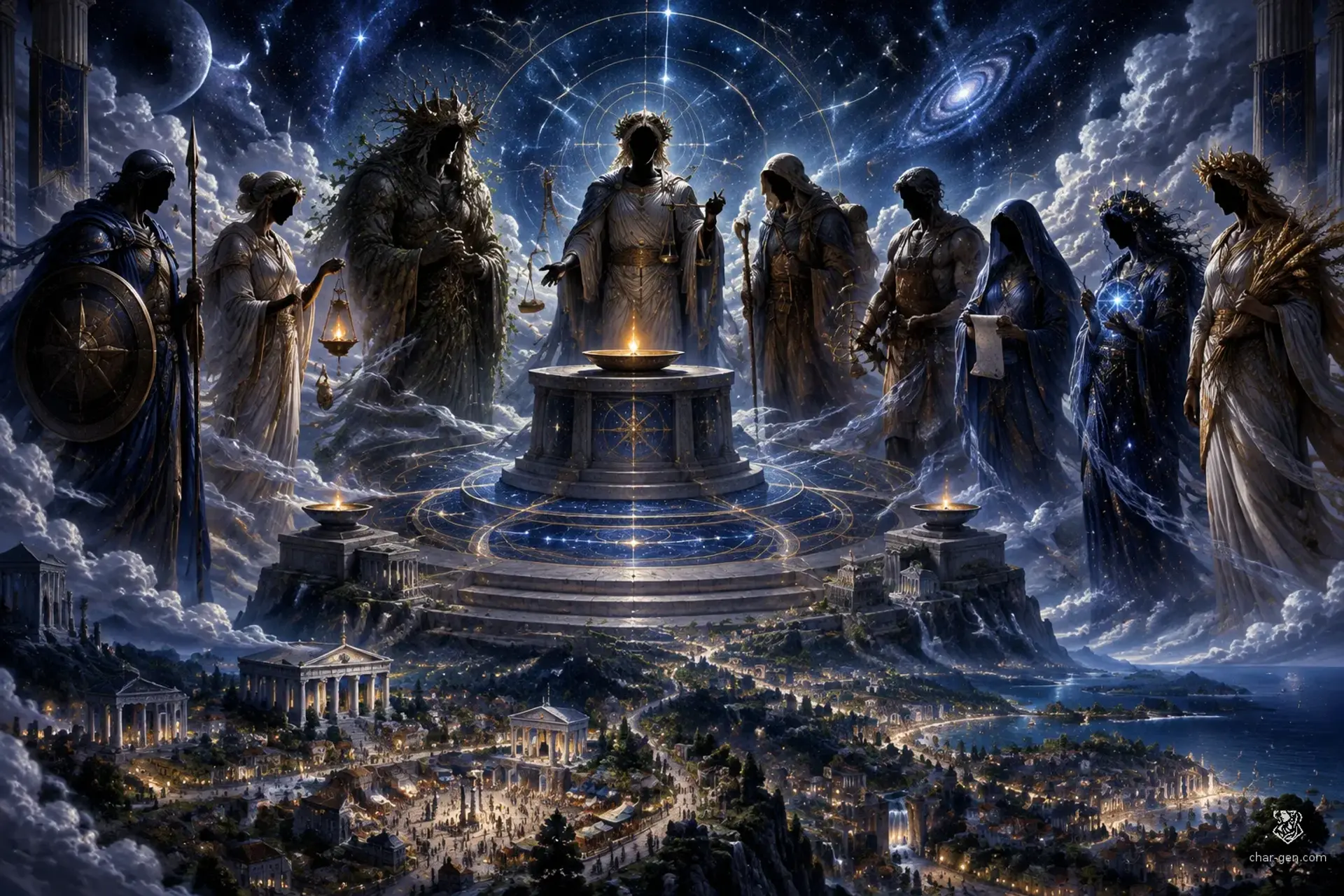
The Ninefold Assembly
The Ninefold Assembly
Invoke a god

Brak
The Unbroken Shield
Symbol A shield with one deliberate notch in its rim.
Holy day The Day of Open Gates
- Stand between danger and those who cannot withstand it.
- Never claim a victory that cost another person their dignity.
- Keep watch even when no reward is promised.
The gods
9Brak
The Unbroken Shield
Greater · Lawful Good
War and protection, practiced in counsel with Goran · Courage that holds even when Orena's laws seem unjust
Direct, patient, and uncomfortable with praise. He believes strength is a public trust, not a personal privilege.
Faith
- Stand between danger and those who cannot withstand it.
- Never claim a victory that cost another person their dignity.
- Keep watch even when no reward is promised.
Holy dayThe Day of Open Gates, when communities feed travelers and renew their watch.
Holy textThe Shield-Songs, a cycle of battlefield testimonies and vows.
RitesTouch a shield or door lintel before taking a dangerous watch. · At funerals, speak aloud the names of those the dead protected. · Offer repaired armor to someone who cannot afford it.
ValuesDuty · Courage · Service
Look
SymbolA shield with one deliberate notch in its rim.
- Bronze
- Rust red
AnimalsOx · Mastiff
AppearanceA broad-shouldered figure in a plain bronze cuirass, carrying a notched shield marked with the names of people he failed to save.
Followers
WhoSoldiers, guards, rescuers, and people charged with protecting a community.
BeliefsBrak's faithful believe that every defense creates a debt of care, and that Goran's peace is worth protecting only when it is shared fairly.
The faith
How it began
According to temple tradition, the first people gathered around a fire during a storm and named the powers they needed: courage, welcome, memory, craft, and the rest.
The names became gods when enough people carried them beyond that first night. The Ninefold Assembly therefore claims no single creator; its oldest doctrine is that divinity and mortal life shaped one another.
The heavens
The world rests on the back of an unseen cosmic ox, whose breath becomes the seasons.
The gods arose when the first mortals named the forces they feared and loved. Above the sky lies the Unlit Expanse, where forgotten possibilities drift; beneath the soil run the roots of the world, tended by Iru. Neither realm is wholly divine or wholly beyond mortal reach.
Gods and mortals
The gods intervene through omens, dreams, answered prayers, and the actions of their mortal institutions.
Their temples run courts, hospices, archives, workshops, granaries, and roadside shrines. Divine aid is real but rarely effortless: a god may open a door, while mortals must decide whether to cross it.
After death
At death, souls cross the River of Names.
Orena weighs their promises, while Pelen records their deeds in the Hall of Returning. Most are welcomed into a quiet afterlife shaped by their strongest mortal bonds; those who reject judgment may return as wandering shades, but only if Iru grants them passage back.
What people say, what is true
Players may hear
For the GM
Plot hooks
Conflicts
The wars
Brak and Orena dispute whether a just law must bend to mercy; their followers contest courts and public squares.
Drazh Velsk covets the secrets Iru keeps beneath the earth. Kima and Pelen disagree over whether invention should be freely shared or carefully guarded. Qor and Yara compete to direct the course of mortal history, while Goran tries to prevent their rivalries from becoming wars.
| Brak | Orena | Iru of Saltmere | Tavi | Goran | Kima | Pelen | Qor | Yara | |
|---|---|---|---|---|---|---|---|---|---|
| A | A | E | |||||||
| A | A | A | |||||||
| E | E | A | |||||||
| A | A | E | |||||||
| A | A | ||||||||
| E | A | A | |||||||
| A | A | E | A | ||||||
| E | A | E | E | ||||||
| A | A | E |
Order of heaven
Structure
The religion has no single supreme priesthood.
Each deity has local temples and specialist orders, while the Ninefold Assembly is honored at shared civic shrines. A rotating conclave of nine keepers—one appointed by each tradition—settles disputes over common rites. Communities may omit a god from local worship, but public ceremonies traditionally name all nine to acknowledge that mortal life needs more than one divine virtue.
Theme
Divinity is a relationship rather than a distant decree: gods answer mortal needs, but their rivalries and virtues are carried into the lives and institutions of their worshippers.
Tone
Mortal-engaged classical fantasy: temples stand in market squares, divine signs appear in daily life, and gods care about the choices of communities as much as the ambitions of heroes.
Alignments
The assembly spans lawful, neutral, and chaotic philosophies, and includes good, neutral, and evil powers.
Its members disagree sharply without dividing into simple benevolent and wicked camps.
Media
0 imagesNo images yet.
Turn The Ninefold Assembly into a sheet
A high-res, share-ready sheet you can post or print.