
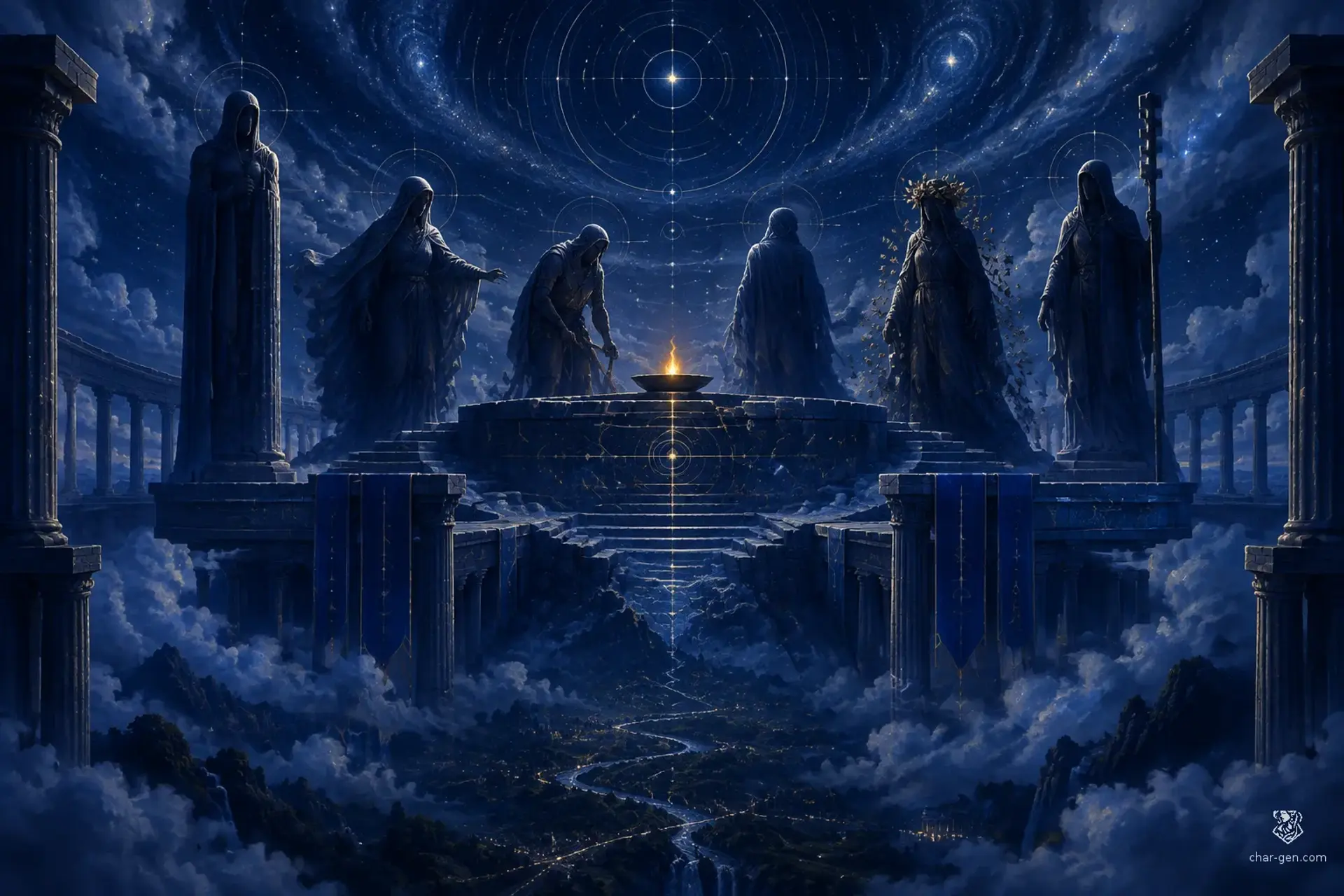
The Far Assembly
The Far Assembly
Invoke a god

Varkesh
The Far Judge
Symbol A closed eye above a balanced pair of scales.
Holy day The Day of Measures
- Give every person a hearing before passing judgment.
- Do not confuse a law’s age with its justice.
- Keep records, for memory is easily bent by power.
The gods
6Varkesh
The Far Judge
Greater · Lawful neutral
Order and civic law, set against Qorim’s defense of necessary disobedience. · Judgment of the dead, a duty he shares uneasily with Nuala.
Remote, exacting, and slow to anger. He believes mercy without discernment becomes favoritism, yet he seldom explains the standards by which he judges.
Faith
- Give every person a hearing before passing judgment.
- Do not confuse a law’s age with its justice.
- Keep records, for memory is easily bent by power.
Holy dayThe Day of Measures, held at the first new moon of the year, when communities review old laws and publicly correct unjust judgments.
Holy textThe Bronze Articles, a collection of verdicts, parables, and unanswered legal questions.
RitesSpeak disputed laws aloud in an empty court before changing them. · Leave a cup of water at a grave for the soul’s long road. · Mark a fair verdict with a small bronze notch on a temple pillar.
ValuesImpartiality · Restraint · Accountability
Look
SymbolA closed eye above a balanced pair of scales.
- Bronze
- Deep blue
AnimalsVulture · Tortoise
AppearanceA tall figure in bronze scale armor, with a face hidden behind a narrow, many-notched mask. A distant sun glints at the edge of the mask but never illuminates the eyes.
Followers
WhoMagistrates, archivists, undertakers, and rulers who seek legitimacy through public law.
BeliefsFollowers believe that mortal choices matter precisely because the gods do not intervene to excuse them. Varkesh’s silence is not approval; it is the space in which people must answer for themselves.
The faith
How it began
In the oldest surviving creation song, the first people found six lights circling a sleeping stone.
Each light became a god only after the first mortal voice named it. Scholars disagree whether the song describes creation, discovery, or a pact between mortals and powers already waiting in the dark.
The heavens
The world rests on a great, sleeping stone beneath the roots of the World-Tree.
Above it turn the heavens, a far-off court where the Six keep their separate stations. Nuala tends the boundary between breath and memory; Tarmo of Keld measures the turning seasons; and Varkesh watches the dark road beyond the stars. The gods shaped the world but do not rule it directly, and their signs reach mortals only through dreams, weather, and rare wonders.
Gods and mortals
The Six rarely appear in person.
Their temples are civic institutions, roadside shrines, family altars, and seasonal gathering places rather than a single unified church. Priests often serve practical needs—burials, calendars, mediation, food stores, and shelter—while disagreeing over doctrine. A community may honor several gods without considering this contradictory.
After death
The dead cross the pale threshold called the Far Shore, where Nuala weighs the memories they carry and Heddan Vale records their names in a book no mortal can read.
Those who are ready pass into quiet ancestral halls; others return as nameless lights in the night sky. Varkesh is said to guard the road against souls who would escape their reckoning.
What people say, what is true
Players may hear
For the GM
Plot hooks
Conflicts
The wars
Heddan Vale insists every oath must be kept, while Qorim teaches that no promise can bind the living forever.
Nuala shelters the vulnerable from Varkesh’s hard verdicts, though she accepts that judgment has a place. Salla’s unpredictable changes unsettle Tarmo of Keld, whose seasons and laws depend on dependable cycles.
| Varkesh | Nuala | Heddan Vale | Qorim | Salla | Tarmo of Keld | |
|---|---|---|---|---|---|---|
| A | E | E | A | |||
| E | A | A | ||||
| A | E | A | ||||
| E | A | E | A | |||
| E | A | A | E | |||
| A | A | E |
Order of heaven
Structure
There is no supreme high priest.
Local temples are led by keepers, judges, hearth-priests, and seasonal wardens, with authority earned through service and local trust. A rare convocation of representatives from all six traditions is called the Far Council; it settles disputes over shared shrines and burial customs but has no power to command kingdoms.
Theme
The gods offer patterns, not answers.
Mortals must balance law with mercy, endurance with change, and freedom with responsibility.
Tone
Distant and contemplative.
The gods rarely answer prayers plainly, and their influence is most often felt through ritual, inherited institutions, strange coincidences, and the choices mortals make in their names.
Alignments
The Six encompass lawful good, neutral good, lawful neutral, true neutral, chaotic neutral, and neutral evil.
Their doctrines disagree sharply, but no alignment is treated as proof of a worshipper’s virtue or guilt.
Media
0 imagesNo images yet.
Turn The Far Assembly into a sheet
A high-res, share-ready sheet you can post or print.