Across the open plain, every road is a promise kept by hand.
TPThe Caneweave Plain
Overview
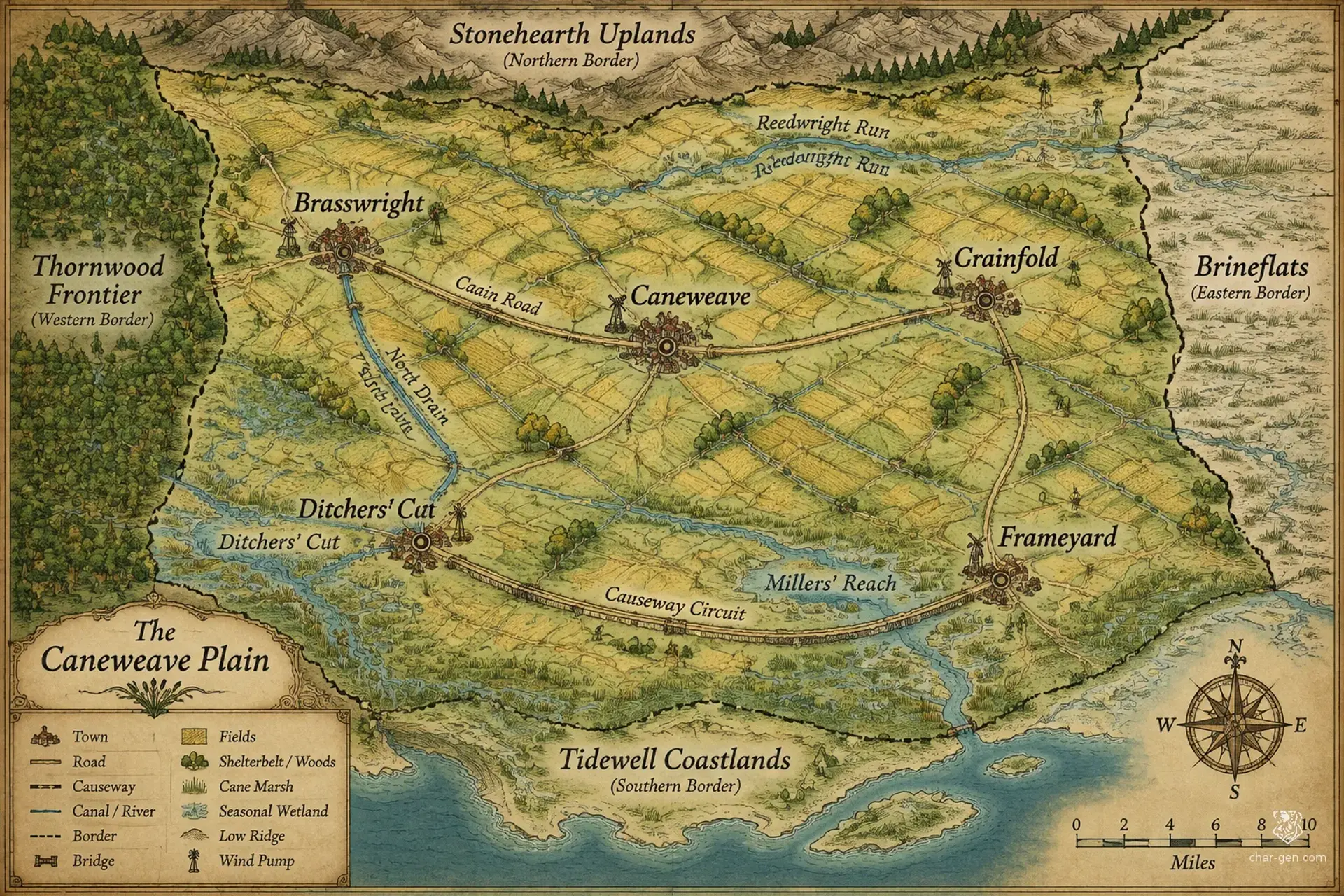
The Caneweave Plain is a broad homeland of Reedwright communities, farmsteads, market towns, and the roads that bind them together. Its people are constructed, but never uniform: hardwood, iron, brass, cane lattice, and generations of repairs all shape individual frames. Grain fields and open grassland dominate the view, while drainage channels and causeways carry trade between scattered settlements. Local councils prize practical agreements, though flood seasons and harvest disputes regularly test them.
Cultures
Reedwright craft traditions shape daily life, with each constructed person choosing or inheriting a distinct frame and material mix.
Market-town custom blends local craft guilds with visiting caravan traditions.
Places
5 settlements
Large · Market townCaneweaveFrame-making market townKnown for cane-lattice workshops and a broad seasonal market green.
Medium · Crossroads townBrasswrightRoadside craft and trade hubIts smiths and wagon crews serve caravans crossing the central plain.
Medium · Market villageGrainfoldHarvest and storage centerA dense belt of storehouses and farms supplies the regional exchanges.
Small · River settlementDitchers' CutCanal landing and service stopBoat crews, drainage workers, and repairers share its canal-side landing.
Small · Craft villageFrameyardReedwright craft villageThe village's open workshops accommodate many frame materials and repair traditions.
How they spread
PatternMost inhabitants live in scattered farmsteads, with denser settlement at crossings, canal landings, and market greens. Towns are numerous but locally governed, and no single settlement dominates the whole plain.
Common kinds
Farmstead clusters around wells and drainage ditches.
Market towns at road and waterway crossings.
Frame-making villages with communal repair yards.
Seasonal exchange grounds beside broad causeways.
Trade routes
The Grain Road links western farms to the southern exchange grounds.
Ditchers' Cut carries grain barges between inland fields and river markets.
The Brass Track follows the main workshops and metal suppliers.
The Causeway Circuit connects market towns above the spring flood line.
Dangers and hooks
4 threats
Most dangerous · HighCauseway WashoutsEnvironmental hazardRecurring along low crossings and poorly maintained farm tracks.
Grassfire RunsModerateEnvironmental hazard
Most common during dry summers and after careless field burning.
Grain Road RobbersVariableHuman threat
Small bands target isolated wagons on long stretches between market towns.
Fever PoolsLowDisease threat
Seasonal around stagnant floodwater and neglected drainage channels.
Hazards of the land
Spring floods can wash out causeways and isolate whole districts.
Summer grass fires race across dry fields and shelterbelts.
Stagnant flood pools bring fever and swarms of biting insects.
Plot hooks
1
Road Before HarvestRepair and negotiationA causeway has collapsed just before the grain wagons arrive, and rival crews blame one another for neglect.Starts: The damaged span at Ditchers' Cut.Reward: A repaired wagon, fair payment, and a standing welcome at nearby farmsteads.
2
No Standard FrameRights and investigationA market authority has begun rejecting Reedwrights with unusual frame materials, claiming their parts violate an old rule.Starts: The seasonal frame market at Caneweave.Reward: A valuable set of fittings and public recognition from the Frame Menders' Compact.
3
The Hidden DrainMysteryFloodwater exposes buried drainage works that appear to redirect water away from one district and into another.Starts: A washed-out ditch near the lower farms.Reward: A share of recovered tools and influence in the next council meeting.
4
Missing MeasureInvestigation and tradeSeveral grain stores stand empty despite signed delivery records, threatening a winter shortage.Starts: The weighhouse at Brasswright crossroads.Reward: A modest purse, provisions, and a choice of recovered trade goods.
The land
Climate and ground
ClimateTemperate, with warm growing seasons, brisk wet springs, and cold winters that can make unpaved roads impassable.
TerrainBroad, gently rolling plains crossed by shallow valleys, farm ditches, and low ridges.
Biomes
Open grassland and cultivated plain.
Seasonal wetlands along the lower waterways.
Scattered hardwood groves and shelterbelts.
Cane marshes near slow channels.
Waters and borders
Waterways
Ditchers' Cut, a canal built to drain fields and move grain barges.
The Reedwright Run, a slow river lined with cane beds.
The Millers' Reach, a broad stream with working sluices.
The North Drain, a seasonal channel that floods the lower farms.
Borders
Rugged uplands to the north.
Salt-grass flats to the east.
Coastal lowlands to the south.
A wooded frontier to the west.
On the road
Caravans favor raised causeways during the spring floods.
Farm tracks are easy to follow in dry weather but often vanish beneath summer grass.
Local repair crews can usually mend a broken wagon or Reedwright frame at market towns.
Landmarks
The old grain road runs straight for days across the central plain.
Hundreds of small wind pumps mark the drier western farms.
Abandoned drainage works hint at an earlier settlement pattern.
A broad market green hosts seasonal exchanges and repair fairs.
Landforms
Long low ridges used for dry-season roads.
Shallow river valleys with fertile banks.
Broad cane marshes and reed beds.
Raised field embankments and drainage ditches.
Resources
Fertile loam and grazing land.
Cane, willow, and hardwood for frames and tools.
Iron bog deposits and small local brassworks.
Clay for storage jars, tiles, and field drains.
Power
Rule
GovernmentA loose league of farmstead councils and market-town assemblies coordinates road upkeep, trade rules, and emergency stores.
SeatA rotating assembly meets at whichever market town hosts the season's exchange.
StabilityPractical and locally rooted, though disputes over tolls, drainage, and grain prices can unsettle cooperation.
Laws
Road crews and landholders must keep public ditches clear before the spring thaw.
Market scales are inspected at each major exchange.
No craft authority may compel a Reedwright to accept a frame alteration.
Harvest stores may be requisitioned only by recorded agreement of local councils.
Factions
Roadwright GuildTrade guild
Influence: Strong along the principal roads and in larger market towns.The Roadwright Guild maintains bridges, mile markers, and wagon tracks while lobbying for toll income.
Frame Menders' CompactCraft association
Influence: Broad among Reedwright craftspeople and neighborhood workshops.The Frame Menders' Compact protects the right of every Reedwright to choose repairs and materials without imposed standards.
Grain FactorsMerchant league
Influence: Considerable during harvest and at the largest exchanges.The Grain Factors seek consistent weights, storage rules, and exclusive contracts with distant buyers.
Faiths
The Kindly Joining
Influence: Common among Reedwright makers and their apprentices.Honors patient making, repair, and the duty to leave useful work for those who follow.
The Field Observance
Influence: Widespread among farm communities.Keeps rites for rain, planting, flood, and harvest, often centered on shared meals.
The Mile Keepers
Influence: Respected by carriers, ditch crews, and market councils.Treats roads and waterways as communal bonds that must be maintained through service.
People and trade
Who lives here
How manyModerate overall, with dense market-town clusters and widely spaced farmsteads across open country.
Main peoples
Reedwrights, constructed people whose frames range from carved hardwood to iron, brass, cane lattice, and mixed repairs.
Human farm families who cultivate grain, legumes, and grazing stock.
Traveling craftsfolk and merchants settled in market towns.
Other peoples
River boat crews and seasonal fishers.
Small communities of itinerant peddlers and repairers.
Languages
Reedcant, used among Reedwright communities and in craft instruction.
Common Trade, spoken at markets and along the main roads.
Lowland Cant, heard among farmsteads and river crews.
Trade
WealthGenerally modest and self-sufficient, with prosperous traders and craft households concentrated around major markets.
Work
Grain and pulse farming.
Construction, repair, and fitting of varied Reedwright frames.
Caravan trade and wagon making.
Exports
Grain, beans, and pressed cooking oil.
Cane lattice, hardwood components, and frame fittings.
Wool, canvas, and sturdy road wagons.
Imports
Salt and preserved fish from the coastward roads.
Fine tools and specialty metals not produced locally.
Markets
Caneweave market town, Brasswright crossroads, The annual Grain Exchange
History and secrets
The plains were settled by farm families and Reedwright communities who learned to share water, roads, and seasonal labor. Market towns grew where causeways met waterways, and local frame shops became a defining feature of the region. A loose league now coordinates trade and public works, though its agreements are continually tested by floods, harvest shortages, and arguments over who pays for the roads.
Key events
Early settlement
The Ditch CompactField communities joined to maintain a shared system of drains and raised tracks after repeated flood losses.
Craft expansion
The First Frame MarketsReedwright makers established open workshops where frames could be built from local materials and repaired without a single imposed pattern.
Road league era
The Toll SettlementA bitter dispute between grain carriers and road builders ended in a reluctant agreement that funded causeways through market tolls.
Secret 1 · GM only
The original canal plan was designed to control flooding unevenly, favoring early market settlements over outlying farms.Found by: Compare old field boundaries with the surviving ditch maps beneath a market weighhouse.If found: A buried drainage network could protect some districts from floods only by diverting them toward others.
Secret 2 · GM only
A sealed store beneath the road contains the first council's toll ledgers and an unratified agreement.Found by: Listen for a hollow sound beneath the oldest section of the grain road after heavy rain.If found: The chamber holds records that could undermine present toll claims and alter control of the road league.
Connections
Media
0 images
No images yet.
Visual sheet
Turn The Caneweave Plain into a sheet
A high-res, share-ready sheet you can post or print.