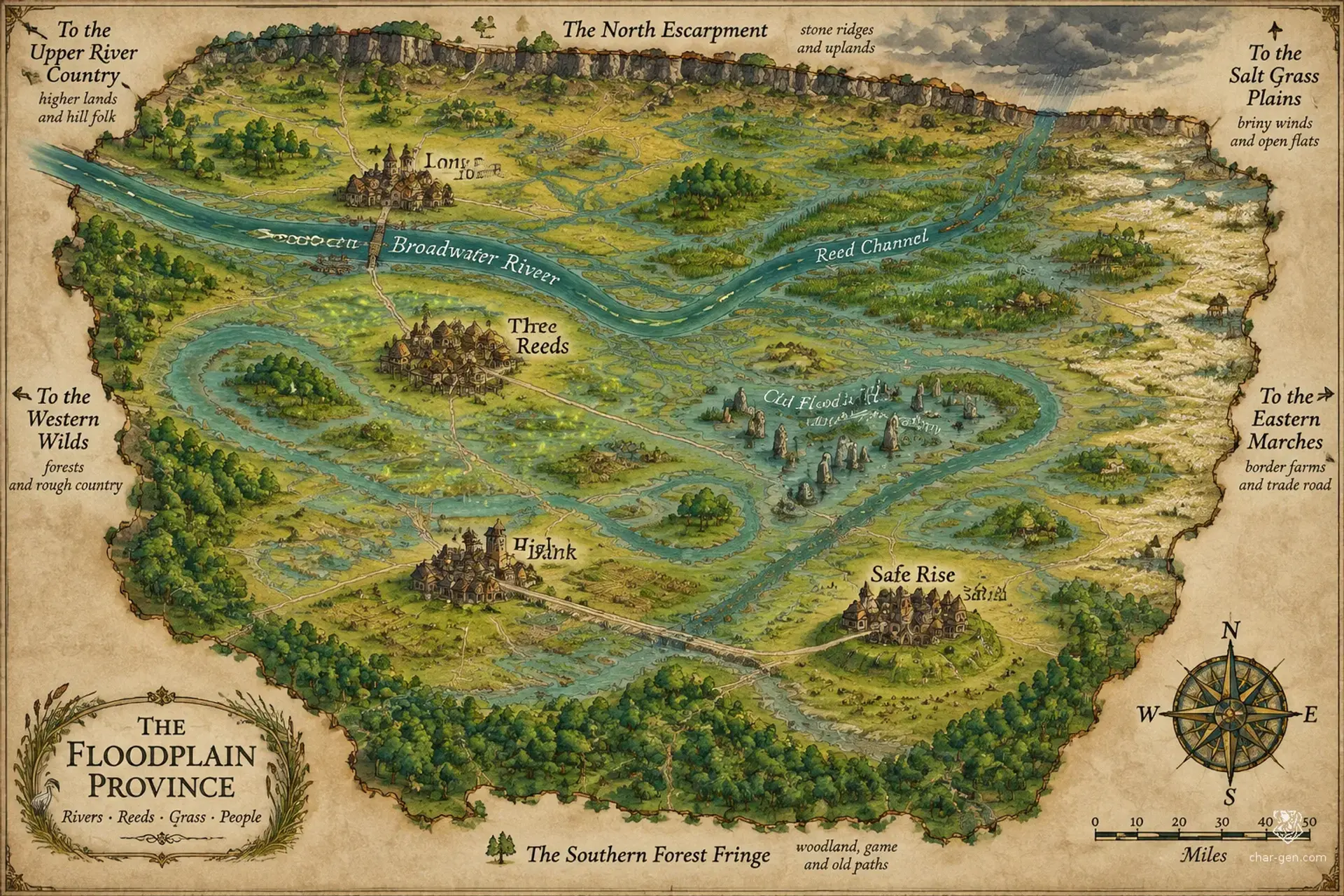
The Long Flood is a broad frontier province of wet grasslands and wandering waterways, stretching across hundreds of miles of open country. Monsoon rains turn its tracks to shallow seas, then leave rich silt for farms, grazing, and settlement. Communities cluster on natural rises and raised banks, separated by reed marshes and long stretches of unsettled plain. Common magic helps people manage daily dangers, but no spell can make the rivers keep their promises.
Cultures
Riverbank farming communities organize work around shared levees and seasonal planting.
Grassland herders follow old grazing circuits and honor hospitality obligations.
Frontier newcomers bring varied craft traditions and adapt quickly to monsoon rhythms.
Places
4 settlements
Large · Market townLong FordCouncil meeting place and major crossingA broad gravel crossing becomes a busy ferry landing when the monsoon swells the river.
Medium · River townThree ReedsRiver market and boat repair stopThree tall reed beds mark a sheltered bend where boat crews trade fish and news.
Medium · Frontier townHigh BankHerding and grain exchangeIts long natural levee keeps homes above ordinary floods and supports a weekly livestock market.
Small · VillageSafe RiseEmergency refuge and farming centerA cluster of farms and storehouses occupies a dry mound surrounded by seasonal marsh.
How they spread
PatternPermanent communities gather on raised banks and dry mounds, while smaller camps move with water and pasture. Long stretches of open plain separate the settled corridors.
The High Bank Track follows the safest ground east to west.
The Broadwater ferry chain links grain markets and river landings.
The Dry Season Road crosses the southern grasslands.
Dangers and hooks
3 threats
Most dangerous · HighThe Fast WaterEnvironmentalFlood surges race down minor channels with little warning.
Reed StalkersModerateBeasts
Large predators hunt along marsh edges and sometimes follow livestock toward settlements.
The Drowned LightsUncertainArcane anomaly
Pale lights drift against the current near old channels after dark.
Hazards of the land
Sudden flood surges
Deep mud that swallows carts
Fever-bearing insects
Lightning storms across exposed grassland
Plot hooks
1
Cold Water RisingDisaster responseA levee has failed upstream, and the floodwater is carrying an unnatural chill toward several farmsteads.Starts: The Ditch Wardens ask for help at Long Ford.Reward: A share of recovered grain and a lasting claim to local hospitality.
2
Maps Beneath the SiltExplorationA newly exposed stone chamber contains maps of channels that no longer exist.Starts: A boat crew brings a rubbing to the market at Three Reeds.Reward: A minor enchanted navigation tool and the Silt Readers' favor.
3
The Broken Grazing LineInvestigationA herd has gone missing where new fences cut across an old seasonal route.Starts: The Open Grass Compact seeks neutral mediators at High Bank.Reward: A trained riding beast and a negotiated right of passage.
4
Lights Against the CurrentMysteryA string of night fires marks something moving through the tall reeds against the current.Starts: Ferry workers report the lights after dusk at Long Ford.Reward: A waterproof charm and a bounty from the ferry communities.
The land
Climate and ground
ClimateHot, humid monsoon climate with a long wet season, brief dry spells, and frequent heavy storms.
TerrainA broad, nearly level plain crossed by shifting channels, shallow basins, and raised natural levees.
The Broadwater River, The Reed Channel, The Old Flood Run
Borders
The low escarpment to the north
The Salt Grass March to the east
The southern forest fringe
The upper river country to the west
On the road
Flooded tracks can vanish for weeks during the monsoon.
Raised causeways and local ferries are safer than open ground.
Common magic aids repairs and navigation but cannot tame the seasonal floods.
Landmarks
A line of standing stones emerges from the Old Flood Run at low water.
The wide flats near Three Reeds glow with fireflies after the first rains.
A dry mound known as the Safe Rise holds traces of an older settlement.
The Reed Channel divides into dozens of boat-sized passages.
Landforms
Low natural levees
Shallow flood basins
Long grass ridges
Silted oxbow lakes
Resources
Fertile alluvial soil
Reeds and timber
Clay
Freshwater fish
Power
Rule
GovernmentA loose frontier province governed through settlement councils, water-rights assemblies, and a rotating provincial moot.
SeatThe provincial council meets at Long Ford, where the safest crossing draws delegates and traders.
StabilityUneasy but functional, with local councils cooperating when floods threaten everyone.
Laws
Levee breaches must be reported and repaired by the nearest communities.
Grazing rights follow seasonal custom unless a council grants an exception.
River salvage belongs to the finder unless it bears a marked claim.
Factions
The Ditch WardensCivic association
Influence: Strong around the central farms and contested where new fields claim old channels.Keep irrigation ditches clear and distribute floodwater by longstanding agreements.
The Open Grass CompactHerders' league
Influence: Widely respected on the open plains and influential at frontier councils.Secure grazing access and resist fences that cut across seasonal routes.
The Silt ReadersArcane fellowship
Influence: Small but growing, especially among river traders and local spellcasters.Recover relics exposed by floods and study the region's common magic.
Faiths
The Shared Water
Influence: Widespread among farmers and ferry communities.Honoring rain, river, and the obligations between neighbors.
The Deep Crossing
Influence: Strong among boat crews and families living beside the channels.Seeking safe passage through uncertainty and offering rites for the drowned.
The Plain's Measure
Influence: Common among herders and frontier travelers.Respecting open ground, animal cycles, and the restraint of taking only what is needed.
People and trade
Who lives here
How manySparse beyond the waterways, with denser clusters near ferries, levees, and market fields.
WealthUneven and generally modest, with prosperous harvest markets beside isolated subsistence farms.
Work
Rice and millet farming
Cattle and water buffalo herding
River transport and boatbuilding
Exports
Grain, Dried fish, Reed mats, Beeswax
Imports
Iron tools, Salt, Fine cloth
Markets
Long Ford, Three Reeds, High Bank
History and secrets
The province began as a chain of farms and ferries along dependable high banks. Repeated monsoons forced neighboring communities to share labor, while the shifting rivers repeatedly erased old boundaries. A generation of relative calm drew settlers seeking cheap land, but new fields now press against herding routes and marsh commons. Floods expose traces of older construction, suggesting that the plain supported organized communities long before its present villages.
Key events
Early settlement
The Levee PactThe first farmsteads raised shared banks after a sequence of destructive seasonal floods.
Three generations ago
The Run's ChangeA major channel shifted west, leaving abandoned hamlets and exposing buried stonework.
Recent decades
The Long ClaimNewcomers established scattered holdings, renewing disputes over grazing and water access.
Secret 1 · GM only
An ancient engineered channel lies beneath the standing stones and still responds to arcane pressure.Found by: The standing stones form a pattern visible only when the Old Flood Run recedes.If found: The stones mark a buried causeway that could redirect floodwater toward settled land.
Secret 2 · GM only
The river's westward shift was accelerated by deliberate work rather than natural change.Found by: Compare the oldest ferry ledgers with the dry-season position of the river.If found: A vanished settlement may survive intact beneath a silt shelf, holding evidence of an older power.
Connections
Media
0 images
No images yet.
Visual sheet
Turn The Long Flood into a sheet
A high-res, share-ready sheet you can post or print.