Where the water takes the road, the healers make another way.
TMThe Thorn Marches
Overview
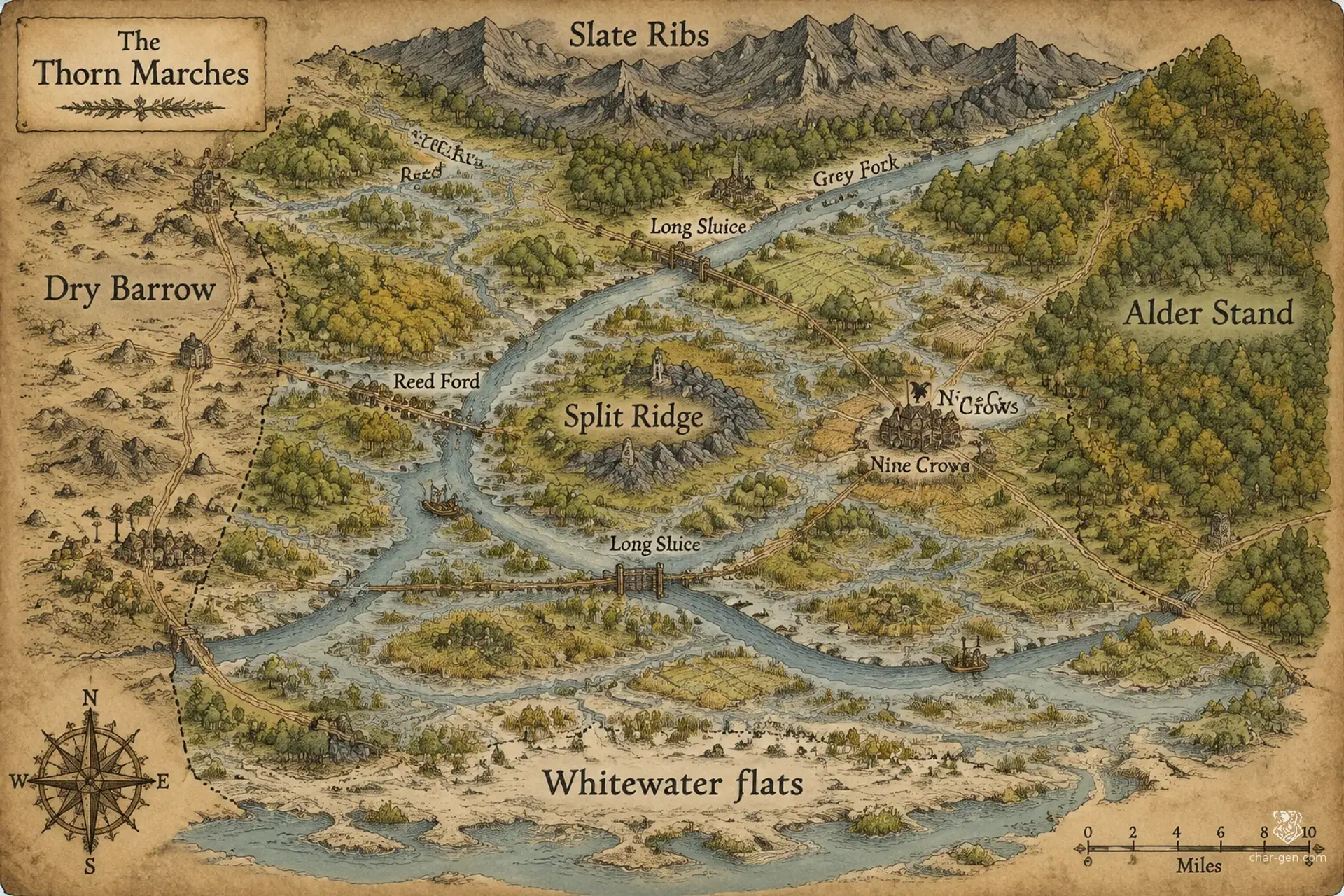
The Thorn Marches are a sprawling frontier of wet lowlands, scattered ridges, and settlements linked by ferries, causeways, and muddy tracks. Floods and altered wildlife shape everyday life as much as harvests do. The region is known for its Gene-Surgeons, practical healers who experiment because distant help rarely arrives in time. Travelers find a place of wary hospitality, hard bargains, and communities that remember who stood watch when the water rose.
Cultures
Marcher communities shaped by floodplain farming, seasonal migration, and mutual aid.
Gene-Surgeon tradition blends practical anatomy, field botany, and careful record keeping.
Old road customs persist among caravan families and border traders.
Places
4 settlements
Large · Ford townReed FordRiver crossing and market hubNamed for a shallow crossing beside dense reed beds, it hosts a busy market and a well-used clinic.
Medium · Ridge settlementSplit RidgeUpland farming and trade centerNamed for a ridge divided by a deep natural cleft, its homes overlook farms and a seasonal fairground.
Small · Canal villageLong SluiceCargo landing and boat repair stopNamed for the straight drainage cut beside its landing, it serves boat crews and marsh guides.
Medium · Roadside villageNine CrowsClinic settlement and herb-growing centerNamed for a storm-night incident locals insist involved nine escaping birds, though outsiders call it an omen.
How they spread
PatternMost people live along waterways, causeways, and the edges of cultivable floodplain. Settlements thin rapidly toward marshes and outer woodland, where isolated clinics and seasonal camps are common.
Common kinds
River market settlements.
Farm hamlets on raised banks.
Roadside clinics and herb gardens.
Timber camps on wooded ridges.
Trade routes
The raised southern causeway linking farms to the Whitewater flats.
The Grey Fork boat route between river markets.
The western road running from the Dry Barrow roadlands to the central basin.
Dangers and hooks
3 threats
Most dangerous · HighThe Pale Bank PackMutated wildlifeA shifting pack of altered predators follows the exposed riverbanks after floods.
The Under-CutHighEnvironmental hazard
Hidden banks and tunnels collapse without warning beneath roads, ferries, and buildings.
Sour Pool FeverModerateDisease
Cases recur near stagnant marsh pools and spread along crowded market routes.
Hazards of the land
Flash floods can trap travelers on low ground.
Some marsh pools carry fever or skin-irritating organisms.
Altered predators stalk livestock and isolated roads.
Unstable banks collapse beneath carts and heavy animals.
Plot hooks
1
Missing LeavesInvestigationA clinic’s carefully logged cases show that a new mutation is spreading along the river, but someone has removed the oldest records.Starts: The Fever Ledger’s public archive at Reed Ford.Reward: Payment, access to medical training, and a reliable local guide.
2
The Herd at the FenceHunt and negotiationA herd of altered deer has begun driving ordinary game toward farms, and the settlers disagree on whether to cull or capture them.Starts: The outer fields near Split Ridge.Reward: Livestock, salvageable antlers, and the gratitude of nearby households.
3
Under the SluiceExplorationA flood exposes an old tunnel containing surgical instruments and a sealed case of specimens that still move.Starts: The cut banks below Long Sluice.Reward: Rare instruments and a share of any safe discoveries.
4
Against the CurrentRescueA ferry crew vanished after claiming they saw lights beneath the water, and their empty boat has returned against the current.Starts: The landing at Reed Ford.Reward: A river passage, recovered cargo, and favors from the ferry families.
The land
Climate and ground
ClimateTemperate and wet, with long rains, brief summers, and sudden cold snaps.
TerrainA broad frontier basin of soft floodplains, wooded ridges, marshy hollows, and scattered stony rises.
Biomes
Wet meadows and reed marshes.
Mixed deciduous woodland.
Scrub-covered uplands.
Floodplain farms and willow groves.
Waters and borders
Waterways
The Reed Run, a slow river threading the central marshes.
The Grey Fork, a branching stream used by small cargo boats.
The Long Sluice, an old drainage channel with steep muddy banks.
Borders
The Slate Ribs upland escarpment to the north.
The Alder Stand frontier to the east.
The Whitewater flats to the south.
The Dry Barrow roadlands to the west.
On the road
Floods can erase familiar tracks after several days of rain.
Raised causeways are safer than direct crossings but often require local guides.
Mutated wildlife makes night travel through woodland especially risky.
Landmarks
Old drainage cuts whose origins are no longer understood.
A field of standing stones used as flood markers.
Scattered clinic gardens growing both ordinary and experimental plants.
The pale exposed banks where mutated fish gather after storms.
Landforms
A wide central flood basin.
Low wooded ridges with exposed slate.
Reed-choked marshes and peat hollows.
Gravel bars and abandoned channels.
Resources
Medicinal plants and fungus.
Willow, alder, and other workable timber.
Peat, clay, and river gravel.
Power
Rule
GovernmentA loose march council of settlement delegates, clinic representatives, and road wardens.
SeatA rotating council meets at whichever market settlement can be reached safely that season.
StabilityUneven but functional, with local councils often more trusted than distant officials.
Laws
Settlements must report outbreaks of unusual illness or animal change.
A healer may treat urgent wounds, but experimental procedures require witnesses.
River crossings must remain open to local residents during flood emergencies.
Factions
Ford MeasureCarters’ and ferrymen’s association
Influence: Strong along the main river road and influential among carriers.Keep the ford tolls fair and maintain safe passage between scattered settlements.
The Fever LedgerGene-Surgeon fellowship
Influence: Respected in clinics, but distrusted by some frontier families.Record every experimental treatment and prevent dangerous procedures from spreading unchecked.
Silt Line AssemblySettlers’ council
Influence: Growing in the outer marches, with little leverage at trade hubs.Secure land and protection for households displaced by altered wildlife and failed harvests.
Faiths
The High Mark
Influence: Widespread among farmers and fishers.Honoring the land’s cycles through offerings at flood markers and planting boundaries.
Red Cot Vow
Influence: Strong among healers and respected in most settlements.Care for the sick, restraint in experimentation, and remembrance of those who died in the fever years.
Still Bank Custom
Influence: Common in isolated hamlets, though practices vary locally.Respecting dangerous places through silence, boundary stones, and small gifts left at crossings.
People and trade
Who lives here
How manySparse beyond river valleys, with clustered hamlets and busy market settlements along reliable roads.
Main peoples
Long-settled river farmers and fishers.
Frontier homesteaders and charcoal burners.
Itinerant healers, herbalists, and Gene-Surgeons.
Other peoples
Caravan families from the southern uplands.
Displaced households from the eastern borderlands.
Languages
March Cant, a local dialect used in markets and councils.
Court Speech, common among officials and distant merchants.
Surgeon’s Marks, a standardized technical vocabulary used in clinics.
Trade
WealthPoor in isolated hamlets, with modest prosperity at river crossings and trade fairs.
Work
Mixed farming and livestock keeping.
Herbal medicine and experimental surgery.
Timber cutting, charcoal burning, and river transport.
Exports
Medicinal herbs and prepared salves.
Tanned hides and smoked fish.
Hardy seed grain and charcoal.
Imports
Iron tools and surgical needles.
Salt, lamp oil, and preserved grain.
Markets
Reed Ford markets, Long Sluice landing, Split Ridge fairground
History and secrets
The Thorn Marches grew from scattered river farms and frontier camps, joined by necessity more than law. Floods, disease, and altered wildlife made trained healers indispensable, and the Gene-Surgeon tradition developed through shared case notes and hard-won experiments. Outsiders remember the region for its strange beasts, while residents remember the failed harvests and the neighbors who stayed to help.
Key events
Three generations ago
The Lean YearsA sequence of failed harvests drove families into the basin, where they settled along raised banks and old roads.
Two generations ago
The Red Cot WinterAfter a fever swept the river settlements, healers began sharing surgical notes and testing remedies under witness.
Recent decades
The Bent-Horn PanicA wave of animal deformities followed the opening of an abandoned drainage tunnel, though the cause remains disputed.
Secret 1 · GM only
The drainage tunnel was once part of a buried treatment complex, not merely an old waterwork.Found by: Compare the oldest clinic records with the exposed drainage cuts after a major flood.If found: The wildlife changes may be tied to deliberate experiments made before the settlements arrived.
Secret 2 · GM only
A buried channel carries contaminated water beneath the marshes toward several busy settlements.Found by: Follow the pale fish upstream and inspect the gravel bars they avoid.If found: Closing or reopening the concealed channel could alter the basin’s water supply and worsen mutations elsewhere.
Secret 3 · GM only
The original river crossing was abandoned after an accident that later accounts misdescribe as a battle.Found by: Ask ferrymen why their oldest route markers all face away from the river.If found: A forgotten crossing could provide a safe escape route or let armed forces bypass the usual road checks.
Connections
Media
0 images
No images yet.
Visual sheet
Turn The Thorn Marches into a sheet
A high-res, share-ready sheet you can post or print.