Where the green ridges end, every tide opens a road or a risk.
SISouth Rum Islands
Overview
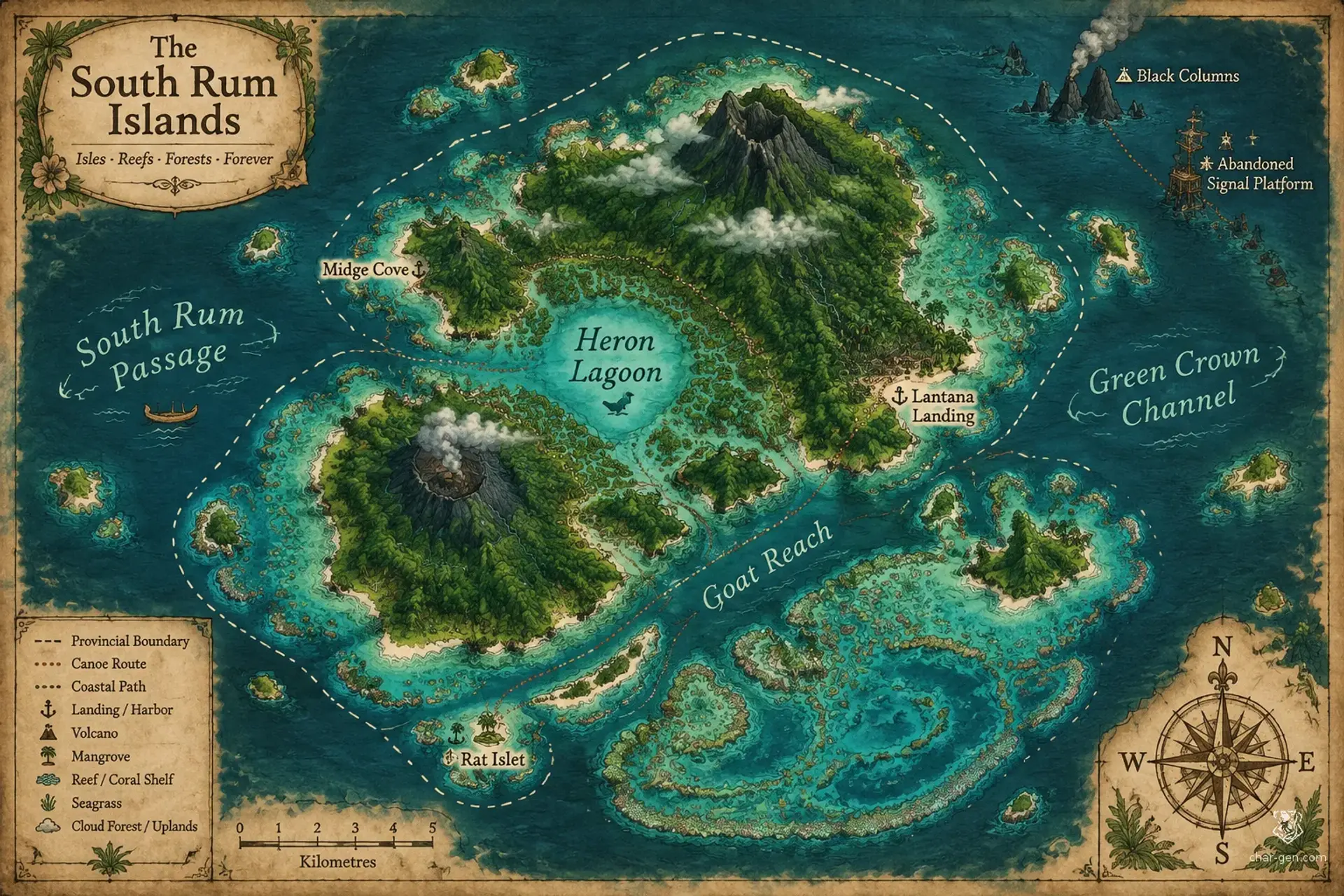
The South Rum Islands are a tropical chain of forested shores, reef mazes, and deep green ridges within the Province of the Green Crown. Fishing villages and canoe routes connect the larger islands, while smaller islets offer shelter, resources, or perilous hiding places. Life follows tides and seasons, but provincial trade, disputed fishing grounds, and rare wrecks draw outsiders into local affairs. Low magic leaves most wonders ambiguous, rooted in weather, custom, and rumor.
Cultures
Māori-inspired fishing-village traditions shape navigation, kinship, and communal stewardship.
Green Crown provincial customs blend island councils with mainland trade practices.
Seasonal voyagers maintain ties across the chain through shared feasts and boat-building.
Places
4 settlements
Large village · Harbor villageGoat ReachRegional fishing and repair stop.A broad harbor village where goats browse abandoned garden terraces and boat crews gather for repairs.
Medium village · Coastal villageMidge CoveFishing and food-preservation center.A sheltered inlet with persistent biting insects, renowned for smoked fish and skilled net-makers.
Small town · Trading landingLantana LandingInter-island market and transport link.A busy canoe landing beside thickets of invasive lantana, with a market that expands on trading days.
Small hamlet · Islet hamletRat IsletLookout and supply stop near the outer reefs.A small settlement struggles to keep stores secure from the rats that arrived aboard visiting ships.
How they spread
PatternMost communities cluster around lagoons, freshwater streams, and safe canoe landings. The steep interiors and exposed outer reefs remain thinly settled.
Common kinds
Fishing villages on sheltered beaches.
Canoe landings beside lagoon channels.
Timber camps near forest edges.
Market harbors at safe reef passages.
Trade routes
Canoe routes follow the South Rum Passage between major harbors.
Coastal boats use the Green Crown Channel to reach mainland markets.
Seasonal crews cross the Heron Lagoon chain to exchange fish, timber, and craftwork.
Dangers and hooks
4 threats
Most dangerous · HighThe Sudden SquallsNatural hazardFast-moving storm cells strike open channels with little warning.
Outer Reef WreckersModerateHuman raiders
They exploit storm damage and isolated wrecks, sometimes posing as rescuers.
The Unmarked PassModerateEnvironmental hazard
A shifting reef channel has recently swallowed boats and disrupted customary routes.
Feral Goat BandsLowInvasive animals
They damage gardens and spread across abandoned terraces on several islands.
Hazards of the land
Sudden squalls can overturn small craft in open channels.
Reef cuts become infected quickly in the humid heat.
Landslides and flash floods follow heavy rain on steep slopes.
Plot hooks
1
The Empty NetsInvestigationA village's traditional fishing ground has gone strangely empty, and neighboring crews are accused of breaking the seasonal closure.Starts: The Net-Keepers ask the party to investigate from a shore-side meeting house.Reward: A trusted local pilot, a share of recovered trade goods, and a formal favor from the alliance.
2
Charts Beyond the BreakersSalvageA wrecked survey vessel lies beyond a dangerous reef, and its missing charts could alter provincial claims.Starts: A harbor trader offers passage to the last reported sighting near the outer reef.Reward: Salvaged coin, navigational charts, and provincial goodwill.
3
The Ridge That AnsweredExplorationA timber camp has vanished beneath a new landslide, while strange lights flicker on the old signal platform.Starts: A Green Crown clerk hires the party at a rotating provincial hearing.Reward: A provincial writ, rescued workers' gratitude, and access to restricted records.
4
The Wreckage ClaimSocial conflictA boat crew returns with a sealed chest claimed by two villages under different salvage customs.Starts: The dispute reaches a council during a crowded market day.Reward: A negotiated payment, local allies, or a distinctive carved canoe fitting.
The land
Climate and ground
ClimateWarm and humid throughout the year, with heavy wet-season storms and brief, calmer trade-wind months.
TerrainA 50-to-150-mile chain of forested volcanic islands, low coral shelves, narrow beaches, and sheltered lagoons.
Biomes
Tropical coastal rainforest.
Mangrove lagoons.
Coral reefs and seagrass beds.
Cloud-damp upland forest.
Waters and borders
Waterways
The South Rum Passage, The Green Crown Channel, The Heron Lagoon chain
Borders
The open ocean to the south and east.
The northern channel leading toward the Green Crown mainland.
Outer reef waters marking the western approach.
On the road
Local pilots read reef breaks and shifting sandbars that can trap unfamiliar boats.
Inter-island crossings are quickest by canoe in settled weather and dangerous during storm season.
Forest paths are steep, muddy, and often disappear beneath fast-growing vegetation.
Landmarks
A forested ridge whose crown is visible from most central islands.
A broad lagoon where several canoe routes converge.
A field of black volcanic columns rising above the surf.
An abandoned signal platform overlooking the outer reef.
Landforms
Steep volcanic ridges cloaked in forest.
Low coral islets and white-sand spits.
Mangrove-fringed lagoons and tidal creeks.
Submerged reefs with narrow navigable passes.
Resources
Hardwood suitable for boats and houses.
Fish, shellfish, and seaweed.
Resins, fibers, and medicinal forest plants.
Power
Rule
GovernmentThe islands belong to the Province of the Green Crown, governed through a provincial commissioner and locally influential village councils.
SeatProvincial hearings rotate among the largest harbor villages, with records kept at Green Crown offices.
StabilityGenerally steady, though disputes over fishing rights, provincial levies, and timber access flare regularly.
Laws
Fishing grounds are shared by custom, and marked nursery waters are closed during spawning season.
Visitors must seek permission before cutting timber or gathering from communal groves.
Disputes between villages are first heard by a council of elders and navigators.
Shipwreck salvage must be declared to the nearest community.
Factions
The Net-KeepersVillage alliance
Influence: Strong along the inhabited shores and reef passages.Protect customary fishing grounds and keep local decisions in village hands.
Green Crown SurveyorsProvincial administration
Influence: Moderate at ports and low in remote coves.Secure dependable timber, taxes, and safe anchorages for the province.
The Goatwake CompanyMerchant consortium
Influence: Widespread among boat crews and market settlements.Control inter-island cargo and bargain for favorable trade terms.
Faiths
The Ancestor Tide
Influence: Strong in village councils, ceremonies, and the teaching of navigation.Honoring ancestors, voyaging traditions, and obligations between living communities.
The Living Shore
Influence: Widespread among fishers and gatherers, with practices varying by island.Respect for reef, forest, and weather as powers that demand care and reciprocity.
The Crown Lantern
Influence: Visible in administrative centers and among some trade families.Provincial devotion centered on lawful stewardship and the symbolic Green Crown.
People and trade
Who lives here
How manyModerate along sheltered coasts and reef passages, sparse in forested interiors and smaller islands.
Main peoples
Māori-inspired island fishing communities.
Green Crown settlers and administrators.
Mixed-heritage boat crews and market families.
Other peoples
Seasonal shellfish gatherers.
Visiting merchants and shipwrights.
Languages
Rumish, the dominant coastal tongue.
Green Crown Common, used in provincial records and trade.
Older island dialects, preserved in songs and navigational terms.
Trade
WealthUneven but generally modest, with prosperous trading families and self-sufficient village communities.
Work
Fishing and shellfish gathering.
Canoe building and inter-island transport.
Forest harvesting and cultivation of tropical crops.
Exports
Dried fish and smoked eel.
Hardwood, woven mats, and carved tools.
Pearls, resins, and medicinal plants.
Imports
Iron tools and fittings.
Grain, pottery, and sailcloth.
Markets
Goat Reach, Midge Cove, Lantana Landing
History and secrets
The South Rum Islands were settled by skilled voyagers who built communities around reefs, lagoons, and reliable canoe routes. Shared fishing customs helped connect scattered villages, while storms and wrecks made rescue obligations central to island law. The Green Crown later claimed the chain as a province, leaving local councils in place. Today, changing fish runs and growing trade strain old agreements, creating openings for negotiation, exploration, and conflict.
Key events
Early settlement
The First Reef CrossingsFounding voyagers settled sheltered shores and established seasonal fishing grounds linked by canoe routes.
Several generations ago
The Wreckage AccordA severe storm wrecked several foreign vessels, prompting shared rules for salvage and rescue.
Provincial era
The Crown SurveyThe Green Crown incorporated the chain as a province while retaining many village councils and customary practices.
Present day
The Empty NetsA recent collapse in one major fish run led neighboring communities to dispute old boundaries and seasonal catches.
Secret 1 · GM only
A rare tide exposes a deep-water channel through the black columns, known only to a few aging pilots.Found by: Compare old tide marks on the black columns with the route notes in a wrecked pilot's journal.If found: A concealed passage through the outer reef could open a safer route and undermine established harbor tolls.
Secret 2 · GM only
Some islands were deliberately omitted from the Crown Survey because their groves were promised to local communities.Found by: Inspect the provincial survey ledgers for matching gaps in records from several small islands.If found: The discovery could force the Green Crown to reconsider land claims and restore village access to forest resources.
Secret 3 · GM only
A network of polished shell mirrors lets smugglers signal between islands without magic.Found by: Ask shellfish gatherers about the nights when the abandoned signal platform shines without a flame.If found: The lights may reveal an illicit warning network used to move cargo past provincial checks.
Media
0 images
No images yet.
Visual sheet
Turn South Rum Islands into a sheet
A high-res, share-ready sheet you can post or print.