Where the grass remembers every road and the wells belong to all.
TRThe Vanishing River
Overview
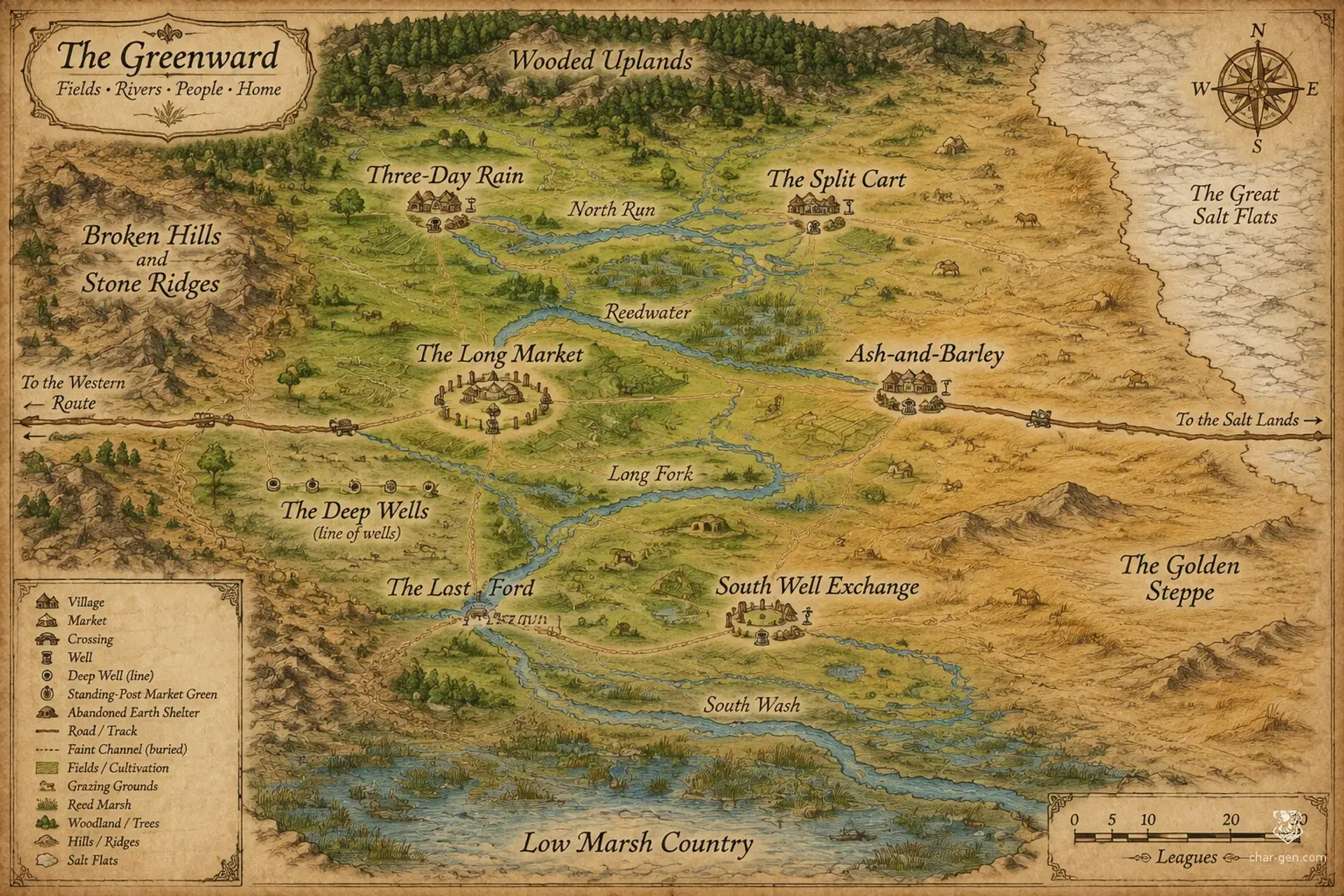
The Vanishing River is a broad homeland of the Meadowrunners, where open plains grade into cultivated grasslands, river meadows, and dry prairie margins. Settlements gather around wells and market greens, linked by visible paths worn through grazing grounds. Low homes of packed earth, timber, sod, and woven reed shelter close-knit communities, while travelers carry felted shelters between them. Seasonal water and harvests shape local politics, making hospitality, route rights, and shared wells matters of survival.
Cultures
Meadowrunner communities shaped by seasonal grazing, shared wells, and open-road hospitality.
Market-green traditions blend farming calendars with traveling craft and song.
Borderland customs favor portable felt shelters and reciprocal route rights.
Places
4 settlements
large village · well villageThree-Day RainMarket village serving nearby grain farms and herds.Its name recalls a brief storm that outsiders claim lasted three days, though local accounts say it ended by morning.
small town · road marketThe Split CartRoute junction with workshops, grazing pens, and a busy green.Named for a famous cart accident that travelers wrongly blame on a collapsed bridge.
large village · farm villageAsh-and-BarleyGrain storage and seed exchange center.The village formed from rival farming hamlets forced to share one granary after a poor harvest.
small settlement · river hamletThe Lost FordSeasonal crossing and gathering point for herders.Travelers insist a flood erased the ford, but the crossing remains shallow in most seasons.
How they spread
PatternCommunities are widely spaced across the plains, clustering where wells, dependable streams, or fertile soil offer year-round support. Seasonal camps gather along established paths and expand around market days.
Common kinds
well villages, market greens, seasonal herder camps, riverbank hamlets
Trade routes
the Broad Track linking western villages to the central markets
the Reedwater Path following river meadows southward
the Salt Road crossing the dry eastern margins
Dangers and hooks
3 threats
Most dangerous · HighRed-Grass Firesnatural hazardFast-moving flames recur across dry prairie margins and can threaten scattered homes.
The Well ClaimantsModeratehuman threat
Roving bands exploit disputed water rights and demand payment at isolated wells.
Prairie Wolf PacksLowwildlife
Packs follow grazing herds and sometimes stalk camps during harsh winters.
Hazards of the land
fast grass fires in dry weather
flash floods in shallow valleys
winter blizzards that erase tracks
Plot hooks
1
Bitter at the BottominvestigationA chain of village wells has begun tasting of bitter clay, threatening the next dry season.Starts: A crowded market green where several well keepers compare failed water tests.Reward: A share of market revenues and lasting access to protected wells.
2
Markers in the GrassdiplomacyA new toll crew blocks a customary route and claims its markers were moved by floodwaters.Starts: A roadside gathering where herders and traders are forced to turn back.Reward: Legal passage rights, trade goods, and allies among route communities.
3
The Red WindsurvivalA grass fire advances toward clustered homes while a wind shift threatens to trap the people fighting it.Starts: A signal post overlooking a smoke line beyond the grazing grounds.Reward: Community favor, livestock, and a place in the seasonal councils.
4
Below the Old TrackexplorationA buried shelter reveals records suggesting that an old river channel still carries water underground.Starts: An earthwork exposed after a storm beside an abandoned path.Reward: A recovered cache and influence over future water agreements.
The land
Climate and ground
ClimateTemperate continental climate with windy springs, warm summers, and cold winters; rainfall varies sharply by season.
TerrainBroad rolling plains interrupted by shallow valleys, low ridges, and scattered watercourses.
Biomes
open prairie, cultivated grassland, river meadows, dry steppe
Waters and borders
Waterways
the North Run, the Reedwater, the Long Fork, the South Wash
Borders
wooded uplands to the north
salt flats to the east
low marsh country to the south
broken hill country to the west
On the road
Visible paths connect homes, grazing grounds, wells, and neighboring villages.
Rain can turn wheel tracks into deep mud, while summer drought makes minor wells unreliable.
Portable felt shelters are common among travelers and seasonal herders.
Landmarks
old earth shelters half-buried along abandoned paths
ring-shaped market greens marked by standing posts
a line of deep wells maintained by several villages
mile-long grass ridges used as landmarks
Landforms
rolling prairie swells
shallow river valleys
low wind-cut ridges
seasonal marsh basins
Resources
fertile loam
wool and hides
reeds
clay for packed-earth building
Power
Rule
GovernmentA loose confederation of village councils, market assemblies, and seasonal herder gatherings.
SeatCouncil gatherings rotate among major market greens, with records kept at several well towns.
StabilityGenerally steady, but drought, disputed grazing boundaries, and grain-price shocks can quickly strain cooperation.
Laws
Well access must be shared during drought under locally witnessed schedules.
Grazing claims follow seasonal markers and must not obstruct established paths.
Market disputes are heard publicly before local elders and route witnesses.
Factions
Well-and-Wind Compactcustomary alliance
Influence: Strong across the central grasslands and among traveling herders.Keep grazing access open and settle disputes through customary gatherings.
Seed-and-Hearth Leaguefarmers' guild
Influence: Moderate in cultivated districts and market settlements.Expand grain storage and secure dependable prices for village harvests.
Road-and-Reed Fellowshipwayfarers' association
Influence: Widely respected along the broad routes, though unevenly enforced.Protect old paths from tolls and make safe conduct binding across local boundaries.
Faiths
The Open Sky
Influence: Widespread in villages and at market gatherings.Seasonal renewal, shared water, and obligations between guests and hosts.
The Kept Hearth
Influence: Strong among settled farming families.Honoring ancestors through careful tending of hearths, wells, and boundary markers.
The Moving Breath
Influence: Most visible among herders and travelers.Finding meaning in wind, migration, and the long journeys between safe camps.
People and trade
Who lives here
How manyLow overall, with dense seasonal gatherings at wells, market greens, and river crossings.
Main peoples
Meadowrunners
settled grain-growing families
seasonal herders
Other peoples
itinerant traders, riverbank reedcutters
Languages
Meadowrunner speech, Trade Cant, Old Road Speech
Trade
WealthModest and broadly distributed, with prosperous harvest markets and vulnerable lean seasons.
Work
grain farming, herding, felt and reed crafts
Exports
wool, dried grain, leather, woven reed mats
Imports
iron tools, salt, fine pottery
Markets
The Long Market, South Well Exchange
History and secrets
Meadowrunner communities have long followed the rhythms of grass, water, and seasonal markets. Villages grew around dependable wells, while herders and travelers carried news between scattered settlements. Shared grazing customs helped the region endure lean years, though access to water has repeatedly tested local bonds. The broad routes remain open through negotiation rather than central command, and every market season renews agreements among farmers, herders, and passing traders.
Key events
Old Counting
The Dry Years AccordA severe dry spell drove neighboring communities to establish shared well schedules that remain the basis of customary law.
Middle Generations
The Vanishing RiverA flood shifted the main channel, and later travelers incorrectly claimed the river had vanished entirely.
Recent Generations
The Open TrackVillage councils opened a protected cross-region path after repeated disputes over tolls and grazing boundaries.
Secret 1 · GM only
The river named in the old accord never disappeared; its deepest channel shifted beneath the prairie and still feeds a chain of wells.Found by: Compare the oldest well ledgers with the buried channels exposed after heavy rain.If found: A hidden underground watercourse could sustain settlements, but control of it may overturn customary access rights.
Secret 2 · GM only
Several route markers were moved generations ago to conceal a broad stretch of shared pasture.Found by: Look for matching cuts on old route posts beneath newer market markers.If found: Proof of a deliberate boundary deception could reopen grazing land and trigger a dangerous dispute.
Media
0 images
No images yet.
Visual sheet
Turn The Vanishing River into a sheet
A high-res, share-ready sheet you can post or print.