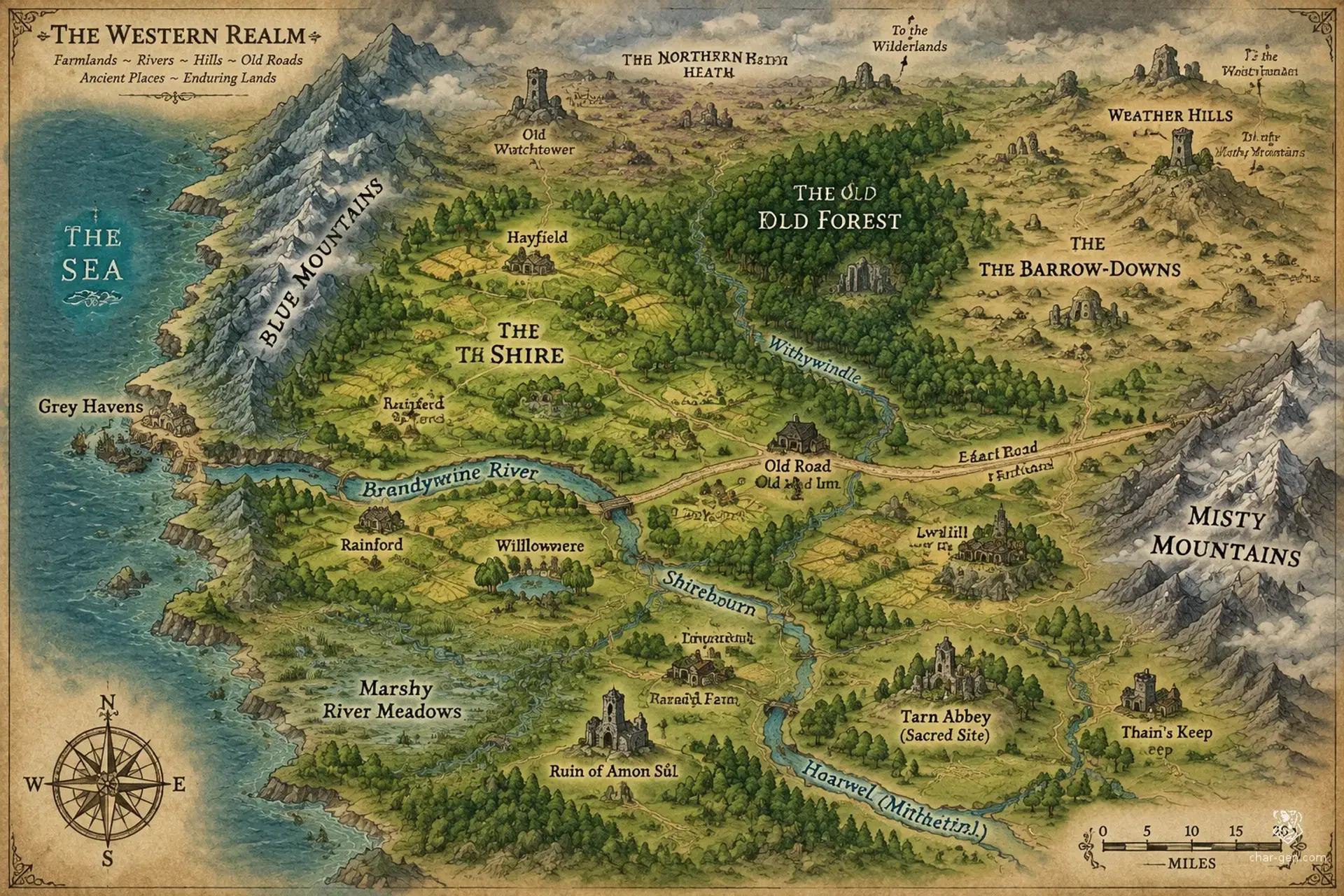
Hearth smoke rises over green fields while old roads listen for footsteps from the east.
TEThe Shire & Eriador
Overview
The Shire & Eriador spans a broad sweep of western Middle-earth, from snug farms and hedged lanes to lonely hills, old roads, and half-forgotten ruins. The Shire is a sheltered pastoral heartland, but beyond its familiar boundaries, settlements grow scattered and travelers depend on local goodwill and unseen protectors. Magic is uncommon and subtle, lingering strongest in ancient places and inherited lore. Rumors from the east now trouble market roads that once seemed safely ordinary.
Cultures
Hobbit communities shaped by gardens, kinship, and local custom.
Rural communities of Men blending farming traditions with roadward hospitality.
Dúnedain and other northern peoples preserving fragments of older lore.
Places
5 settlements
Large village · VillageHayfieldAgricultural market and place to gather local newsA broad farming village known for its harvest gatherings and well-kept lanes.
Small town · Market villageRainfordTrade stop and crossing pointA river crossing with a busy market yard that grows muddy after storms.
Small village · VillageLow HillFrontier supply pointA compact settlement of cottages and small farms near the edge of the settled country.
Hamlet · Inn and hamletOld Road InnRoadside refuge and rumor sourceA weathered coaching house serves travelers, carters, and messengers along a quiet stretch.
Hamlet · Riverside hamletWillowmereFishing and river trade communitySeveral steadings share a marshy river meadow where fish and reeds supplement farm work.
How they spread
PatternSettlements cluster thickly in the Shire's fertile fields and along rivers, roads, and crossings. They thin rapidly northward and eastward, where isolated steadings, ruins, and wilderness dominate.
Common kinds
Farm villages and clustered homesteads
Market villages and roadside inns
Small towns at bridges and crossroads
Ranger shelters and remote steadings
Trade routes
The East Road links western settlements with Bree and the eastern approaches.
River crossings carry local produce and connect scattered market villages.
Old north-south tracks join farms, woodland edges, and remote watchpoints.
Dangers and hooks
4 threats
Most dangerous · ModerateThe Barrow-hauntUndead perilA few ancient tombs stir uneasily, especially during nights of mist and cold wind.
Eastern ScoutsModerateHostile agents
Unfamiliar riders and spies have been reported near distant road crossings.
Roadside CutpursesLowBandits
They target lone travelers and poorly guarded wagons on remote stretches.
Hungry PacksLowWildlife
Wolves and other beasts press closer to farms when winter is lean.
Hazards of the land
Sudden floods and rain-swollen fords
Wolves and other hungry beasts in remote country
Unstable ruins and forgotten dungeons
Bandits or hostile travelers on isolated roads
Plot hooks
1
Tracks in the Turnip RowsInvestigationA succession of night raids leaves broken gates and missing livestock, but no clear tracks.Starts: A farmstead beside a market roadReward: Coin, provisions, and a favor from the local community
2
The Silent MilepostRescue and explorationA courier carrying an old map has vanished near a ruined watchpoint, and several parties seek the same route.Starts: A roadside inn on the East RoadReward: A recovered map and access to a hidden safe path
3
A Light Beneath the MoundsMysteryAn ancient barrow hums faintly at dusk, unsettling nearby animals and drawing curious treasure-seekers.Starts: A village at the edge of the Barrow-downsReward: A modest heirloom and the gratitude of the villagers
4
The Message at MarketIntrigueA trader brings alarming eastern rumors, but a forged message may be designed to empty a vulnerable settlement.Starts: A crowded market near a river crossingReward: Trade credit, useful contacts, and trustworthy intelligence
The land
Climate and ground
ClimateMild and temperate, with frequent rain, gentle summers, and occasional hard winters.
TerrainFertile rolling farmland and low hills give way to heath, woodland, and increasingly wild country toward the north and east.
Biomes
Rolling farmland and low hills
Temperate grassland and pasture
Mixed woodland and hedgerows
Heath and scrubland
River meadows and marshy shallows
Waters and borders
Waterways
The Brandywine River
The Shirebourn
The Withywindle
The Hoarwell, also called the Mitheithel
Borders
The Blue Mountains rise to the west.
The Misty Mountains and their approaches lie to the east.
The Grey Havens and western shores open toward the Sea.
The northern marches fade into broad, lightly settled wilds.
On the road
The East Road is the surest long-distance route, though its eastern stretches can be lonely.
Rain turns unsurfaced tracks into deep mud and swollen streams can delay carts.
Rangers know safer paths through the wilds but rarely advertise their routes.
Landmarks
The East Road crosses the region toward the Misty Mountains.
The Barrow-downs hold ancient tombs beneath their grassy heights.
The Old Forest borders the eastern Shire and resists easy passage.
The Weather Hills carry the remnants of old northern watchpoints.
Landforms
Low, rounded hills
Broad river valleys
Open heath and moor
Wooded ridges and ancient mounds
Resources
Fertile soil and pasture
Timber and firewood
Clay, stone, and river fish
Medicinal herbs and orchard fruit
Power
Rule
GovernmentThe Shire governs itself through local custom, elected or inherited offices, and community meetings; beyond it, settlements depend on village councils, keepers, and regional alliances.
SeatAuthority is local and dispersed, with Shire business handled through customary offices and meetings rather than a single capital.
StabilityThe Shire is notably stable, while Bree-land and the farther marches rely on local agreements and vigilant travelers.
Laws
Shire custom protects private gardens, boundaries, and peaceful household life.
Road use and market disputes are settled by local authority and established custom.
Serious violence is forbidden, though remote communities may lack a reliable watch.
Old ruins and marked ranger paths are not to be disturbed without good cause.
Factions
Shire MootsLocal councils
Influence: Strong within the Shire, limited beyond its borders.The Shire's customary officers and local councils
Northern RangersWandering protectors
Influence: Quiet but consequential across the northern settlements.Maintain safe roads, discreetly watch the eastern approaches, and preserve old knowledge.
Roadwardens' FellowshipCarters and traders
Influence: Practical influence at inns, markets, and road crossings.Keep the East Road usable and secure fair passage for caravans.
Faiths
The One and the Valar
Influence: Broad cultural influence, usually quiet and personal.Reverence for the One and respect for the created world, expressed through custom more than formal worship.
Elven remembrance
Influence: Most visible among Elves and those who preserve older lore.Memory, song, and care for the living world and its long history.
Hearth and Harvest Customs
Influence: Common in daily life, especially among rural communities.Household blessings, harvest gratitude, and local traditions.
People and trade
Who lives here
How manyDense in the Shire's settled farmlands and sparse across the northern and eastern wilds.
Main peoples
Hobbits of the Shire
Men of Bree-land and the settled roads
Dúnedain of the North
Other peoples
Dwarven merchants and travelers
Elves passing along ancient roads
Languages
Westron
Hobbit dialects of Westron
Sindarin, chiefly among lorekeepers
Adûnaic, known to a few scholars
Trade
WealthGenerally comfortable in the Shire, with modest means and uneven security elsewhere.
Work
Mixed farming and orchards
Brewing, milling, and food preservation
Roadside trade and animal husbandry
Exports
Grain, pipe-weed, and apples
Cheese, wool, and cured meats
Ale, pottery, and carved wood
Imports
Iron tools and worked metal
Fine cloth and southern wines
Salt and specialized medicines
Markets
Market villages of the Shire
Bree and its crossroads
Waystations along the East Road
History and secrets
The Shire grew from settled farmland within the greater lands of Eriador, where the remnants of older kingdoms lie beside ordinary roads and fields. Kingdoms rose and fell, roads decayed, and the northern wilds claimed abandoned places. Hobbits preserved a quiet, self-governing way of life, while Rangers kept a largely unseen watch. In the present, rumors from the east disturb familiar markets even as daily routines continue.
Key events
Early Third Age
The Shire's SettlementHobbit families settled fertile lands west of the Brandywine and established durable village customs.
Late Third Age
The Northern Kingdom's DeclineThe North-kingdom fractured, leaving roads and watchful duties to scattered communities and the Dúnedain.
Third Age, 1636
The Great PlagueA great plague crossed the region, thinning settlements and leaving many old homesteads abandoned.
Third Age, 1975
The Fall of AngmarThe defeat of the Witch-king ended a northern terror, but much of Eriador remained sparsely settled.
Secret 1 · GM only
An abandoned northern watch-network still has hidden shelters and signal points along the old roads.Found by: Compare the marks on old milestones with fragments kept by a ranger or lorekeeper.If found: A concealed route could help protect settlements or provide an approach for hostile forces.
Secret 2 · GM only
One isolated mound contains an ancient ward whose subtle influence has kept a nearby valley unusually peaceful.Found by: Notice how local animals avoid a grassy rise even when the weather is calm.If found: Disturbing the site may awaken a lingering peril, while understanding it could avert a local disaster.
Secret 3 · GM only
Someone is using routine trade traffic to move supplies along a forgotten branch of the East Road.Found by: Aged market ledgers record shipments that never arrived, all tied to one neglected road.If found: The missing goods may reveal organized theft, or a deliberate effort to conceal movement from the east.
Media
0 images
No images yet.
Visual sheet
Turn The Shire & Eriador into a sheet
A high-res, share-ready sheet you can post or print.