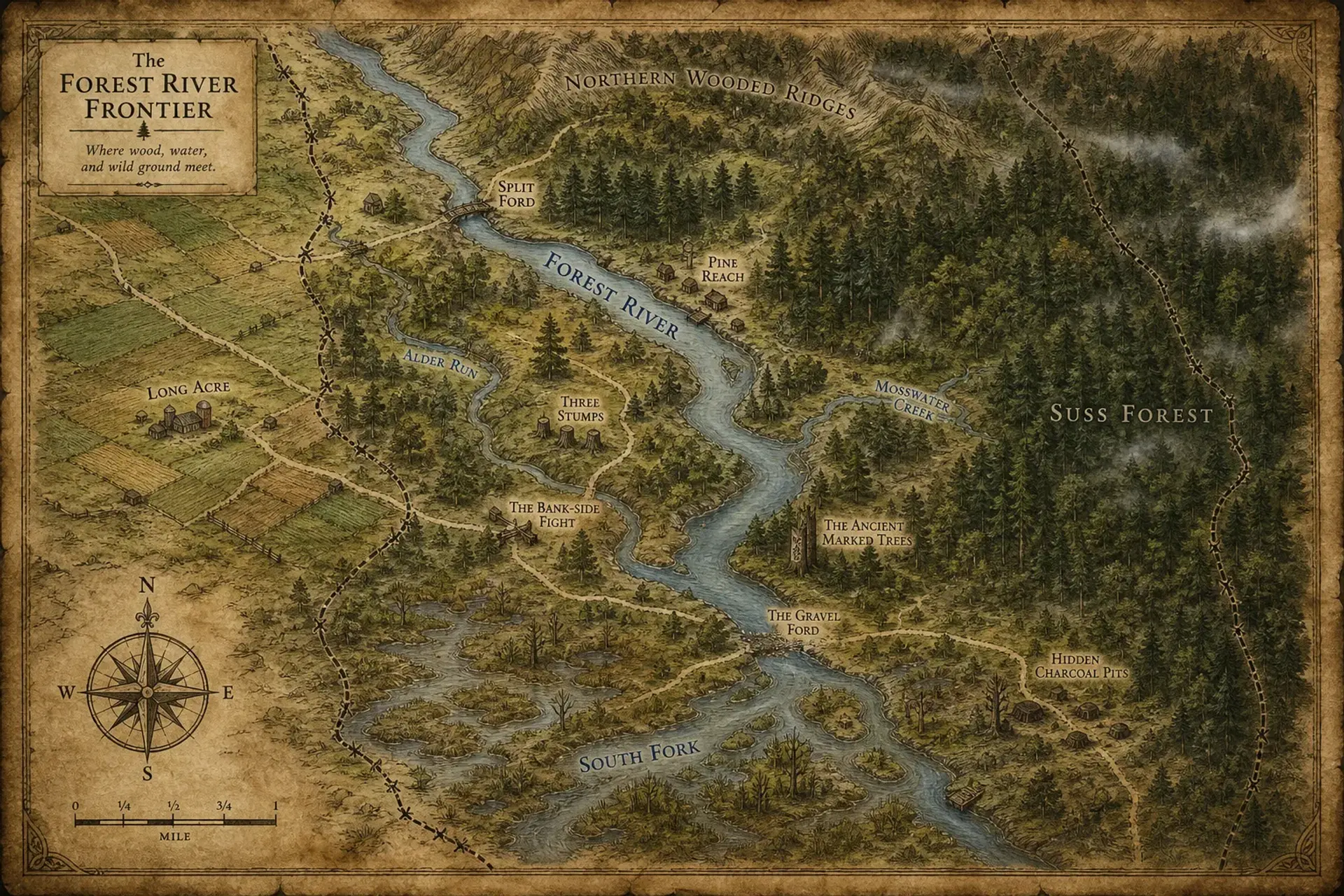
Forest River is a broad woodland region where the Suss Forest presses close to a winding, cold-water channel. Small settlements occupy clearings, fords, and raised banks, separated by long stretches of timber and wet ground. The river offers food and a route for trade, but its crossings are few and its floods unpredictable. Wolves, werewolves, and human rivalries make the familiar paths feel unsafe, especially near the site of a recent battle.
Cultures
Suss foresters value shared trails, seasonal hunting, and careful use of the woods.
Riverfolk organize life around ferries, fishing rights, and flood seasons.
Homesteaders from the distant lowlands preserve customs poorly suited to the deep forest.
Places
4 settlements
Small · Ferry hamletSplit FordCrossing and trade stopA broad gravel crossing with a ferry when the water rises.
Small · River villagePine ReachFishing and river tradeA riverside cluster of fish sheds, boat landings, and modest storehouses.
Tiny · Work campThree StumpsTimber and charcoal productionA scattered camp whose name comes from three old trees left beside its main track.
Small · Ridge hamletLong AcreFood supply and horse exchangeAn upland farming cluster named with a term carried over from its founders' distant homeland.
How they spread
PatternSettlements cluster at fords, dry banks, and the edges of clearings. The forest interior is mostly empty except for seasonal camps and isolated shelters.
The river passage linking Split Ford with Pine Reach
A ridge track carrying timber west to the farms
A hunters' path connecting scattered forest clearings
Dangers and hooks
3 threats
Most dangerous · HighThe Bank PackWerewolves and wolvesTracks and signs remain near the site of the recent battle, despite the slain creatures being left behind.
FloodwaterModerateEnvironmental hazard
Seasonal surges sweep through backwaters and over low crossings.
Sinkholes and concealed roots break through the forest floor.
Plot hooks
1
The Empty BankInvestigationA ferryman finds the bodies from the bank-side fight disturbed, though no tracks lead away from the river.Starts: The landing at Split FordReward: A reliable river passage and payment in trade goods
2
Marks in the GroveFaction disputeTimber crews discover fresh boundary marks cutting across a grove claimed by several families.Starts: A logging camp on the northern ridgeReward: A share of the timber claim or a favor from the local council
3
The Pressed PackWilderness threatA string of missing traps and ravaged camps suggests that something is driving predators toward the river.Starts: A hunter's shelter beside Alder RunReward: Fine furs, local guides, and a safe route through the woods
4
Under the FordExplorationA flood exposes a stone-lined passage beneath the old landing, with fresh air rising from below.Starts: The gravel flats at Split FordReward: Recovered relics and the right to keep one discovered treasure
The land
Climate and ground
ClimateCool, wet temperate weather brings misty springs, mild summers, and long damp autumns.
TerrainThe Forest River winds through dense woods, low ridges, muddy flats, and occasional open glades.
Biomes
Mixed temperate forest, Riverine wetlands, Pine barrens, Brushy clearings
Waters and borders
Waterways
Forest River, Alder Run, Mosswater Creek, The South Fork
Borders
The deeper Suss Forest to the east
Open farm country to the west
A chain of low wooded ridges to the north
Marshy tributary country to the south
On the road
River crossings are scarce and often controlled by local ferrymen.
Old hunting tracks vanish beneath leaf litter and shifting undergrowth.
After heavy rain, the banks become slick and low trails flood.
Landmarks
The bank where the hunting pack tried to trap travelers
A line of ancient trees marked with shallow cuts
A broad gravel ford exposed during dry months
Ruined charcoal pits hidden beneath bracken
Landforms
Steep, undercut riverbanks
Low wooded ridges
Flooded backwaters
Broad mossy clearings
Resources
Hardwood timber
Freshwater fish
Clay and river gravel
Medicinal herbs
Power
Rule
GovernmentLoose councils of settlements share customary laws, with wardens enforcing river and woodland agreements.
SeatNo single seat governs the region; seasonal councils meet at the busiest ferry crossings.
StabilityGenerally steady, though disputes over timber rights and unexplained wolf attacks strain cooperation.
Laws
Ferries must keep a passage open for local residents.
Large timber stands require consent from nearby households.
A found corpse must be reported before burial or removal.
Factions
Ford WardensLocal compact
Influence: Strong along the river settlements.They protect customary access to fishing places and oppose reckless timber cutting.
The Lowland CompanyMerchant consortium
Influence: Growing near sawpits and landing stages.They seek reliable timber contracts and wider access to the forest interior.
Rootmark KeepersTraditionalist society
Influence: Quiet but respected among forest families.They preserve old paths and keep outsiders from disturbing marked woodland sites.
Faiths
The River Mothers
Influence: Common among river families and ferry crews.Offerings for safe crossings, steady rain, and fish in season.
The Root Ancestors
Influence: Strong among forest-born households.Respect for old trees, ancestral paths, and the balance between taking and leaving.
The Far Lantern
Influence: Practiced quietly by hunters and travelers.Protection from beasts and guidance for the dead who perish far from home.
People and trade
Who lives here
How manySparse overall, with small clusters along the river, clearings, and established tracks.
Main peoples
Forest-born human families
River traders and ferrymen
Scattered woodland halfling communities
Other peoples
Seasonal charcoal burners, Traveling hunters
Languages
Common, Suss Cant, River Trade Speech
Trade
WealthModest, with most wealth held in trade goods, boats, and usable land.
Work
Timber cutting, Fishing and ferry service, Hunting and trapping, Charcoal burning
Exports
Hardwood planks, Smoked fish, Furs and hides
Imports
Iron tools, Salt, Grain
Markets
Split Ford, Pine Reach
History and secrets
The Forest River has long drawn scattered families to its fords, fishing reaches, and dry ground above the flood line. Its channel has shifted repeatedly, erasing old paths and forcing settlements to move. Recent timber growth has brought more outsiders and sharper disputes over access. The party's battle with wolves and werewolves is now a local warning, especially because the slain creatures were left where they fell before the travelers crossed the water.
Key events
First settlement
The Ford CampsEarly families established camps at reliable fords and began marking routes through the woods.
Flood years
The Changed ChannelA run of floods shifted the river channel and drowned several old landing places.
Recent generations
The Landing AccordTimber crews and fishing families formed a compact after a dispute over a shared landing.
Recent past
The Bank-Side FightA hunting pack trapped travelers near the bank before being slain, leaving bodies on the forest side.
Secret 1 · GM only
The woodland boundary marks conceal an older map of freshwater sources and safe routes.Found by: A charcoal burner remembers that the oldest boundary cuts point toward a spring beneath the ridge.If found: The spring feeds a hidden stream that could change the value of several land claims.
Secret 2 · GM only
One member of the hunting pack escaped before the party crossed the river.Found by: The tracks around the slain pack cross and recross the bank without matching the number of bodies found.If found: A surviving creature may be gathering allies or following the party's trail.
Secret 3 · GM only
An older river channel lies beneath the floodplain and still holds a usable stone causeway.Found by: A sunken post appears only at low water near a stretch where the channel runs unusually straight.If found: The post marks an abandoned crossing that could reopen a lost trade route.
Connections
Media
0 images
No images yet.
Visual sheet
Turn Forest River into a sheet
A high-res, share-ready sheet you can post or print.