Where the last hay dries, old stones keep their counsel.
LPLate Hay Plain
Overview
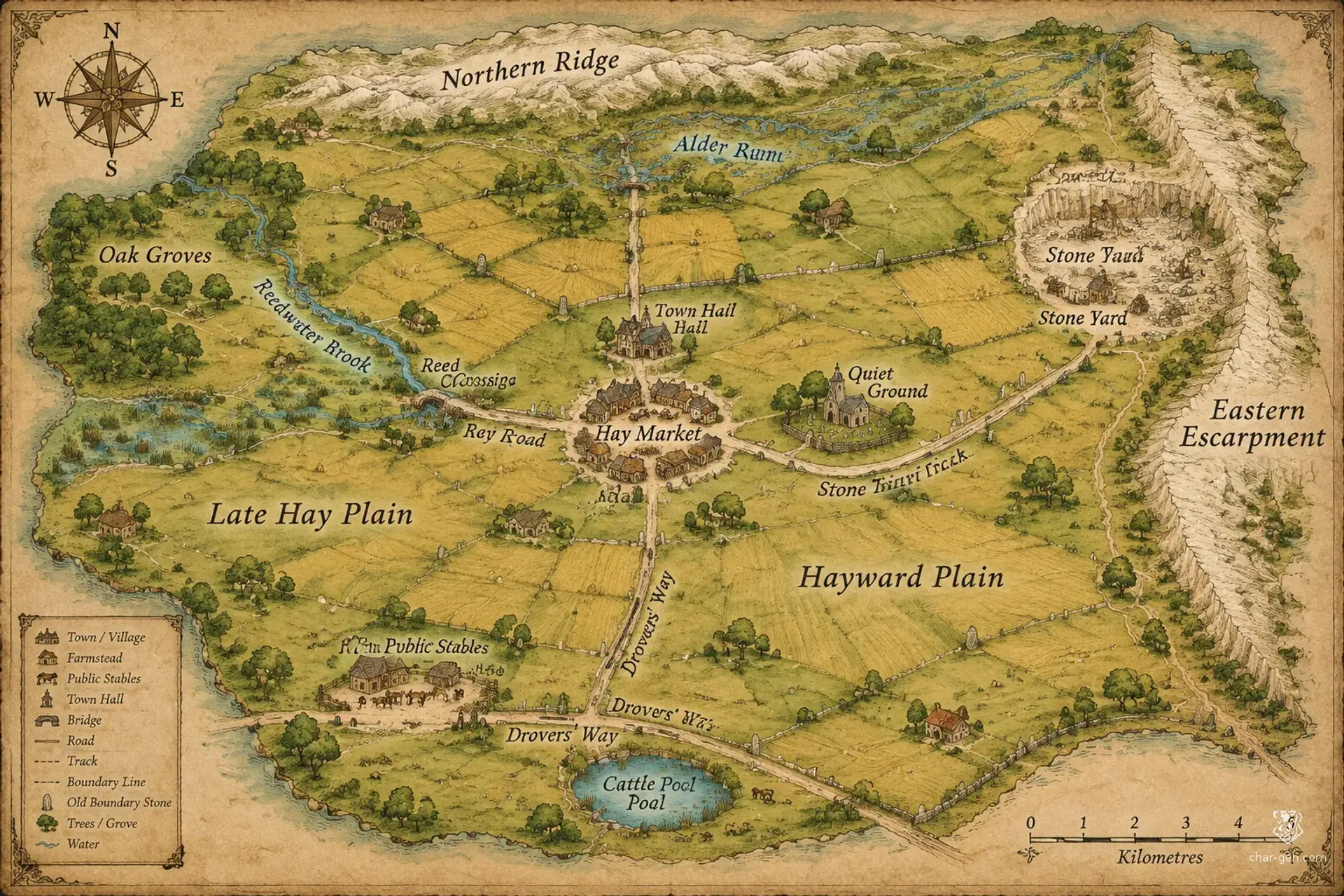
Late Hay Plain is a modest stretch of temperate grassland, broad enough for scattered farms, hamlets, and several competing local interests. Its open fields and low ridges make travel easy in fair weather, while rain-swollen hollows can isolate settlements. A quarry, public stables, carpenter's yard, graveyard, and shared town hall give the crossroads district a practical heart. Magic is uncommon, and local mysteries tend to hide in old boundaries, buried stone, and family memory.
Cultures
The Hayward communities mark the turning seasons with shared harvest meals and pasture fairs.
The Quarryfolk preserve practical stoneworking customs and pass trade skills through family workshops.
The Roadside households welcome travelers with local news, lodging, and communal stable care.
Places
4 settlements
Small · Market villageHay MarketAdministrative and trading crossroadsA market village with a town hall, public stables, a carpenter's yard, and weekly livestock sales.
Small · Quarry hamletStone YardQuarrying and stone tradeWorkers quarry chalk and limestone nearby, and the settlement's yards are crowded with cut blocks.
Tiny · HamletQuiet GroundBurial ground and roadside shelterA few cottages and a caretaker's house stand beside the walled graveyard.
Small · Riverside hamletReed CrossingFarm market and western crossingA timber bridge and several farmsteads serve travelers crossing the brook.
How they spread
PatternFarmsteads are scattered across the plain, while hamlets gather near wells, crossings, and reliable tracks. The largest gatherings form around the town hall, stables, and weekly market.
The Hay Road links western farms to the market crossroads.
The Stone Track carries quarry loads toward the eastern escarpment.
The Drovers' Way follows pasture edges south toward neighboring lands.
Dangers and hooks
3 threats
Most dangerous · ModerateLeanwinter WolvesPredatorsPacks range near isolated herds during cold months.
Trackside TakersModerateBandits
Small bands waylay lone carts on poorly watched stretches of road.
The Hollow CutLowEnvironmental hazard
Unstable quarry passages occasionally collapse without warning.
Hazards of the land
Sudden summer storms flood low crossings.
Unmarked quarry cuts threaten careless travelers.
Wolves sometimes follow livestock herds in lean winters.
Plot hooks
1
Tracks at the GraveyardInvestigationA set of fresh hoofprints circles the graveyard wall each morning, though the gate remains locked.Starts: The graveyard caretaker asks the party to spend a night on watch.Reward: A reliable riding horse and a modest payment.
2
The Cut Beneath the RidgeExplorationA quarry crew broke into a sealed chamber containing tools that do not match the region's known history.Starts: The Chisel Hands offer access in exchange for safe recovery of their missing foreman.Reward: Useful stonework, local favors, and a share of recovered goods.
3
The Empty StallCrimeA string of stolen horses suggests that someone is using the stables as cover for a wider smuggling route.Starts: A stable keeper quietly hires the party after another valuable mount disappears.Reward: A travel horse, coin, or information about regional routes.
4
Lines in the GrassNegotiationTwo hamlets claim the same strip of hay meadow after old boundary markers vanish.Starts: The town hall requests neutral investigators before the dispute turns violent.Reward: Council favor, supplies, and a small parcel of grazing rights.
The land
Climate and ground
ClimateTemperate, with mild wet springs, warm summers, and frosty winters.
TerrainMostly rolling plains, broken by low ridges, shallow hollows, and a few stony rises.
Biomes
Open grassland, Hay meadows, Scattered oak groves, Reed-lined ponds
Waters and borders
Waterways
The Reedwater Brook winds through the western meadows.
The Alder Run drains the northern hollows.
The shallow Cattle Pool fills seasonally beside the southern track.
Borders
Low chalk ridges mark the northern edge.
A belt of mixed woodland shades the western boundary.
A shallow escarpment rises to the east.
The southern boundary fades into neighboring pasture.
On the road
Dry-weather tracks cross the open fields, but rain turns them into deep ruts.
The old graveyard lane is the quickest route between the market and the quarry.
Travelers can usually find stables near larger crossroads.
Landmarks
A walled graveyard stands beside the old road.
The public stables shelter riders and freight horses.
A busy quarry cuts into the eastern ridge.
The town hall hosts seasonal councils and market hearings.
Landforms
The rolling Hayward Plain
The eastern chalk escarpment
The shallow reed hollows
The low northern ridge
Resources
Chalk and workable limestone
Grazing land
Hardwood from the western groves
Freshwater from shallow wells
Power
Rule
GovernmentLocal hamlets send elected speakers to a seasonal council, which appoints temporary road and market stewards.
SeatA shared town hall at the largest crossroads serves as the meeting place, without being a formal capital.
StabilityGenerally steady, though disputes over pasture, quarry rights, and road upkeep recur.
Laws
Common wells must remain open to residents and passing drovers.
Quarry owners must shore unsafe cuts and mark their boundaries.
The dead may not be buried outside consecrated ground without council leave.
Horses kept for hire must be inspected at the public stables.
Factions
The Dry Grass MootPastoral council
Influence: Strong among farmers and drovers.They maintain pasture boundaries and negotiate fair access to shared wells.
The Chisel HandsCraft guild
Influence: Strong near the eastern stone workings.They seek steady contracts and oppose restrictions on quarry access.
The Dust Road WardensVolunteer patrol
Influence: Moderate along the main trade track.They keep roads passable and press settlements to fund bridge and culvert repairs.
Faiths
The Hearth Wheel
Influence: Widespread in farmsteads and village gathering halls.The turning seasons, household labor, and shared harvests.
The Quiet Names
Influence: Strong around the graveyard and among older families.Remembering the dead and keeping burial grounds undisturbed.
People and trade
Who lives here
How manySparse beyond the market lanes, with scattered hamlets and farmsteads across the open plain.
Main peoples
Long-established farming households
Stonecutters and quarry workers
Seasonal drovers and carters
Other peoples
Traveling peddlers, Itinerant shrine keepers
Languages
Common, Hayward, Quarry Cant
Trade
WealthModest overall, with reliable harvests and a few prosperous livestock and stone merchants.
Work
Grain and hay farming, Livestock breeding, Stone quarrying, Carpentry and wagon repair
Exports
Hay and grain, Horses and cattle, Quarried building stone, Carved timber fittings
Imports
Iron tools, Salt, Fine cloth
Markets
Hay Market, Stone Yard
History and secrets
The plain grew from scattered farms into a loose network of hamlets linked by pasture tracks and seasonal markets. Quarry work brought new workers and lasting trade, while the public stables and town hall grew around the busiest crossroads. A graveyard established after a deadly fever remains a place of remembrance and local caution. The settlements share traditions, but no single community governs the whole region.
Key events
Early settlement
The First Hay CutFamilies cleared the central meadows and established the first shared grazing boundaries.
Middle years
The Ridge OpenedStone workers opened the eastern ridge and supplied blocks for nearby bridges and halls.
Recent generations
The Quiet BurialA fever season prompted the building of a walled graveyard and a permanent caretaker's cottage.
Secret 1 · GM only
The graveyard's oldest wall encloses stones taken from a much older burial site beneath the quarry.Found by: A loose graveyard stone bears the same mason's mark found on a sealed quarry wall.If found: The graveyard was built over an older burial place, and opening the chamber could expose contested ancestral claims.
Secret 2 · GM only
An obsolete survey shows that the eastern pasture boundary was moved after a flood, not by lawful agreement.Found by: Compare the town hall's boundary map with the marks carved on several abandoned mile posts.If found: The true boundary could settle a bitter land dispute or threaten the livelihoods of several hamlets.
Media
0 images
No images yet.
Visual sheet
Turn Late Hay Plain into a sheet
A high-res, share-ready sheet you can post or print.