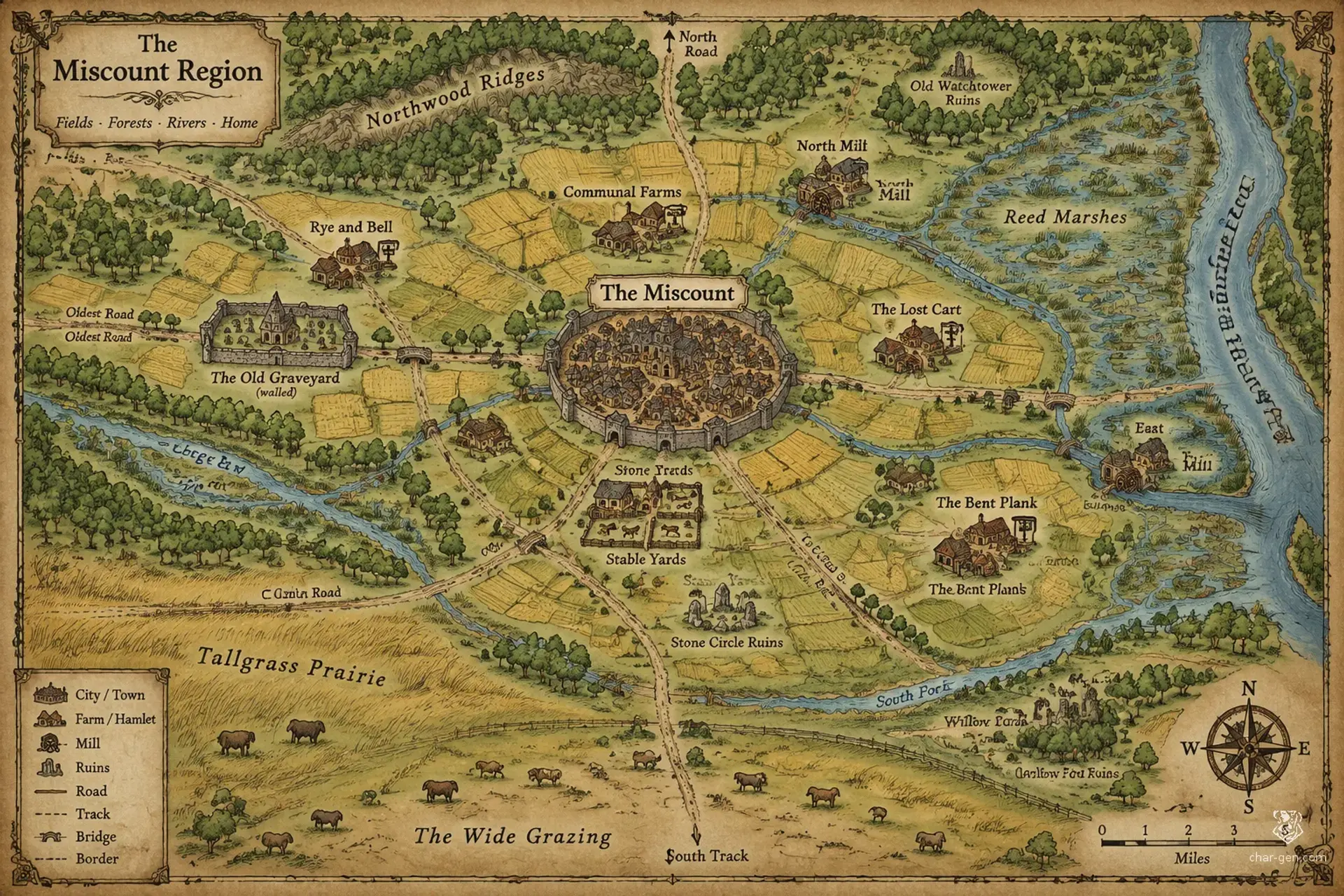
Where grain roads pass the quiet stones of the dead.
RRRye and Reed
Overview
Rye and Reed is a temperate plains region organized around a compact city-state and its broad belt of farms, pasture, and market settlements. Its level roads make travel straightforward in fair weather, while wet seasons turn ditches and low fields into obstacles. The region is known for grain, horses, practical crafts, and a civic culture built on negotiated obligations. Beneath its dependable routines lie old burial grounds, disputed tolls, and forgotten waterworks.
Cultures
The Fieldward tradition prizes shared harvest labor and practical hospitality.
The Ledgerfolk influence favors contracts, public records, and measured civic debate.
The Roadside custom welcomes traveling craftspeople and seasonal workers.
Places
4 settlements
Large · Walled cityThe MiscountCivic and commercial centerOutsiders say the market was named for a botched census, but locals insist the mistake was only a missing stall fee.
Medium · Market townRye and BellRegional livestock and grain marketIts name recalls rival grain and bellfounding interests that merged to keep a market charter.
Small · Stable hamletThe Lost CartRoadside lodging and horse exchangeTravelers blame the settlement's name on a vanished caravan, though the original event was a single cart stuck in a ditch.
Medium · Crossing townThe Bent PlankRiver crossing and timber depotThe name recalls a bridge repair that locals claim was completed in one night, a story outsiders dispute.
How they spread
PatternMost residents live in the central city and along roads or waterways, with farmsteads spaced across the open plains. Small settlements cluster near wells, bridges, mills, and reliable grazing.
Common kinds
Walled market city, Farm villages, Roadside stable hamlets, River crossing towns
Trade routes
The north road links the city to upland timber and ore markets.
The river route carries grain and timber toward eastern towns.
The south track connects pasture settlements to seasonal fairs.
Dangers and hooks
3 threats
Most dangerous · ModerateThe Ditch RunnersBanditsThey appear near isolated farms and road crossings after dusk.
The Gray FeverVariableDisease
It returns sporadically in wet seasons, especially around crowded stables.
Prairie FireLowEnvironmental hazard
Dry winds can carry flames across pasture and threaten grain stores.
Hazards of the land
Spring floods can isolate low-lying farms.
Sudden prairie fires threaten pasture and grain stores.
Wolves and feral dogs sometimes trail livestock.
Plot hooks
1
Tracks Among the GravesMysteryA graveyard caretaker finds fresh hoofprints inside a locked burial enclosure, though no graves appear disturbed.Starts: The walled graveyard beside the oldest roadReward: A safe-conduct pass and a well-kept riding horse
2
Water OwedCivic disputeA broken mill ditch threatens several farms, and each community claims another must pay for repairs.Starts: The communal farm beltReward: Coin, local goodwill, and rights to a useful riverside workshop
3
The Borrowed HerdInvestigationA stablehand reports that a string of valuable horses has been replaced by calm animals with unfamiliar brands.Starts: The public stable yardReward: A trained mount and a share of recovered trade goods
4
Iron Before HarvestEscort and intrigueA blacksmith's new tool order is being diverted, threatening harvest work across several villages.Starts: The blacksmith row at the central marketReward: Quality tools, a guild favor, and a modest purse
The land
Climate and ground
ClimateTemperate, with warm summers, cool wet winters, and occasional spring storms.
TerrainMostly level plains, gently rolling near the northern uplands and cut by shallow river valleys.
Biomes
Tallgrass prairie
Cultivated fields and pasture
Riparian groves
Seasonal marsh
Waters and borders
Waterways
The Eastmere River, The Sedge Run, The Mill Ditch, The South Fork
Borders
Low wooded uplands to the north
A broad river frontier to the east
Open grazing country to the south
A chain of market towns to the west
On the road
Packed-earth roads are dependable in summer but turn muddy after prolonged rain.
Local stables offer fresh mounts along the busiest routes.
Flooded crossings and fog can delay travelers in the low meadows.
Landmarks
A walled graveyard stands beside the oldest road into the city.
A public stable yard serves drovers, couriers, and travelers.
A long belt of communal farms supplies nearby settlements.
An old blacksmith row and carpenter yard face the main market lane.
Landforms
Wide grassland plains
Shallow river valleys
Low northern ridges
Reed-filled marsh basins
Resources
Fertile loam
Hardwood from river groves
Clay for bricks and roof tiles
Abundant pasture
Power
Rule
GovernmentA compact city-state governs its surrounding farms and market settlements through a council of ward delegates, guild voices, and rural speakers.
SeatA central civic hall in the principal walled city, shared by elected ward delegates and rural representatives.
StabilityGenerally stable, though arguments over tolls, grain levies, and urban influence flare during poor harvests.
Laws
Market weights must be inspected at each seasonal fair.
Graves and marked burial grounds may not be disturbed without civic permission.
Roadside stables must provide water to travelers in emergencies.
Open flames are forbidden near grain stores during harvest.
Factions
The Rye and Plow CompactFarmers' league
Influence: Strong in villages and at harvest gatherings.They seek stable grain prices and shared upkeep of roads, wells, and irrigation ditches.
The Toll DisputeMerchants' association
Influence: Strong along the main roads and in market wards.They want predictable tolls and expanded protection for caravans and drovers.
The Bent Hinge SocietyCraft guild coalition
Influence: Moderate in workshops and among younger craftspeople.They press for apprenticeships, fair wages, and access to civic contracts.
Faiths
The Furrow Vow
Influence: Common among farming families and village councils.Honors soil, seasonal labor, and the duty to share food in lean years.
The Quiet Measure
Influence: Strong around graveyards and among civic caretakers.Keeps rites for the dead and teaches that memory is a communal responsibility.
The Open Mile
Influence: Visible among merchants, drovers, and stable workers.Treats roads, honest exchange, and safe passage as sacred obligations.
People and trade
Who lives here
How manyModerate overall, with dense settlement around the city-state and scattered villages across fertile plains.
Main peoples
Long-settled farming families
Urban craftspeople and merchants
Seasonal laborers and drovers
Other peoples
Itinerant performers
Small communities of hill-country migrants
Languages
Common Trade Speech, Field Cant, Ledger Hand
Trade
WealthModerate, supported by reliable agriculture and busy regional trade, though wealth is unevenly distributed.
Work
Grain and vegetable farming
Horse breeding and stable services
Blacksmithing, carpentry, and wagon repair
Exports
Wheat, barley, and beans
Horses and harnesses
Tools, timber goods, and preserved food
Imports
Iron ore and finished tools
Salt and lamp oil
Fine cloth and specialty spices
Markets
The central market ward, The north road fairground
History and secrets
The region grew from a cluster of grain markets and horse yards that relied on one another for food, transport, and repair. A shared charter gradually bound the city and its surrounding farms into a small civic state. Its prosperity has depended less on conquest than on reliable roads, fair measures, and working agreements. Old burial grounds, abandoned ditches, and contested tolls still recall moments when cooperation nearly failed.
Key events
Early civic era
The Weighing CharterThe first market charter joined scattered farm communities under common weights, road duties, and dispute rules.
Middle civic era
The Quiet GravesA fever season led residents to establish a shared burial ground beyond the city road, later maintained by neighboring settlements.
Recent generations
The Bridge CountCarters and farmers settled a dispute over bridge tolls by creating a public schedule that still shapes trade.
Secret 1 · GM only
The graveyard was placed over an earlier drainage junction, and its oldest stones mark the buried channels.Found by: Compare old grave markers with the original road survey kept in the civic hall.If found: The oldest burial plot conceals a sealed drainage passage that could protect the city from flooding or become a covert route.
Secret 2 · GM only
Some bridge timbers were replaced with weaker wood after the famous toll settlement, though the accounts record no such work.Found by: Look for mismatched timber marks in the carpenter yard and ask who ordered repairs after the Bridge Count.If found: Proof of the substitution could overturn a respected local agreement and expose a continuing scheme to redirect toll revenue.
Media
0 images
No images yet.
Visual sheet
Turn Rye and Reed into a sheet
A high-res, share-ready sheet you can post or print.