Where every bridge remembers a flood and every courtyard keeps watch.
MBMorglas Basin
Overview
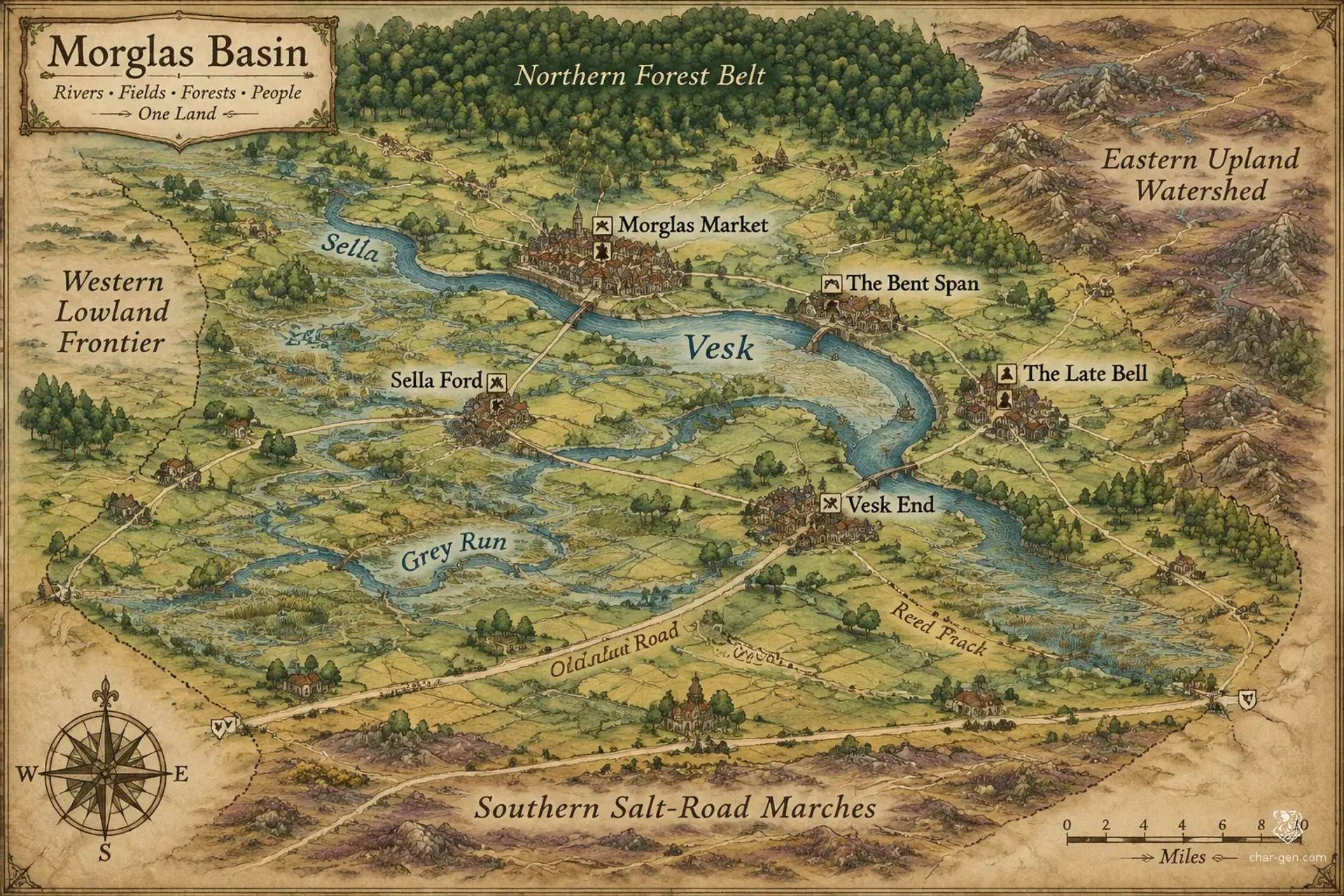
Morglas Basin is the homeland of the Morrowglass, a broad, populous region where rivers, old roads, and crowded market districts knit together many towns. Its urban communities gather around bridges, bathhouses, public courts, and markets, while homes rise in close clusters around shared stairwells and watchful courtyards. Practical balconies and deep window ledges overlook lively streets. Beyond the cities, farms, marshes, and upland villages depend on the same trade routes and flood cycles.
Cultures
Morrowglass urban culture centers on shared stairwells, watchful courtyards, old markets, bridges, bathhouses, and public courts.
Riverward communities blend Morrowglass customs with the seasonal rhythms of ferry work and floodplain farming.
Upland communities preserve older speech and host fairs where regional traditions mingle.
Places
5 settlements
Large · Market cityMorglas MarketMajor exchange and civic gathering district.Its name is a worn corruption of an older Veski phrase for high ground, and its market streets occupy a raised bank above the river.
Medium · Bridge townThe Bent SpanBridge tolls, warehousing, and river trade.Named for a bridge that allegedly sagged during a public procession, though outsiders disagree about which procession.
Small · River townSella FordFerry service and grain collection.Its name preserves a worn form of an older phrase meaning reed crossing, and its ferries serve farms on both banks.
Medium · Market townThe Late BellFlood refuge, repair yards, and memorial court.Named for a warning bell that rang too late during a famous flood, a story visitors regularly assign to the wrong year.
Small · River portVesk EndTimber landing and regional supply point.The name is a worn shortening of an older Veski term for the river's outer reach, where upland goods meet river barges.
How they spread
PatternSettlements cluster along navigable waterways, old roads, and raised banks, with the greatest density around market courts. Smaller villages occupy safer ridges and the edges of cultivated floodplains.
Common kinds
Dense market cities with courtyards and public baths.
Bridge towns and ferry villages at river crossings.
Agricultural villages on raised ground above floodplains.
Upland hamlets near woodland and heath.
Trade routes
The Vesk river route connects inland markets to southern salt roads.
The Old Court Road links regional assemblies and major market districts; its name is a worn corruption of an obsolete Veski term for meeting ground.
The Reed Track follows the marsh edge between fishing villages and upland farms.
Dangers and hooks
3 threats
Most dangerous · SevereMarsh FeverDiseaseOutbreaks follow floods in crowded wards and low-lying villages.
The Returning WaterHighNatural hazard
Floods sweep through low districts and marsh roads each year, with severe seasons threatening whole settlements.
TollcuttersModerateBanditry
Small crews prey on merchants along isolated roads and weakly guarded ferries.
Hazards of the land
Spring floods can isolate whole districts and ruin stored grain.
Overloaded bridges and neglected embankments fail without warning.
Marsh fever and contaminated wells spread after inundations.
Plot hooks
1
The Crossing AccountInvestigationA missing toll ledger could expose years of forged collections and put several river crossings under rival control.Starts: A ferry court near the Bent Span hires the party to recover a ledger stolen during market day.Reward: A legal passage writ, coin, and a lasting favor from local ferrymen.
2
Under the Common StairsExplorationA courtyard's residents hear hollow sounds beneath their shared stairwell, where a sealed passage may connect to an abandoned bathhouse.Starts: The Courtyard Wardens ask the party to inspect a cracked landing before repairs begin.Reward: A hidden cache and the wardens' support in future neighborhood disputes.
3
The Water's DueSocial conflictFlood refugees accuse a wealthy market ward of diverting water toward their homes, but the old sluice plans have vanished.Starts: Displaced families gather outside a public court seeking witnesses and protection.Reward: A recovered deed, local allies, and a share of reclaimed property.
4
The Bell BelowMysteryA bell rings beneath the marsh after every heavy rain, though no known tower stands there.Starts: A bathhouse keeper offers a reward for finding the source before panic empties the nearby district.Reward: A safe route through the marsh and a rare medicinal herb.
The land
Climate and ground
ClimateTemperate and often humid, with gentle summers, damp winters, and spring floods that can reshape roads and fields.
TerrainA broad basin of rivers, low ridges, cultivated plains, and wooded margins, with old roads linking dense urban districts.
Biomes
Temperate broadleaf forests.
Fertile river floodplains and marsh meadows.
Rolling agricultural lowlands.
Cool upland woods and heath.
Waters and borders
Waterways
The Vesk, a broad navigable river whose name descends from an older local word for moving water.
The Sella, a slow tributary with a name worn down from an older term for reed banks.
The Grey Run, a minor stream named for a famed flood whose date and cause are disputed.
Borders
The eastern upland watershed.
The southern salt-road marches.
The northern forest belt.
The western lowland frontier.
On the road
Floodwater can cut the low roads for days, while local ferrymen know alternate channels.
Crowded markets slow travel, and neighborhood passage customs matter as much as official gates.
Upland tracks become muddy and difficult after prolonged rain.
Landmarks
Old market squares preserve layers of paving from successive town plans.
Public bathhouses stand near springs and river-fed channels.
Covered bridges shelter small shrines and toll stations.
Dense residential blocks cluster around communal stairs and courtyards.
Landforms
A wide central basin cut by branching rivers.
Low wooded ridges dividing farming districts.
Reed marshes and seasonally flooded meadows.
A broken upland rim marked by heath and shallow valleys.
Resources
Fertile alluvial soil.
Clay for pottery and brickmaking.
Timber and reeds from the river margins.
Freshwater fish and marsh herbs.
Power
Rule
GovernmentA patchwork of chartered towns, neighborhood councils, and rural assemblies, coordinated by a rotating regional moot.
SeatNo single capital governs the region; rotating assemblies meet in major market courts, and their customary gathering place is commonly called the Old Court, a worn form of an obsolete Veski phrase for shared judgment.
StabilityGenerally stable through local compacts and trade agreements, but strained by toll disputes, flood displacement, and unequal access to civic courts.
Laws
Market weights must be publicly checked at recognized exchange courts.
Bridge and ferry tolls must be posted before collection.
Household courtyards must keep a clear passage for fire and flood evacuation.
Factions
Courtyard WardensNeighborhood compact
Influence: Strong in dense neighborhoods, where shared stairwells and courtyards make their local networks effective.The Courtyard Wardens take their name from an old phrase for door-watchers, now shortened by generations of Morrowglass speech.
Bridge LedgerMerchants' association
Influence: Considerable along the principal river crossings and market roads.The Bridge Ledger is a worn corruption of an older Veski term for crossing dues, and the association seeks to standardize tolls and protect its members' contracts.
Low Bell CircleCivic reform movement
Influence: Growing among tenants, bathhouse workers, and displaced families.The Low Bell Circle is named for the flood warning bell that rang too late during a notorious inundation, a story outsiders routinely misdate.
Faiths
Hearth Measure
Influence: Strong in courtyards, neighborhood courts, and domestic rites; its name is a worn corruption of an older Veski expression for the household's common portion.The Hearth Measure teaches mutual responsibility among households and the keeping of shared spaces.
Veski Current
Influence: Widely practiced by ferrymen, river workers, and families in flood districts; its name descends from an older local word for flowing water.The Open Current honors changing waters, safe crossings, and the dead lost to floods.
Witness Lantern
Influence: Prominent around markets and civic courts, where its keepers mediate disputes; the name recalls a lantern carried during an infamous court hearing outsiders often place in the wrong year.The Witness Lantern values public testimony, truthful accounts, and visible acts of charity.
People and trade
Who lives here
How manyHigh along navigable rivers and old roads, moderate across the cultivated interior, and sparse in upland woods.
Main peoples
Urban Morrowglass residents concentrated in dense market towns and cities.
Riverward farmers, ferrymen, and craftworkers settled along the waterways.
Upland villagers and herders living in scattered ridge communities.
Other peoples
Traveling traders from neighboring regions.
Bathhouse keepers and seasonal laborers who move between towns.
Languages
Morrowglass, the dominant civic and market language.
Veski, an older river language still heard in rural districts.
Trade Cant, used by traveling merchants and caravan crews.
Trade
WealthModerate overall, with conspicuous wealth in major market districts and persistent hardship in flood-prone wards.
Work
Market trade and money changing.
Textile production, pottery, and household crafts.
River transport, milling, and floodplain agriculture.
Exports
Dyed cloth and woven rugs.
Pottery, glassware, and carved household fittings.
Grain, river fish, and medicinal herbs.
Imports
Iron tools and worked metal from the eastern uplands.
Salt and preserved fish from the southern coast.
Markets
Morglas Market, a sprawling exchange district whose name is a worn corruption of the old Veski phrase for high ground.
The Bent Span, a riverside trading quarter named for a bridge that supposedly sagged during a public procession.
History and secrets
The region grew where river crossings and old market roads met, and its towns expanded around public courts, baths, and shared courtyards. Trade brought wealth, while floods repeatedly tested the ties between neighborhoods. Local compacts gradually replaced distant rule, but their authority remains negotiated. Outsiders often mistake the Late Bell flood for a single storm, though residents remember years of warnings and failures.
Key events
Early charter era
The Shared MeasureA chain of market courts formed mutual rules for weights, debts, and public arbitration.
Three generations ago
The Late BellA catastrophic flood damaged bridges and districts, prompting communal stairwell watches and new evacuation customs.
Recent past
The Crossing CompactThe river towns disputed tolls until merchants and ferrymen negotiated a common schedule.
Secret 1 · GM only
A network of sealed channels beneath several old districts can redirect floodwater, but its original controls were deliberately hidden.Found by: Compare the oldest bathhouse foundation stones with the water channels shown on obsolete market maps.If found: The passage could reveal a forgotten water-control system and give its discoverers leverage over flood defenses.
Secret 2 · GM only
The first compact granted rural ferrymen a permanent share of crossing revenue, a right quietly erased from later copies.Found by: Search court copies of the Crossing Compact for a clause omitted from the public version.If found: Proof could force a renegotiation of tolls and destabilize the merchants' association.
Secret 3 · GM only
The Late Bell disaster followed years of deliberate neglect, rather than one sudden flood as official commemorations claim.Found by: Ask elders in upland villages about the shared phrase used in old flood songs.If found: The truth could discredit a celebrated civic account and expose the cost borne by neglected communities.
Connections
Media
0 images
No images yet.
Visual sheet
Turn Morglas Basin into a sheet
A high-res, share-ready sheet you can post or print.