Where the reefs split, the first makers sleep beneath the tide.
SCSplit Reef Coast
Overview
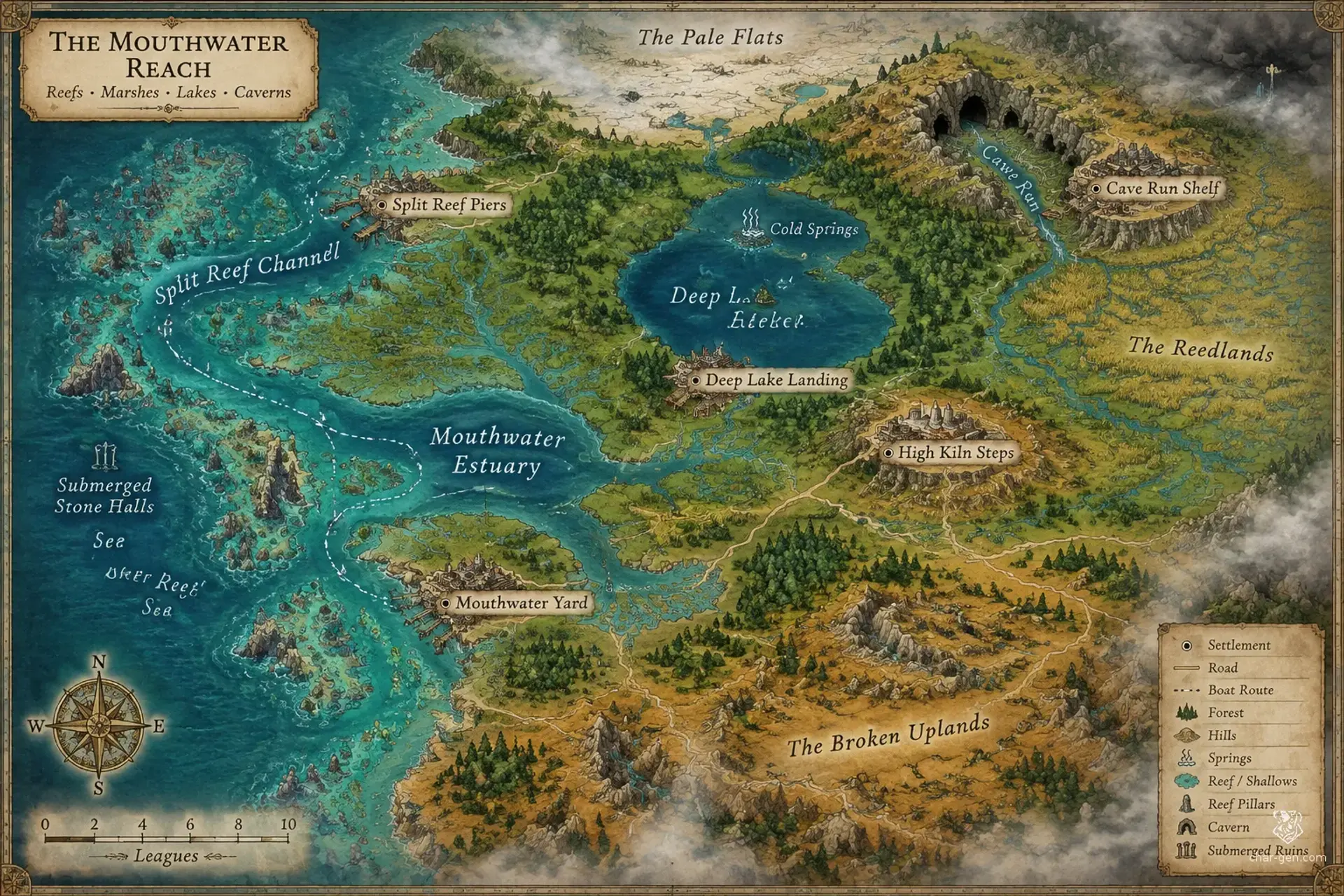
The Split Reef Coast is a broad maritime homeland where reefs, marshes, flooded caves, and inland lakes shape daily life. Brinewrought communities trace their beginnings to submerged assembly halls beneath the outer shoals, though their settlements now range from kiln terraces to floating lake villages. Travel and trade depend on tide knowledge, shared freshwater, and careful repair work. Storms expose old structures and new dangers, while competing councils strive to keep the region connected without exhausting its living shores.
Cultures
Brinewrought craft traditions of reef kilns and communal body repair.
Lake communities shaped by freshwater fishing and seasonal flotillas.
Estuary folk who blend Brinewrought customs with shoreward trade.
Places
5 settlements
Large · Harbor marketSplit Reef PiersRegional trade and pilot exchange.Its market shifts between the upper decks and sheltered tide pools as water levels change.
Medium · Lakeside townDeep Lake LandingFreshwater fisheries and lake transport.Houses are built on stone shelves above cold spring water, with floating sheds moored offshore.
Medium · River portMouthwater YardEstuary trade and marsh goods.Barges, reed skiffs, and repair crews crowd its broad estuary banks.
Small · Craft villageHigh Kiln StepsBody repair, pottery, and fired components.Its ceramic ovens stand on terraces above the highest recorded tides.
Small · Cavern hamletCave Run ShelfCave guiding and ruin salvage.A narrow row of homes overlooks a flooded cavern entrance used by trained divers.
How they spread
PatternMost settlements cluster near sheltered water, freshwater access, or safe kiln ground. The outer reefs and flooded caverns remain sparsely inhabited, with seasonal work camps appearing when tides permit.
Common kinds
Reefside fishing villages, Kiln and repair hamlets, Estuary market towns, Floating lake communities
Trade routes
A coastwise boat route threading the marked reef passages.
An estuary barge route connecting marsh markets to inland farms.
A lake circuit carrying fish, repair parts, and freshwater goods.
Dangers and hooks
3 threats
Most dangerous · HighThe Loose PillarsEnvironmental hazardStorms dislodge reef columns and shift safe channels without warning.
The Flooded ChambersHighSite hazard
Old cavern passages can fill in minutes and trap explorers behind rising water.
Core TakersModerateCriminal activity
Small salvage crews raid isolated ruins and target unattended Brinewrought bodies.
Hazards of the land
Sudden tidal surges in flooded caverns.
Sharp reef shelves hidden beneath clear water.
Saltwater intrusion that can ruin lake wells.
Unstable ruin chambers and trapped air pockets.
Plot hooks
1
The Unmatched LimbsExplorationA newly opened cavern contains body parts fitted to a design no living Brinewrought craftworker recognizes.Starts: A repair yard beside the lowest spring tide entrance.Reward: A recovered bronze joint pattern and a council favor.
2
Marks in the Wrong WaterInvestigationA chain of reef markers has been moved, sending several cargo boats into dangerous shallows.Starts: The pilot hall at Split Reef market piers.Reward: A share of recovered cargo and trusted pilot access.
3
Salt Beneath the LakeEnvironmental mysteryA lake spring is turning brackish, and every nearby settlement blames a different cause.Starts: The communal well at Deep Lake landings.Reward: A freshwater claim, rare algae, or a settlement alliance.
4
The Waiting CoreRescueA salvage crew has vanished near the submerged assembly ruins, leaving a sealed glass core behind.Starts: The tide stairs below the old kiln terraces.Reward: The core, if safely recovered, or a valuable repair commission.
The land
Climate and ground
ClimateMild, wet coastal climate with frequent fog, strong seasonal storms, and warm, humid summers.
TerrainA convoluted shore of reefs and inlets gives way to marshy estuaries, flooded caverns, and deep freshwater lakes.
Split Reef Channel, Mouthwater Estuary, Deep Lake, Cave Run
Borders
Open sea to the west.
A low salt plain to the north.
Reed country to the east.
Broken uplands to the south.
On the road
Reef passages shift with storms, so local pilots are essential.
Cavern routes flood quickly during spring tides.
Lake crossings are safest at dawn, when fog thins over the water.
Landmarks
Submerged stone halls beneath the outer reef.
A freshwater lake with cold springs rising from its bed.
Kiln terraces built above the highest seasonal tide.
A field of standing reef pillars used as navigation marks.
Landforms
Broken coral shelves.
Low estuary flats.
Limestone cave systems.
Deep lake basins.
Resources
Pearl beds and shell limestone.
Freshwater springs and lake fish.
Sea glass, salt, and medicinal algae.
Bronze-bearing rock in the southern uplands.
Power
Rule
GovernmentA web of harbor councils, lake assemblies, and craft circles settles disputes through negotiated compacts.
SeatNo single seat governs the region; councils meet at whichever harbor can host them safely.
StabilityMostly stable, though rival harvest claims and disputes over ruin access periodically strain local agreements.
Laws
Mark safe passages and respect the posted reef closures.
Never remove a construct’s core or body piece without consent.
Share freshwater access during drought or salt intrusion.
Salvage from the submerged ruins requires communal witness.
Factions
Reef MarkersPilot and harbor league
Influence: Strong among pilots, divers, and harbor councils.Keep the reef passages open while limiting destructive harvests.
The Low Kiln CircleCraft guild
Influence: Quietly influential among Brinewrought repairers.Protect the submerged assembly ruins and control access to their workshops.
Deep Shore CompactLocal council alliance
Influence: Growing in lakeside villages.Secure fair access to lake fisheries and prevent shoreward monopolies.
Faiths
The Returning Water
Influence: Widespread among coastal Brinewrought and pilots.Honoring the tides as makers, destroyers, and keepers of memory.
The Quiet Source
Influence: Strong in inland settlements.Treating springs and deep lakes as shared sources that must not be claimed outright.
The First Kiln
Influence: Most influential among artisans and ruin wardens.Remembering makers through careful repair and the preservation of old craft.
People and trade
Who lives here
How manyModerate overall, dense around safe harbors and freshwater shores, and sparse across exposed reefs.
Main peoples
Brinewrought constructs with ceramic, stone, bronze, and sea-gathered bodies.
Shorefolk in fishing villages and estuary towns.
Lakeward families who move between floating and fixed settlements.
Other peoples
Reef divers from distant coasts.
Small communities of cave-dwelling artisans.
Languages
Brinecant, spoken through voice and resonant shell instruments.
Coast Trade, a shared tongue of docks and markets.
Lake Sign, a practical language of gestures used underwater.
Trade
WealthUneven but generally modest, with prosperous trade piers beside self-sufficient fishing communities.
Work
Reef harvesting and pearl diving.
Ceramic firing and construct repair.
Fishing, salt gathering, and lake transport.
Exports
Sea glass and shell inlay.
Bronze fittings and fired ceramic ware.
Salt fish, pearls, and medicinal algae.
Imports
Iron tools and fittings.
Grain and preserved fruits.
Fine glass for sealed body cores.
Markets
Split Reef market piers, Deep Lake landings, Mouthwater estuary yards
History and secrets
Brinewrought tradition holds that the first of their people were assembled in submerged chambers beneath the reefs. Over generations, shore settlements grew around safe passages, freshwater lakes, and kiln sites. Storms have repeatedly uncovered fragments of the old workshops, renewing arguments over who may explore them. The region’s councils formed from practical bargains over water, salvage, and the dangerous work of keeping sea lanes open.
Key events
Old Tide
The Reef BreakA great storm opened a reef passage and exposed stonework beneath the tide.
First Making
The First ShellsBrinewrought makers began building bodies from kiln-fired ceramic, bronze joints, and sea materials.
Common Measures
The Freshwater CompactThe lake and estuary communities agreed on shared water rights after a prolonged dry season.
Secret 1 · GM only
The assembly halls contain records showing that the first Brinewrought bodies were adapted over time rather than built to one fixed pattern.Found by: Compare tool marks inside the submerged halls with the oldest Brinewrought body plates.If found: The ruins were not merely workshops, but a place where early constructs learned to alter their own designs.
Secret 2 · GM only
A sealed chamber beneath Deep Lake redirects freshwater through channels that may connect to the old reef workshops.Found by: Listen for a repeated tone beneath the lake during a calm night and follow it toward the cold spring vents.If found: The hidden chamber could provide clean water, or destabilize the lake if opened carelessly.
Connections
Media
0 images
No images yet.
Visual sheet
Turn Split Reef Coast into a sheet
A high-res, share-ready sheet you can post or print.