
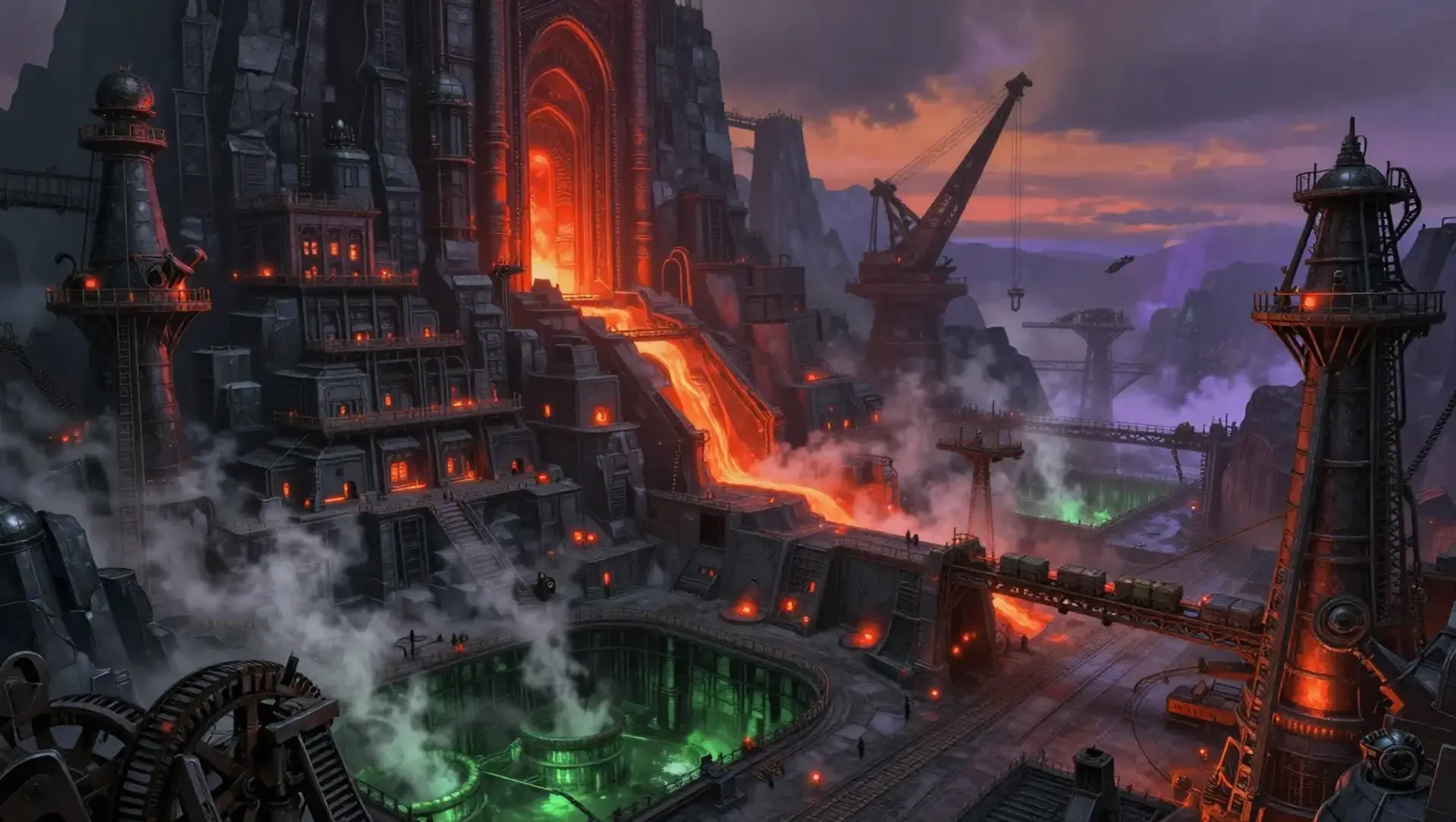
The Forge of Solstice
The Forge of Solstice is a fortress built to make other places function. Its vertical districts descend from fortified basalt courts into roaring foundries, submerged loading bays, sealed ledger chambers, and broad cooling basins where black water steams against iron embankments. Nearly 3,500 workers, artificers, smiths, and scribes keep the valley's hydraulic infrastructure alive. Every gate, piston, and shipment passes through a system designed to prevent waste, theft, and dissent.
The Forge of Solstice
Where every bridge, gate, and waterwheel begins as fire beneath the basalt.
“The Forge of Solstice never truly quiets. Hammer blows roll through the basalt like distant thunder, steam clouds turn the galleries slick, and the taste of iron clings to every breath. Bells mark shifts, sluice openings, inspections, and funerals. Even at rest, the fortress seems to labor, its walls sweating mineral water while red furnace-light pulses beneath iron walkways and crowded administrative halls.”
Gallery
Connections
Geography
Culture
The fortress teaches that nothing valuable should be wasted, whether metal, water, labor, or a life. Pride in skilled work is genuine, but so is the habit of treating people as replaceable components. A worker who saves a crew earns lasting respect. A supervisor who slows production without authority may be branded unreliable, even when caution prevents disaster.
Forge culture favors practical beauty. Smiths compete over the cleanest weld, crews decorate helmets with stamped copper badges, and night-shift workers gather for rhythmic hammer songs whose verses preserve local history. The most admired performers are bell-ringers who can coordinate entire production tiers by tone alone. Gambling on shift predictions, casting quality, and cooling times is common, though officially forbidden in the Great Foundry.
History
Government
Minister Oren Vale has concealed repeated pressure failures because admitting the true scale of the damage would void several lucrative contracts and expose his dependence on Black Ledger financing.
A labor strike is building after three workers died in a cooling-channel collapse. The administration threatens arrests, while the Foundry Brotherhood has enough support to halt the entire fortress.
The experimental hydraulic engine was designed to stabilize pressure surges, but its blueprints were removed from the Ledger-Vaults and replaced with convincing copies.
Economy
Fresh food, safe drinking water, and unclaimed personal time are scarce. The Cooling Basins can purify industrial water, but much of their capacity is reserved for machinery. Star-Sand is tightly rationed, and unauthorized access to experimental components can bring imprisonment.
Defenses
The Solstice Watch combines armored fortress guards, trained furnace crews, and specialized engineers who know how to weaponize steam, slag, and hydraulic pressure. Their officers answer to the ministerial administration, though many rank-and-file guards are related to foundry workers and quietly resist orders that would endanger laborers.
Law & Order
- crime Level
- Moderate, with theft, smuggling, sabotage, forged badges, and wage fraud common. Violent crime is less frequent than industrial crime, because nearly everyone understands how easily disorder can become lethal.
- enforcement
- The Solstice Watch patrols visible machinery and gates, while ledger clerks investigate financial offenses. The Office of Industrial Continuity controls evidence in most cases, creating deep suspicion. Workers use whistles, chalk marks, and shift songs to warn one another when official patrols cannot be trusted.
- typical Punishment
- Fines, wage seizure, loss of work privileges, and confinement in the basalt holding cells. Serious sabotage brings hard labor in a hazardous maintenance tier or transfer to a remote extraction site. The administration quietly prefers coerced repayment to public trials.
Calendar of Events
Turn The Forge of Solstice into a sheet
A high-res, share-ready sheet you can post or print.