
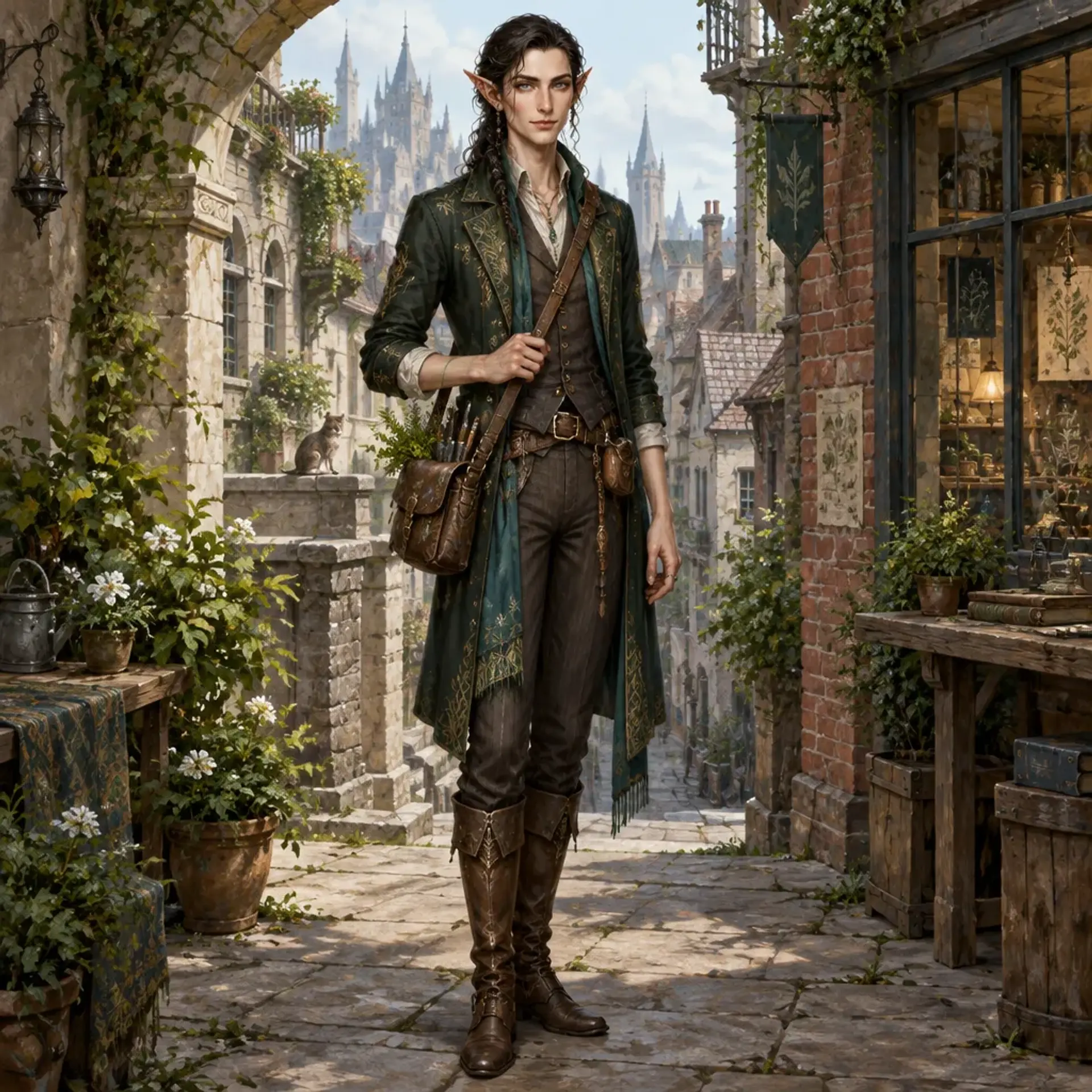
Homo feyaris urbanus
City elves are at home in crowded streets and uneasy anywhere a single tradition claims to speak for them.
Height 1.7 to 1.9 meters
At a glance
Languages Common, Elven
Height 1.7 to 1.9 meters
Weight 59 to 86 kilograms
Lifespan 128 to 180 years
At the table
You are a humanoid with the City Elf and Elf traits. You have 8 ancestry Hit Points and a Speed of 25 feet.
Your senses are keen, granting you low-light vision. You can see in dim light as though it were bright light.
Your mixed heritage and years of adapting to changing communities have made you notably versatile. When you select an ancestry feat, you can select from City Elf or Elf ancestry feats, subject to the normal prerequisites.
You have a +1 circumstance bonus to saving throws against effects with the mental trait that would make you fascinated or controlled. This reflects your resistance to enchantment and similar efforts to override your will.
Common, Elven
City elves are versatile by upbringing, often developing the curiosity and ambition to master many pursuits. Pathfinder 2E assigns ancestry boosts through its normal rules; this entry grants no locked ability score increases.
A strong connection to human neighborhoods and civic life, often paired with a practical craft or trade.
Oldward city elves descend chiefly from the elves who remained in the mortal world after the Great Fey incursion. Their families may keep fragments of ancient custom, but their daily lives are rooted in the human cities they helped build.
City elves are at home in crowded streets and uneasy anywhere a single tradition claims to speak for them. They inherit elven senses and artistic passions alongside human curiosity, inventiveness, and ambition, making them adaptable neighbors, restless creators, and persuasive companions. Many carry the history of a people who stayed behind when the Great Fey incursion ended, yet generations of urban life have made their own culture distinct.
City elves are typically tall and slender, with a height of 1.7 to 1.9 meters and a weight of 59 to 86 kilograms.
Their features vary widely, reflecting generations of life among human communities, but tapered ears, keen senses, and an unusually expressive presence are common. Some have subtle traces of fey ancestry, such as strikingly bright eyes or hair that catches light oddly. Their looks do not reliably reveal whether their forebears were elves who remained in the mortal world, humans changed by long residence in the Feywild, or one of the rare infants transformed near a rift.
Urban
Childhood lasts longer than it does for humans, though city elves often take part in family trades and neighborhood life from an early age.
A city elf is generally considered an adult around their twentieth year, though experience and maturity vary.
Most city elves spend the bulk of their lives as active adults, building careers, relationships, and civic influence across generations.
In old age, many city elves become keepers of neighborhood memory, their long recollections linking present-day streets to vanished eras.
Most city elves descend from elves who, nearly 3,000 years ago, did not return to the Feywild or retreat into isolated Elven Courts sheltered around a Mythal after the Great Fey incursion.
Over generations, these communities lost much of their connection to the Feywild and made lives among human neighbors. They preserve selected elven and eladrin customs, especially in art, seasonal observances, and care for urban nature, while adopting local languages, trades, and civic traditions. City elves are versatile, durable, and innately charming, but tend to be free-spirited and impatient with overbearing rules. They often form associations around a block, craft, garden, or shared cause rather than a single inherited authority.
City elves favor personal devotion, neighborhood shrines, and gods whose concerns touch art, change, nature, freedom, or craft.
Their communities encompass every alignment, but many prize independence and resist authorities that demand unquestioning obedience. Their skepticism of rigid rules is not necessarily hostility to law: a fair custom that protects neighbors may earn respect, while a regulation serving only its authors rarely does.
City elves usually have deep ties to the human communities in which they live, while also preserving fragments of elven and eladrin culture.
They may be called half-elves by humans or elves who mean it as an insult, a label many reject as a claim that they are incomplete. Some are descendants of humans who spent years in the Feywild and acquired fey traits. In rare and tragic cases, a human infant born near a Feywild rift transforms into a city elf; superstition may lead frightened families to abandon the child, believing it was swapped for a changeling.
City elves live wherever city life offers room to adapt: old market districts, riverside wards, crowded tenements, and prosperous neighborhoods alike.
Their homes are often arranged around shared courtyards, balconies, rooftop beds, or workshops that open onto the street. Some preserve elven arches, living wood, and garden rooms, while others favor the local city's materials and styles. Their architecture is less a single tradition than a record of generations borrowing, altering, and making a place their own.
No images yet.
A high-res, share-ready sheet you can post or print.