
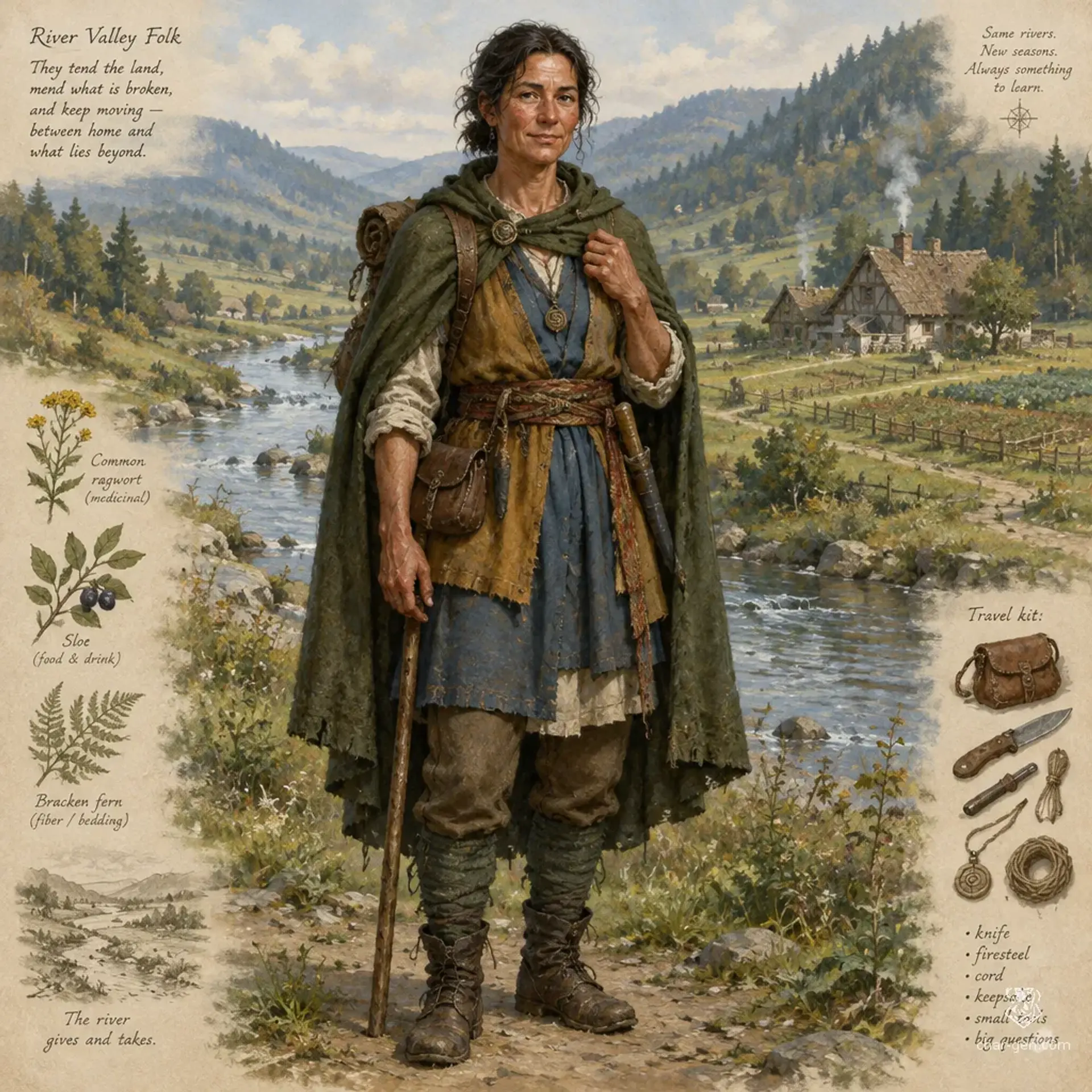
Homo primordialis
At a glance
Languages Common, One other language of your choice
Height About 4 ft. 10 in. to 6 ft. 4 in.
Weight About 100 to 250 lb.
Lifespan 70 to 90 years
At the table
When you finish a Long Rest, you gain Heroic Inspiration. If you already have it, you may keep it rather than gaining another benefit from this trait.
Choose one skill. You gain proficiency in it, reflecting a talent shaped by your upbringing, practice, or personal curiosity.
You gain one Origin feat of your choice for which you qualify. This represents an early habit, lesson, or opportunity that helped shape you.
Humans tend toward practical resilience, curiosity, and adaptable judgment, but no ability score is prescribed. Assign your ability score increases as you wish.
Their customs emphasize hospitality, shared labor, and an intimate knowledge of seasonal change.
Hearthward humans are associated with settled communities, cultivated land, and strong networks of neighbors. Their traditions often preserve practical knowledge through family crafts, local festivals, and communal work.
The First Humans are not a single people from a single lost garden, but a name for the many communities that tell of an original pair who stepped into an unfinished world and chose to make a life there. Curious, mortal, and astonishingly varied, humans inherit no one destiny. They make homes from what they find, carry old stories into new lands, and leave their mark through choices both humble and world-shaping.
Humans vary widely in stature, complexion, hair, features, and build.
Most have two arms and two legs, expressive faces, and skin adapted to the conditions of their ancestry and home. Their bodies bear the marks of ordinary lives: calluses from work, scars from mishap, and signs of age. Human appearance offers no reliable measure of temperament, origin, or ability.
Nearly any temperate or hospitable environment, from river valleys and open plains to crowded cities, highlands, and coastal settlements.
A child learning language, custom, and the limits of the world around them.
An adolescent or young adult, often testing inherited rules and choosing a path of their own.
An adult regarded as fully responsible for their choices, though many human cultures mark this threshold differently.
An elder whose recollections may span several generations of a village or family.
Human culture is shaped by circumstance rather than a common temperament.
Some societies prize hospitality, others discipline or invention, and many contain deep disagreements about the right way to live. Across these differences, humans often gather meaning through kinship, craft, storytelling, and the passing of knowledge between generations. The oldest origin tales speak of two people confronted with abundance, uncertainty, and the freedom to choose; modern storytellers debate whether those figures were ancestors, symbols, or both.
Human traditions include reverence for ancestors, nature, household spirits, distant gods, and ideals such as justice or discovery.
Tales of the first pair are interpreted in many ways, from sacred history to teaching story. Humans have no characteristic alignment; their beliefs and choices reflect their individual lives and communities.
Human communities trade, marry, feud, ally, and migrate among peoples of every ancestry.
Their short generations can encourage urgency, but humans are no more uniform in their attitudes than in their appearance. Some communities preserve elaborate genealogies; others define kinship through adoption, shared labor, or mutual protection.
Humans have no single homeland.
Their settlements range from temporary camps and clustered farms to dense cities, each adapting to local materials and hazards. Their architecture often preserves traces of earlier lives: a hearth built around an older foundation, a shrine at a crossroads, or a family home expanded one generation at a time.
No images yet.
A high-res, share-ready sheet you can post or print.