
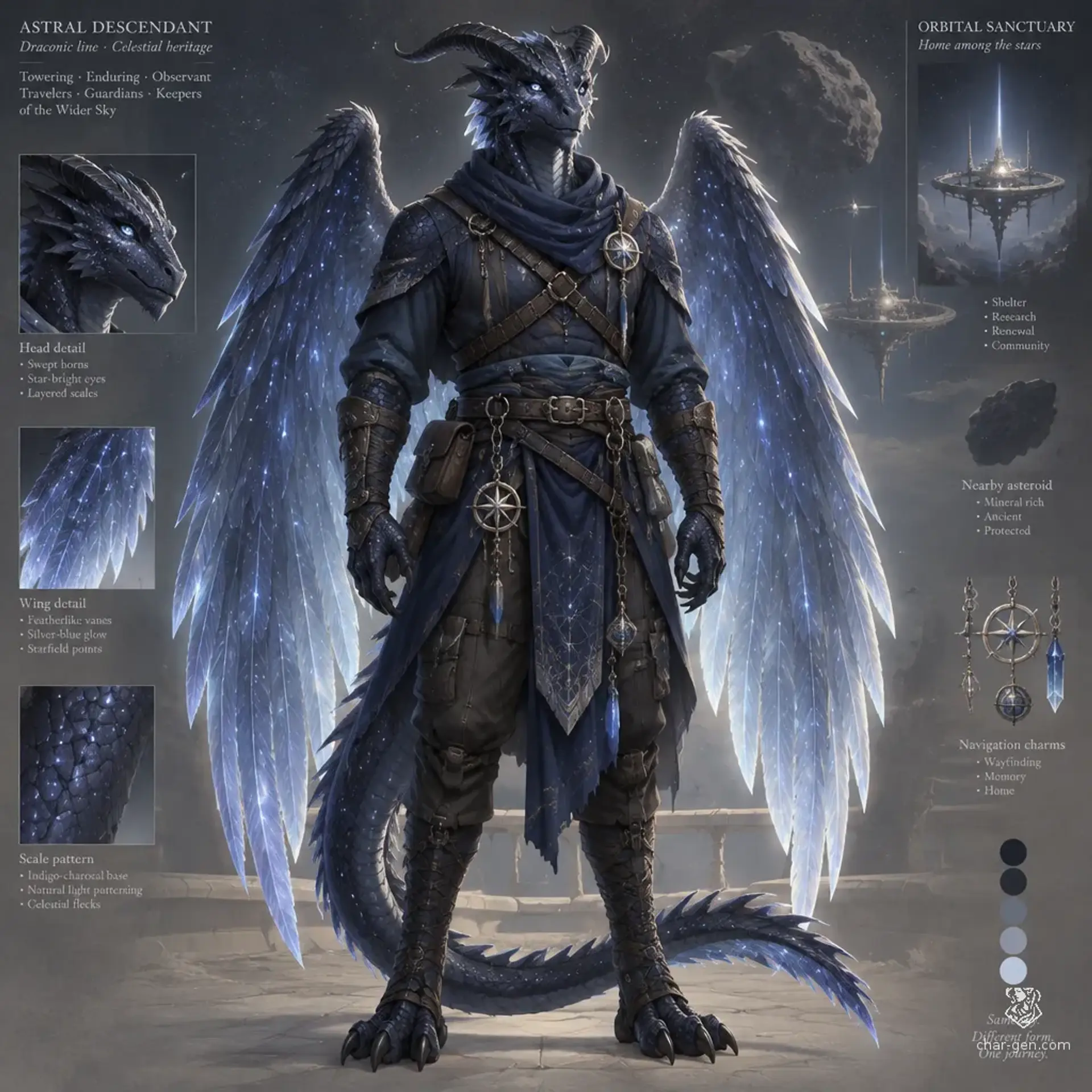
Draconis astralis
A starwake steps from the void on wings of living radiance, scales gleaming like a piece of the night sky.
At a glance
Darkvision 60 ft.
Languages Common, Draconic
Resistances Fire, Radiant
Height 7 to 9 feet
Weight 300 to 500 pounds
Lifespan 300 to 400 years, adult at 20
At the table
Your size is Large. In combat, you occupy a 10-foot-by-10-foot space. The DM may need to account for your size when determining whether you can use equipment, enter a space, or ride a mount intended for a smaller creature.
Your radiant wings give you a flying speed of 30 feet. You can fly through open space, including a vacuum, without needing air, wings do not tire, and this flight has no time limit. You do not need a surface, atmosphere, or ordinary gravity to remain aloft. This trait does not protect you from other hazards of space, such as extreme heat, cold, radiation, or collisions, and it does not grant a special means of traveling between star systems faster than your flying speed.
You have resistance to fire damage and radiant damage.
You can see in dim light within 60 feet of yourself as if it were bright light, and in darkness as if it were dim light. In darkness, you discern colors only as shades of gray.
You know the Draconic language and can speak, read, and write it. You can also speak, read, and write Common.
Common, Draconic
Fire, Radiant
Starwakes tend toward Constitution and Charisma, reflecting their endurance and luminous presence, but players assign any ability score increases as they wish.
Their wing-light burns gold or white, and they are famed for guiding travelers through dangerous passages.
Dawnward starwakes are commonly chosen as escorts and emissaries. Many make a personal vow to answer beacons for help, though each decides what that vow means.
A starwake steps from the void on wings of living radiance, scales gleaming like a piece of the night sky. These great dragon-descended travelers can fly without air or ground beneath them, and they cross the dark between worlds as other folk cross a road. Their light can guide a lost crew home, but it also makes them impossible to overlook.
Starwakes are towering, dragon-descended humanoids with dense frames, scaled faces, swept horns, and long tails.
Their scales range from deep indigo and charcoal to coppery gold, often patterned with pinpricks of natural light. Radiant wings unfold from their shoulder blades, their featherlike vanes formed of luminous energy. The glow brightens with emotion but does not depend on sunlight. Their eyes often resemble bright stars against dark irises.
Otherworldly: the open void, celestial bodies, astral crossings, and great vessels traveling between worlds.
Newly hatched starwakes are already sturdy and alert. Their wings glow faintly, and they learn to orient themselves by the stars before they can speak.
Young starwakes travel, study, and take on obligations to a flight-house. Their first solo passage through open void is an important rite of adulthood.
Adults may serve as scouts, envoys, guardians, or navigators. Many spend decades building a reputation before taking a seat in their house's councils.
Elders' scales grow pale and their wing-light steadies into a slow pulse. They are honored as keepers of routes, histories, and hard-won cautions.
Starwake society is organized around flight-houses: extended kinship groups that maintain routes, shelters, and records of safe passage.
Membership is earned through trust and shared responsibility rather than blood alone. Their oral histories pair practical navigation with family memory, and a skilled guide is valued as highly as a celebrated warrior. Starwakes are powerful, but their elders teach that great strength is most useful when it makes room for others.
Many starwakes revere the stars as witnesses to their ancestors' journeys, while others honor gods of travel, light, protection, or knowledge.
Their traditions prize responsibility and courage, but no alignment is prescribed. Some become steadfast guardians; others reject the expectation that their gifts obligate them to serve.
Starwakes are accustomed to being mistaken for omens, guardians, or threats.
They often approach unfamiliar peoples as potential fellow travelers, though their immense size and radiant wings can make quiet diplomacy difficult. Flight-houses trade route knowledge and safe passage with other communities, and individual starwakes may form deep, enduring friendships with people they have guided through peril.
Starwakes favor orbital sanctuaries, hollowed asteroids, and vast vessels built around sheltered gardens and communal halls.
Their homes use broad, unobstructed passages and tether points, with strong shutters and warm chambers for visitors who cannot endure vacuum. A flight-house often marks its territory with a beacon visible from far away.
No images yet.
A high-res, share-ready sheet you can post or print.